 Bjorn / CC BY-SA 2.0 via Wikimedia Commons
The Story
This coast has been rising for about half a million years. Each time the sea cut a flat bench into it, the land lifted the bench out of reach and the waves started on another. At Jug Handle five of those benches are stacked one above the next, each roughly a hundred feet higher and a hundred thousand years older than the one below.
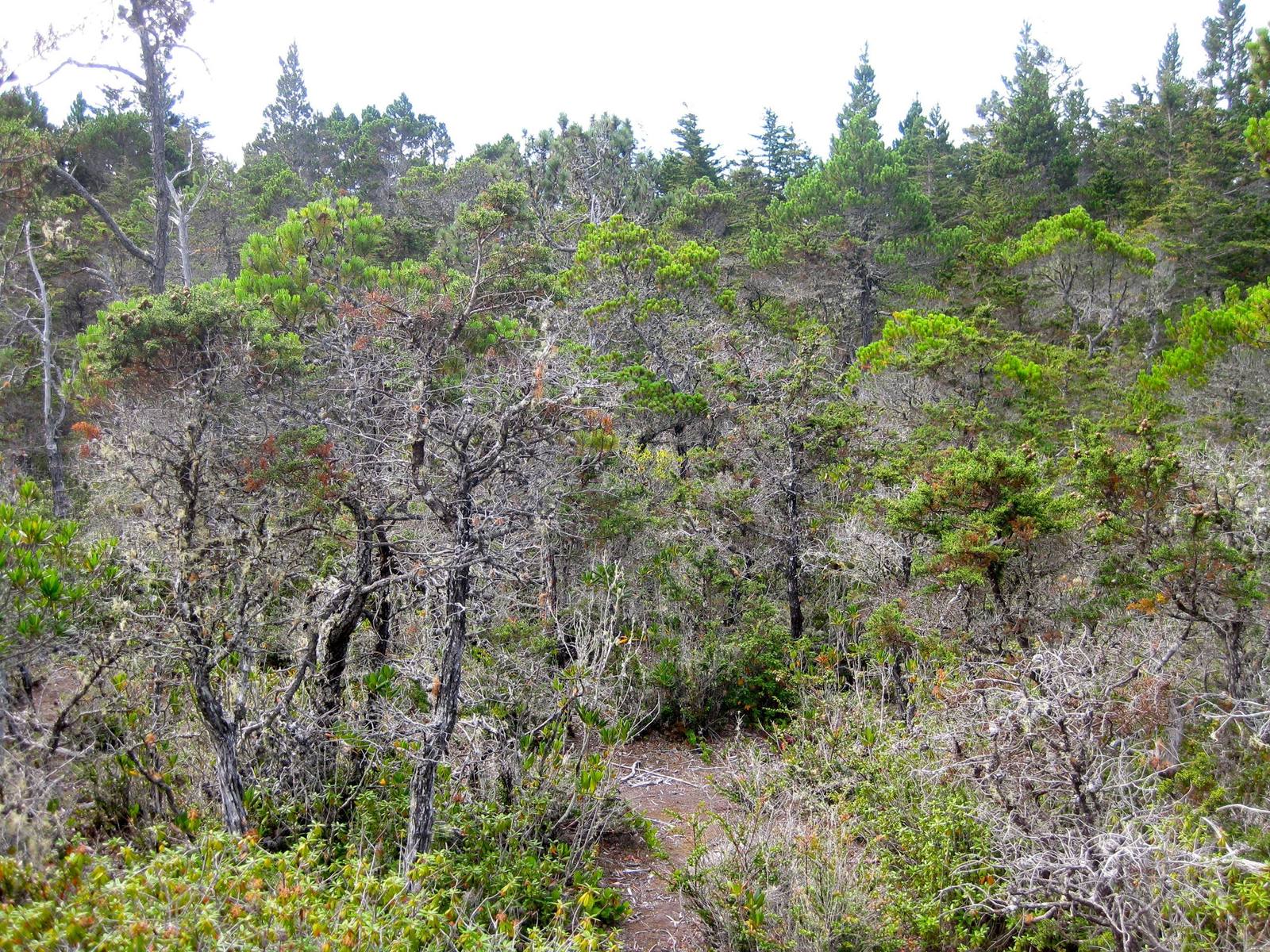
What makes the walk worth taking is that every step is a different stage in the life of a soil. The lowest terrace, a beach a hundred thousand years ago, carries coastal prairie. Higher up, bishop pine, fir and redwood grow on soils still young enough to feed them. On the oldest terraces rain has had hundreds of thousands of years to leach the nutrients away, leaving a bleached, acid soil over an iron hardpan that roots cannot get through. Water stands on it like a bog, and the pygmy cypress and Bolander pine growing there can be a century old and barely head-high.
The soil scientist Hans Jenny spent more than half a century studying ground like this and pressed for the staircase to be saved; the botanist John Olmsted led the campaign that did it. The reserve was established in 1976, and the trail ends on the top step in the Hans Jenny Pygmy Forest Reserve.
The trail runs about two and a half miles each way from the parking area off Highway 1, climbing gently the whole time.
Visitor Info
On the Map
Nearby
The closest stops worth working into your route
Historical markers nearby
Roadside plaques and monuments within a short detour