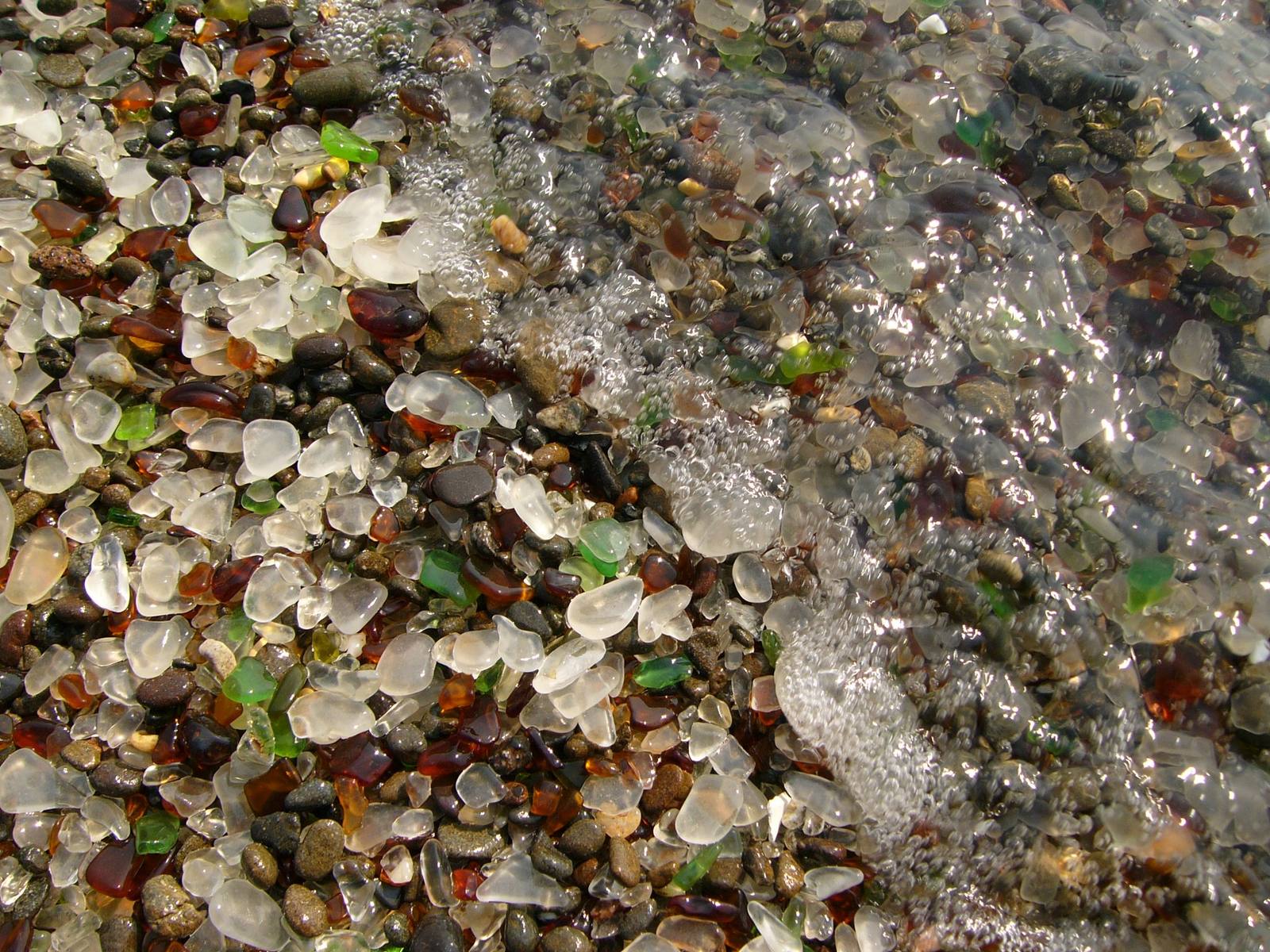
 Jef Poskanzer / CC BY 2.0 via Wikimedia Commons
The Story
For most of the twentieth century Fort Bragg threw its trash into the sea. On Union Lumber Company land at the edge of town, people tipped household rubbish over the bluffs onto the shore: bottles, crockery, appliances, whole cars. Everyone called the place the dumps. The first site, opened in 1906, filled by 1943; the second lasted until 1949; the third, the one now called Glass Beach, took the town's waste until 1967, when the regional water-quality board and city leaders closed it.
Cleanups hauled out the metal and the bulk. What the crews could not reach, the Pacific went to work on, and over the next few decades the broken glass was tumbled into smooth pebbles of brown, green, white and the occasional blue. By the end of the century the cove was famous for a material nobody had meant to put there.
The state bought the thirty-eight acres around it in 2002 and made them part of MacKerricher State Park, where taking glass is illegal. It has not stopped much. Summer crowds have carried off so much that the main beach now has the least glass of the three; the two older sites lie to the south, the first of them on the town's coastal trail.
What is left is not renewable. The town stopped making it in 1967.
Visitor Info
On the Map
Nearby
The closest stops worth working into your route
Historical markers nearby
Roadside plaques and monuments within a short detour