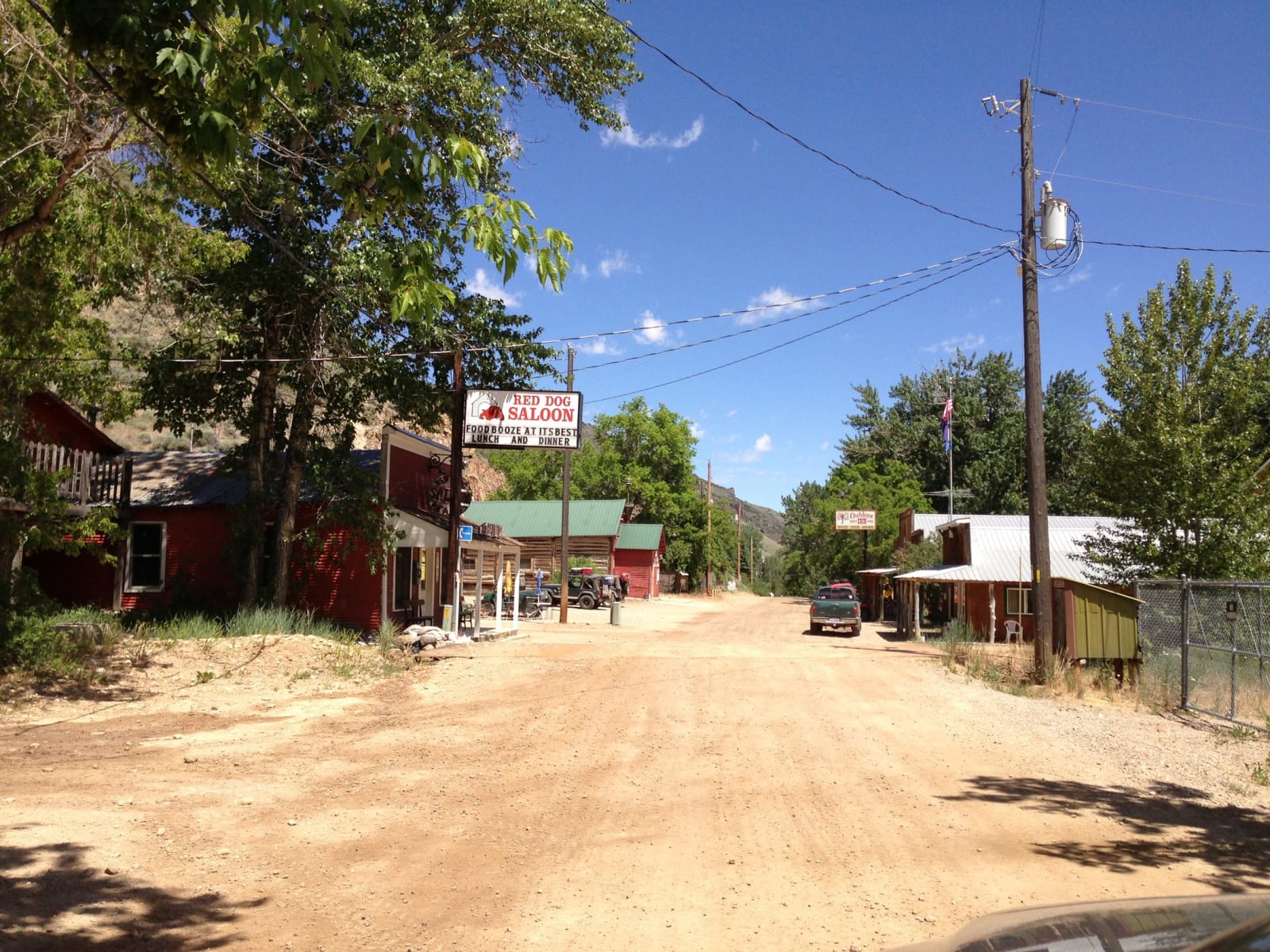
 Famartin / CC BY-SA 3.0
The Story
Jarbidge is the end of the road, and it earns the title twice over. It sits at the bottom of a canyon two thousand feet deep in the far northeast corner of the state, hard against the Idaho line, reached only by long miles of narrow dirt road and cut off by snow for much of the year — by most reckonings the single most isolated town in Nevada, and a real candidate for the most remote in the Lower 48. Its name is a warning. The Shoshone called this canyon after Tsawhawbitts, a man-eating giant of their legends said to lurk in it and carry off anyone who entered, and they gave the place a wide berth for generations. Prospectors who came for the gold mangled the word into "Jarbidge," and the monster has been the town's namesake ever since.
The gold came late and all at once. When Dave Bourne struck it along the Jarbidge River in 1909, the find set off what is generally called the last major gold rush in the American West — a stampede of fifteen hundred prospectors over the winter of 1909-10, staking claims in a tent city sometimes pitched on twenty feet of snow. For a brief, improbable run the Jarbidge district out-produced fading Goldfield to become Nevada's leading gold camp, pulling some ten million dollars out of the canyon before the mines wound down in the 1930s. A fire gutted the business district in 1919, and the town never came close to its boom-time size again. But unlike most camps of its kind, it never quite died.
It also hosts one of the West's tidiest endings. On a blizzard evening in December 1916, a mail wagon laboring up the Idaho road was ambushed; the driver was shot dead and some four thousand dollars taken. It is remembered as the last stagecoach robbery in the American West — the close of a chapter that had opened sixty years earlier on the same kind of roads. The robber, Ben Kuhl, was convicted partly on a bloody palm print he left on a mail envelope, said to be among the first times handprint evidence was admitted in an American court. The Old West and the forensic age changed hands in a snowbound Nevada canyon, more or less in the same instant.
Around the town stands the reason many people now make the drive: the Jarbidge Wilderness, the first wilderness area ever designated in Nevada and today more than a hundred thousand acres of high, wild country. Summits rise above ten thousand feet; the Jarbidge River runs cold and fast below, holding redband trout, mountain whitefish, and the southernmost bull trout in the country, strictly catch-and-release. Elk and mule deer work the aspen and meadow, and the trails see so few boots that solitude is essentially guaranteed. It is some of the least-traveled alpine wilderness in the West, hidden behind some of its worst roads.
What's here now is a living ghost town of a couple dozen year-round souls — fiercely independent, officially on Pacific time but running their clocks on Idaho's. The mile-long townsite keeps its 1910 saloons and inn, the 1911 jail you can walk into, a community hall with its original painted stage curtain, and a scatter of miners' cabins with a cemetery on the slope. There is a trading post, a gas pump, a bar, and not much else — and that is the point. When a flood washed out the canyon road and the Forest Service moved to keep it closed, the townspeople famously grabbed shovels and rebuilt it themselves. The frontier here did not get tamed so much as left alone.
It is the perfect last stop in Cowboy Country, and the hardest-won: the place where the region's gold story finally runs out, at the literal edge of the map. Make the long drive up from Elko in summer — the only season the roads reliably allow it — and you arrive somewhere that feels less visited than simply left behind, in the best possible way. Beyond Jarbidge there is only wilderness, and the giant in the canyon, and Idaho.
Visitor Info
On the Map
Nearby
The closest stops worth working into your route
Historical markers nearby
Roadside plaques and monuments within a short detour