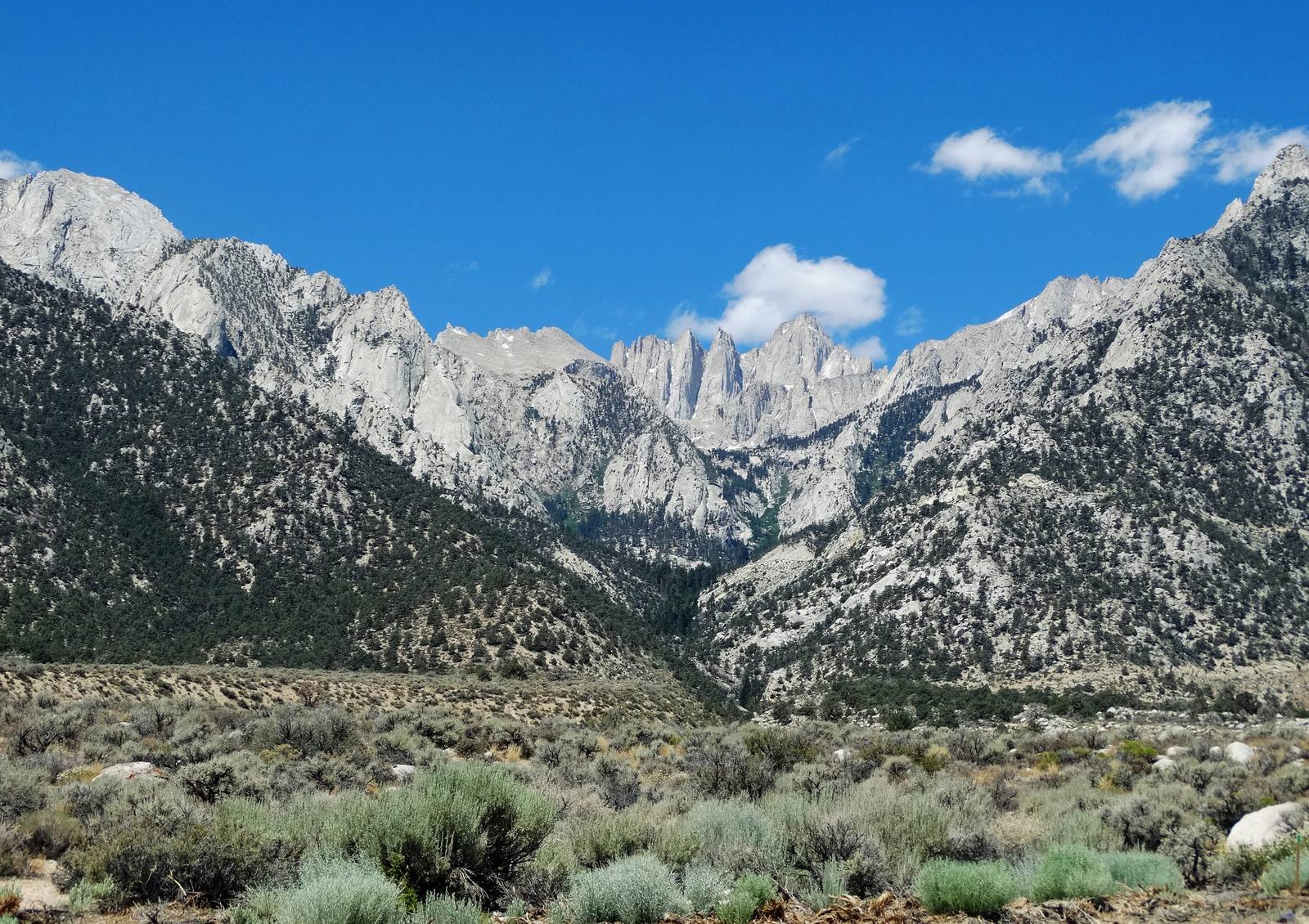
The Sierra Nevada crest seen from the floor of the Owens Valley — pale granite spires and buttresses standing along the skyline at the head of a deep canyon, dark conifers running up the slopes on both sides and bare grey rock rising above them. A broad apron of sage and rabbitbrush fills the foreground with granite boulders scattered through it, and cumulus stand over the crest in a deep blue sky.
inkknife_2000 / CC BY-SA 2.0 via Wikimedia Commons
California · Region

Eastern Sierra & Owens Valley

Payahuunadü, the land of flowing water — US-395 under the Sierra escarpment, the Alabama Hills, Manzanar's hard history, Bishop, Mono Lake's tufa towers, and the ghost town of Bodie kept in arrested decay.

9 places to explore

The Nüümü and the Newe called this valley Payahuunadü — the land of flowing water — and made it exactly that, running irrigation ditches off the Sierra snowmelt for centuries to farm a desert valley green. What followed is one of the plainest injustices in California: the Army marched the people out in the 1860s, settlers took the ditches, and then Los Angeles took the water itself — the aqueduct opened in 1913, and by 1926 Patsiata, Owens Lake, was a dry bed whose dust storms poisoned the valley for decades. The Nüümü are still here, still fighting for the water, and the valley still carries their name for it.

US-395 runs the whole length of it, pinned between the highest Sierra crest and the Inyo and White Mountains, the eastern escarpment rising two vertical miles off the sagebrush in places. At Lone Pine the Alabama Hills pile their rounded granite in front of Mount Whitney, the highest summit in the contiguous United States; Hollywood shot hundreds of Westerns in these rocks and never really left. A few miles north stands Manzanar, where the United States imprisoned more than ten thousand Japanese Americans behind barbed wire from 1942 to 1945 — a concentration camp on ground the Nüümü had already been driven from once, two forced removals sharing one square mile of desert.

Farther up the valley: Bishop, the Eastern Sierra's easygoing capital and home to the valley's largest Paiute community; the strange tufa towers of Mono Lake, one of the oldest lakes in North America — Los Angeles reached this far for water too, and the lake dropped for decades until the courts made the city share; and up a washboard road, Bodie — a gold-rush town abandoned nearly whole and kept in arrested decay, the best ghost town in the West by most reckonings.

What to See in Eastern Sierra & Owens Valley

9 places across the region, grouped by what they are.

Geology & Rock Formations
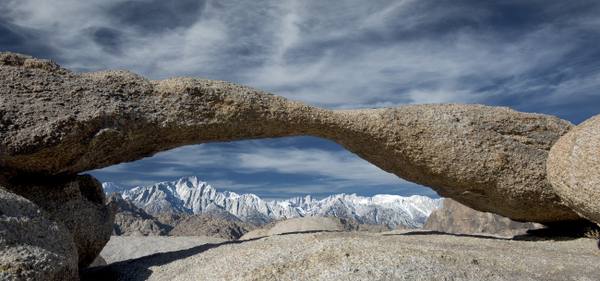
A natural granite arch in the Alabama Hills framing the snow-covered Sierra Nevada crest, weathered boulders below the span and dark cloud breaking over the range above it.

Alabama Hills

Lone Pine

Rounded golden granite under the Sierra wall, and Hollywoods oldest outdoor set.

View details →
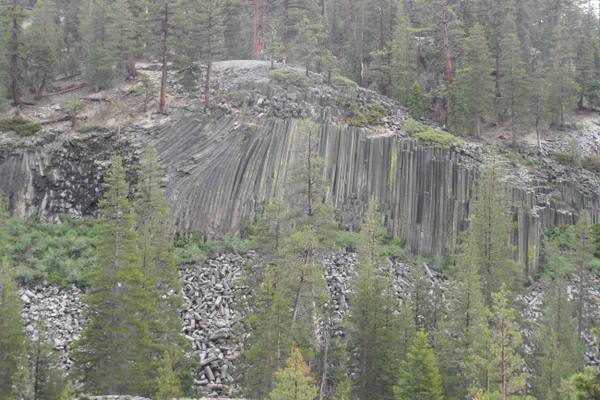
The basalt columns of Devils Postpile seen across the valley, vertical grey shafts fanning outward down the cliff face, a talus pile of broken column sections at its foot and pines growing thickly around it.

Devils Postpile National Monument

Mammoth Lakes

A wall of hexagonal basalt columns with a glacier-polished top, and a 101-foot waterfall downstream.

View details →

Natural Areas

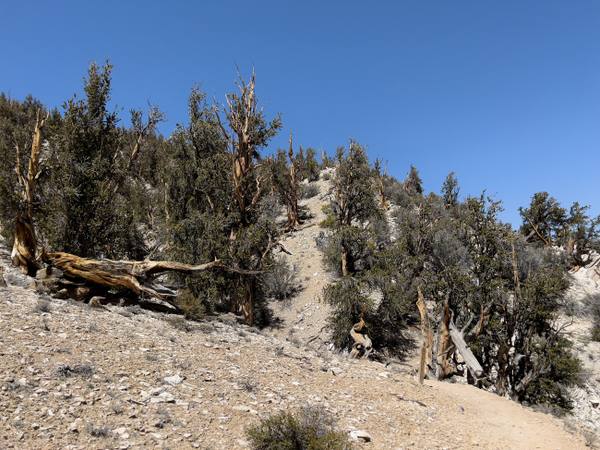
Bristlecone pines scattered across a pale dolomite slope, several with bare weathered trunks and dead limbs, a bleached fallen trunk in the foreground and a footpath climbing the ridge under a deep blue sky.

Ancient Bristlecone Pine Forest

Big Pine

Trees older than the pyramids, growing on white dolomite at ten thousand feet.

View details →
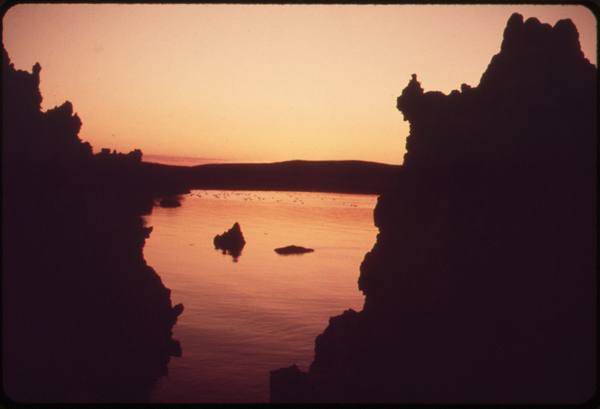
An April 1972 photograph of Mono Lake at sunset, tufa towers standing in dark silhouette on either side of a channel of orange-lit water, birds resting on the surface and a low dark ridge across the far shore.

Mono Lake

Lee Vining

A saline lake older than most of the Sierra, with tufa towers and a water fight it eventually won.

View details →
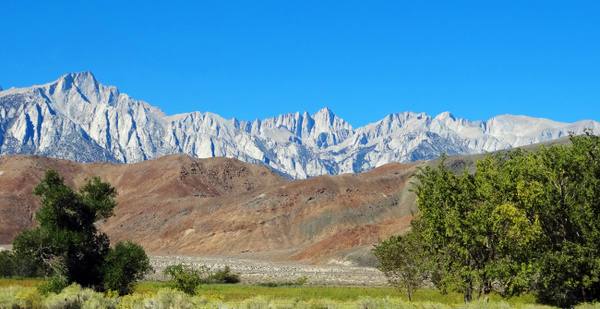
Pale granite peaks and spires along the Sierra Nevada crest seen from the Owens Valley floor, a red-brown alluvial ridge below them and cottonwoods and rabbitbrush in the foreground under a deep blue sky.

Mount Whitney

Lone Pine

At 14,505 feet, the highest summit in the contiguous United States, eighty miles from the lowest point.

View details →
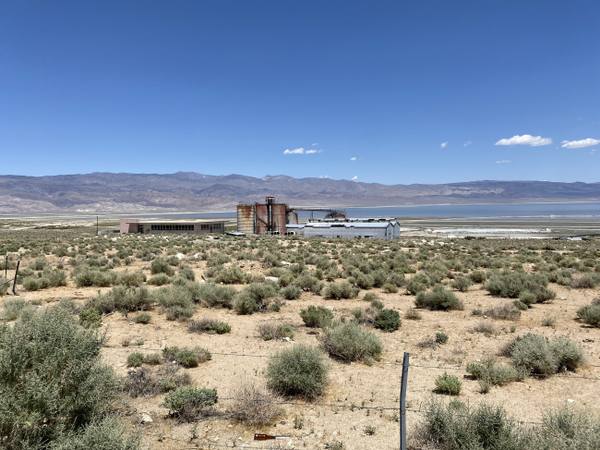
The bed of Owens Lake, a derelict industrial plant with rusted tanks and long white sheds standing on the shore, shallow water and salt crust spreading across the flat beyond it and a long bare range along the far side.

Owens Lake

Lone Pine

Patsiata, the lake Los Angeles drank, and the most expensive dust in America.

View details →

Historic Sites

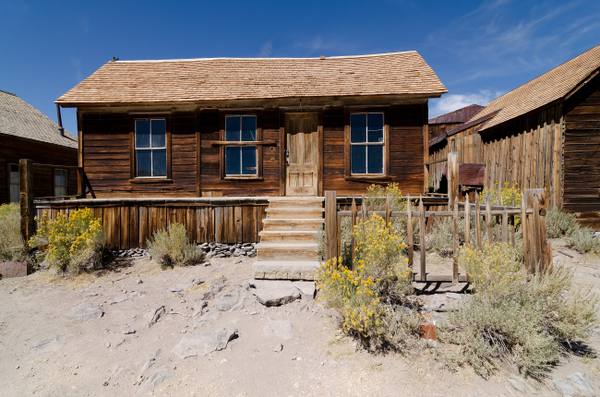
A weathered timber house at Bodie with a shingled roof, six-pane windows and a plank door above wooden steps, a leaning picket fence and yellow rabbitbrush in the dirt yard and other unpainted buildings crowding in on both sides.

Bodie State Historic Park

Bridgeport

A gold town of ten thousand left exactly as it emptied, held in arrested decay at 8,375 feet.

View details →
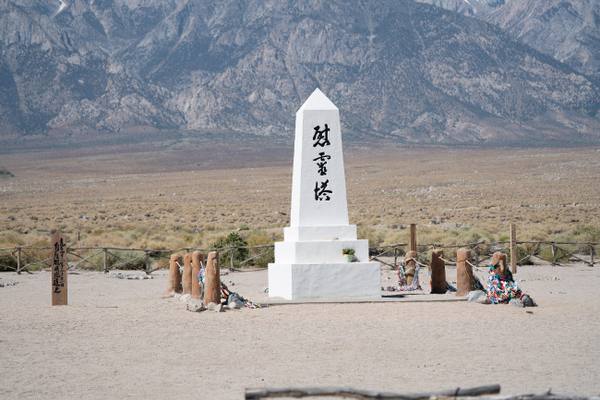
The white concrete obelisk in the Manzanar cemetery, black Japanese characters on its face reading Soul Consoling Tower, offerings and strings of folded paper cranes left along the rope-and-post fence around it, the sagebrush flat behind and the Sierra Nevada rising steeply beyond.

Manzanar National Historic Site

Independence

A concentration camp on twice-taken ground, where the United States imprisoned more than eleven thousand of its own.

View details →

Towns & Gateways

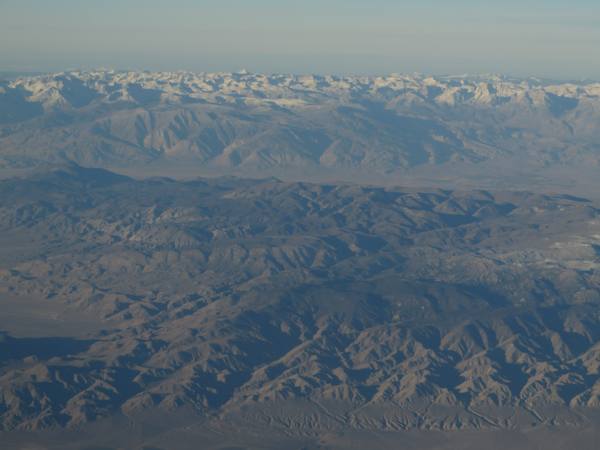
A high aerial view over the Eastern Sierra, snow-capped peaks along the skyline, a hazy valley floor below them and range after range of bare ridges receding into the foreground.

Bishop

Bishop

The Eastern Sierras working capital, and the home of the Nüümü who were traded out of their own valley.

View details →

Scenic Drives through Eastern Sierra & Owens Valley

Scenic Byway

U.S. 395: The Eastern Sierra

The one road along the east wall of the Sierra: Payahuunadü and Manzanar, the Whitney and bristlecone spurs, Mono Lake, and Bodie at the end of thirteen miles of Bodie Road.

182 mi · 4.5 hrs

Stories from Eastern Sierra & Owens Valley

Geology

The Crater You Drive Across

Between Bishop and Mono Lake, U.S. 395 spends twenty miles crossing the floor of a supervolcano that erupted 760,000 years ago, buried the region in ash, and has been quietly swelling and shaking since 1980 — which is how a ski town ended up arguing with the United States Geological Survey.

6 min read

Eastern Sierra & Owens Valley rewards the unhurried. Pick a base, fan out, and let the country between the headline stops surprise you.

← Explore more of Open Road Guide