 Fabio Achilli / CC BY 2.0
The Story
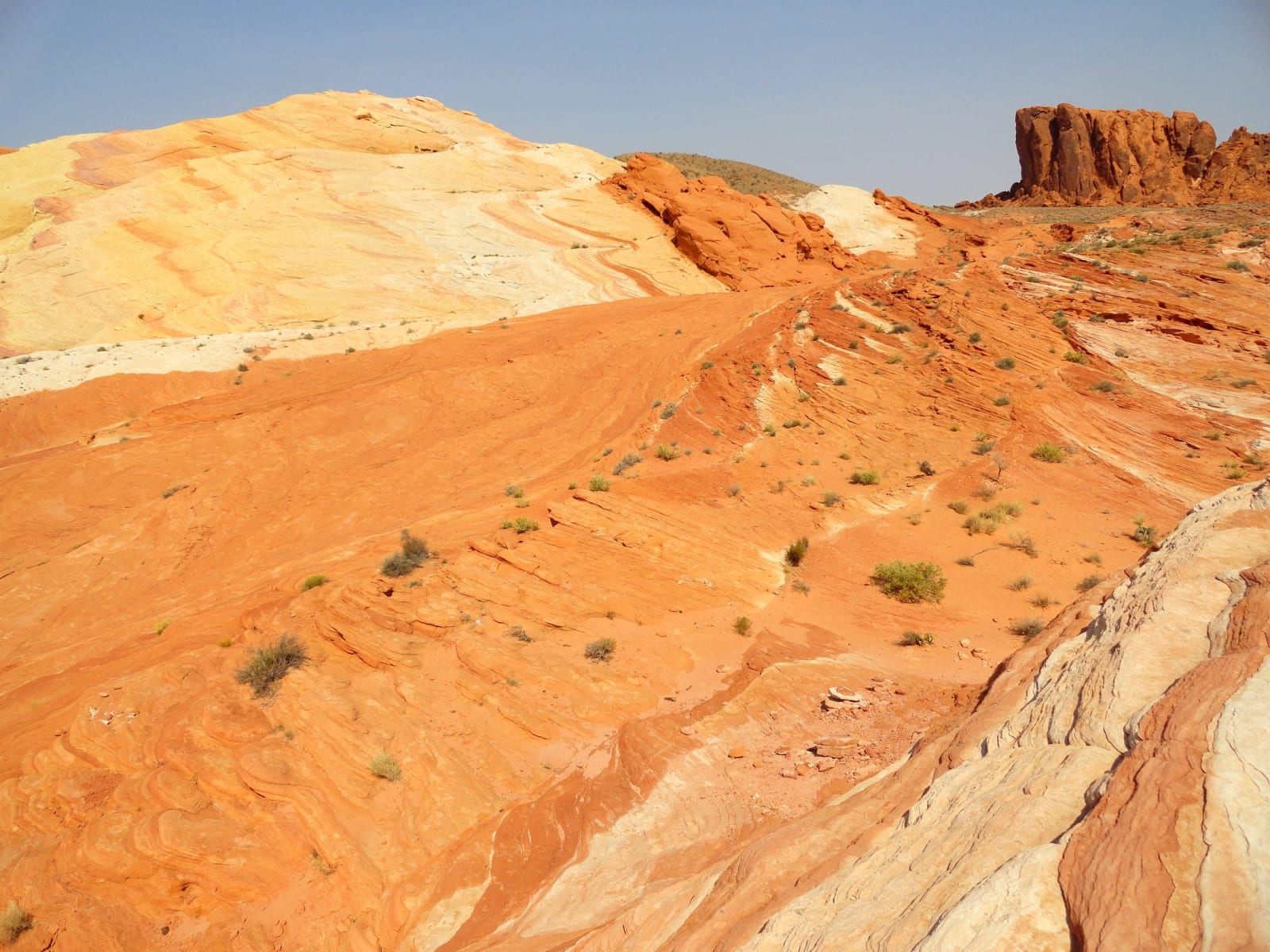
Valley of Fire is the oldest state park in Nevada and, at nearly 46,000 acres, the largest — a basin of blazing red Aztec sandstone an hour northeast of Las Vegas that looks, in the low light of morning and evening, exactly like its name. The red rock is the remnant of Jurassic sand dunes, petrified and uplifted and then carved by wind and flash flood into fins, domes, arches, and twisting walls, and when the sun catches it at a low angle the whole valley seems to ignite. An AAA official driving through at sunset in the 1920s is the one usually credited with the name, and whatever the truth of that story, it has never needed improving.
The geology is the reason to come. The brilliant red outcrops are Aztec Sandstone, laid down roughly 150 million years ago when this corner of the Mojave was a sea of dunes; the iron in the sand oxidized over the eons into the rust and crimson that define the park. Those red formations sit cradled in older gray and tan limestone, a contrast that makes the color read even more vividly, and scattered through the park are petrified logs — the remains of an ancient forest washed in and buried some 225 million years ago, older than the dunes that surround them. It is a compressed lesson in deep time, written in stone and legible from the road.
The Valley of Fire Road runs about ten and a half miles between the east and west entrances — a designated Nevada Scenic Byway — and nearly every landmark in the park is a short walk from it. Elephant Rock guards the east entrance, a sandstone arch that genuinely resembles its namesake, trunk and all. The Fire Wave, a swirl of red-and-white banded rock that looks like a frozen whirlpool, has become the park's signature photograph. Arch Rock, the Beehives, Rainbow Vista, the Seven Sisters, and the pale knobs of White Domes each offer a different version of the same essential magic, and the spur road north to White Domes is, mile for mile, one of the most scenic stretches of pavement in southern Nevada.
Long before any of it was a park, people left their mark here. More than three thousand petroglyphs are carved into the desert varnish of the park's rocks, the oldest attributed to the Basketmaker culture some 2,500 years ago and later work to the Ancestral Puebloans who hunted and gathered across the valley until drought pushed them out around 1150. Atlatl Rock, named for the spear-thrower depicted in one of its carvings, is reached by a steel staircase that brings you face to face with the panel. Petroglyph Canyon, the short sandy trail to Mouse's Tank, is lined with them — bighorn sheep, human figures, and symbols whose meaning is still argued over.
Mouse's Tank itself is a natural basin in the rock that holds rainwater for months after a storm, and it takes its name from a Southern Paiute man called Mouse who, in the 1890s, used this maze of canyons as a hideout while a fugitive from the law. The water was what made the hideout possible — in a valley this dry, a tank that keeps water is the difference between passing through and staying — and the same scarcity is why the Ancestral Puebloans never truly settled here despite all the rock art they left behind.
The modern history is shorter but visible. A rough track called the Arrowhead Trail crossed the valley in 1912, an early auto route between Salt Lake City and Los Angeles, and the recreational and archaeological value of the place was recognized soon after. The Civilian Conservation Corps arrived in 1933 and built the campgrounds, trails, and three stone cabins of native sandstone that still stand near the west end. The park opened on Easter Sunday in 1934 and was formally designated by the legislature the following year; in 1968 it was named a National Natural Landmark.
Hollywood found the valley early and keeps coming back. Elvis raced through it in Viva Las Vegas, the 1966 western The Professionals shot here, and the red rock has stood in for alien planets and post-apocalyptic wastes in Total Recall, Transformers, and Domino. Devotees of a certain franchise make the pilgrimage to Silica Dome, the broad slab where Captain Kirk met his end in Star Trek Generations — the kind of fact that means nothing until you are standing on the exact rock, at which point it means a great deal.
Timing is everything here, and it is mostly about heat. Summer highs routinely run between 100 and 115 degrees and occasionally near 120, hot enough that the park closes many of its trails — including the Fire Wave and White Domes loops — from mid-May through the end of September, after a long history of heat emergencies. Fall through spring is the season: mild days, cold-clear light, and the low sun that sets the sandstone on fire. Stop first at the visitor center, where the exhibits on geology and prehistory will repay the half hour, then drive the byway slowly and walk the short trails early. The valley earns its name twice a day, at the two ends of the light, and there is no bad time to be standing in it when it does.
Visitor Info
On the Map
A story featuring this place
Go deeper into the history and character of this stop
Nearby
The closest stops worth working into your route
Historical markers nearby
Roadside plaques and monuments within a short detour