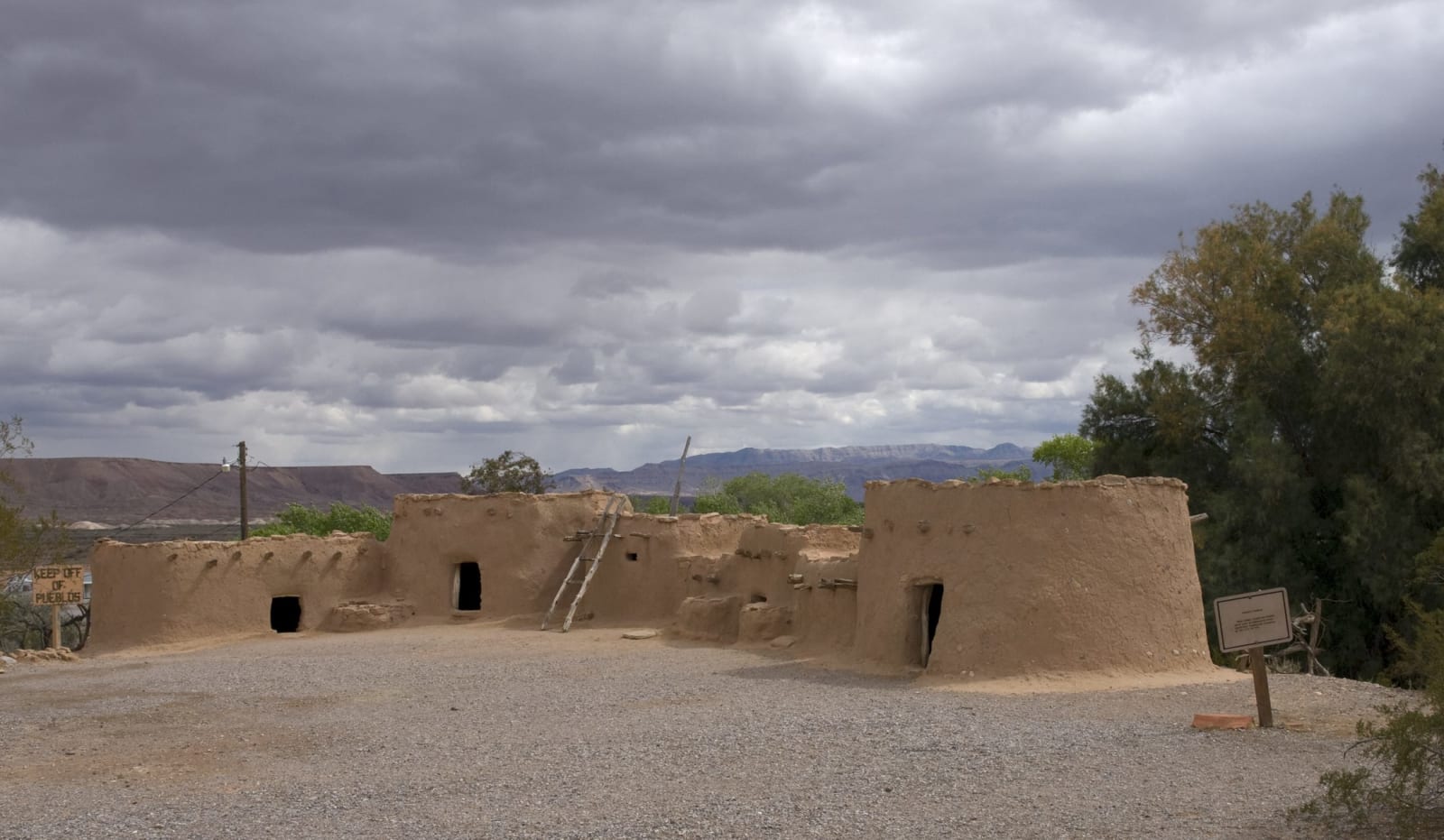
 Ymblanter / CC BY-SA 4.0
The Story
An hour northeast of Las Vegas, in the quiet farm town of Overton, sits a low building of adobe and local stone that holds one of the most affecting stories in southern Nevada — the record of an entire ancient city that the desert hid, archaeologists raced to excavate, and Lake Mead then swallowed. The Lost City Museum is small, and the history it keeps is anything but.
The "Lost City" is Pueblo Grande de Nevada, a sprawling complex of villages strung along the Muddy River in the Moapa Valley. People lived here as early as eight thousand years ago; by about 300 A.D. the Basketmaker culture had settled in, and the Ancestral Puebloans — long called the Anasazi — built pit houses and multi-room pueblos here until roughly 1150, when they migrated away. Some of the structures ran to many dozens of rooms. It was the largest such settlement west of the Colorado River, and for centuries it sat unremarked except by the Indigenous people who never considered it lost at all.
In 1924 two Overton brothers, John and Fay Perkins, brought the ruins to the attention of Nevada's governor, and the pioneering archaeologist Mark Raymond Harrington — working for the Museum of the American Indian — arrived to excavate. What he found was not a scatter of arrowheads but an ancient metropolis, and the newspapers of the day seized on it, christening it the Lost City. Then the work became a race. Downstream, the federal government was pouring Hoover Dam, and everyone understood that the rising reservoir behind it — Lake Mead — would drown the heart of the valley. Through the Depression, federal relief crews excavated and documented as fast as the water rose, pulling out pottery, woven sandals, turquoise jewelry, and dart points, some of the oldest more than thirteen thousand years old.
The museum is itself a product of that scramble. The Civilian Conservation Corps built it in 1935 — first called the Boulder Dam Park Museum — to a design by Harrington himself, and they set it on a small mesa in Overton that was, fittingly, an excavated pueblo site, so the building literally stands on the ruins it interprets. Outside, a reconstructed Puebloan house-cluster rises on original foundations; a later wing was built directly over more ruins to protect them in place.
Today it is one of Nevada's state museums, and it makes a natural companion to two nearby giants. The most developed stretch of the Lost City lies under the Overton Arm of Lake Mead, a few miles south — the same reservoir, seen elsewhere as recreation, here seen as a kind of flood that took a civilization's record with it. And Valley of Fire, with its own Ancestral Puebloan petroglyphs, sits just sixteen miles down the road, so the museum and the rock writing read as two halves of one story: the people who were here long before the neon, and the dam that rewrote the map they lived on.
Visitor Info
On the Map
A story featuring this place
Go deeper into the history and character of this stop
Nearby
The closest stops worth working into your route
Historical markers nearby
Roadside plaques and monuments within a short detour