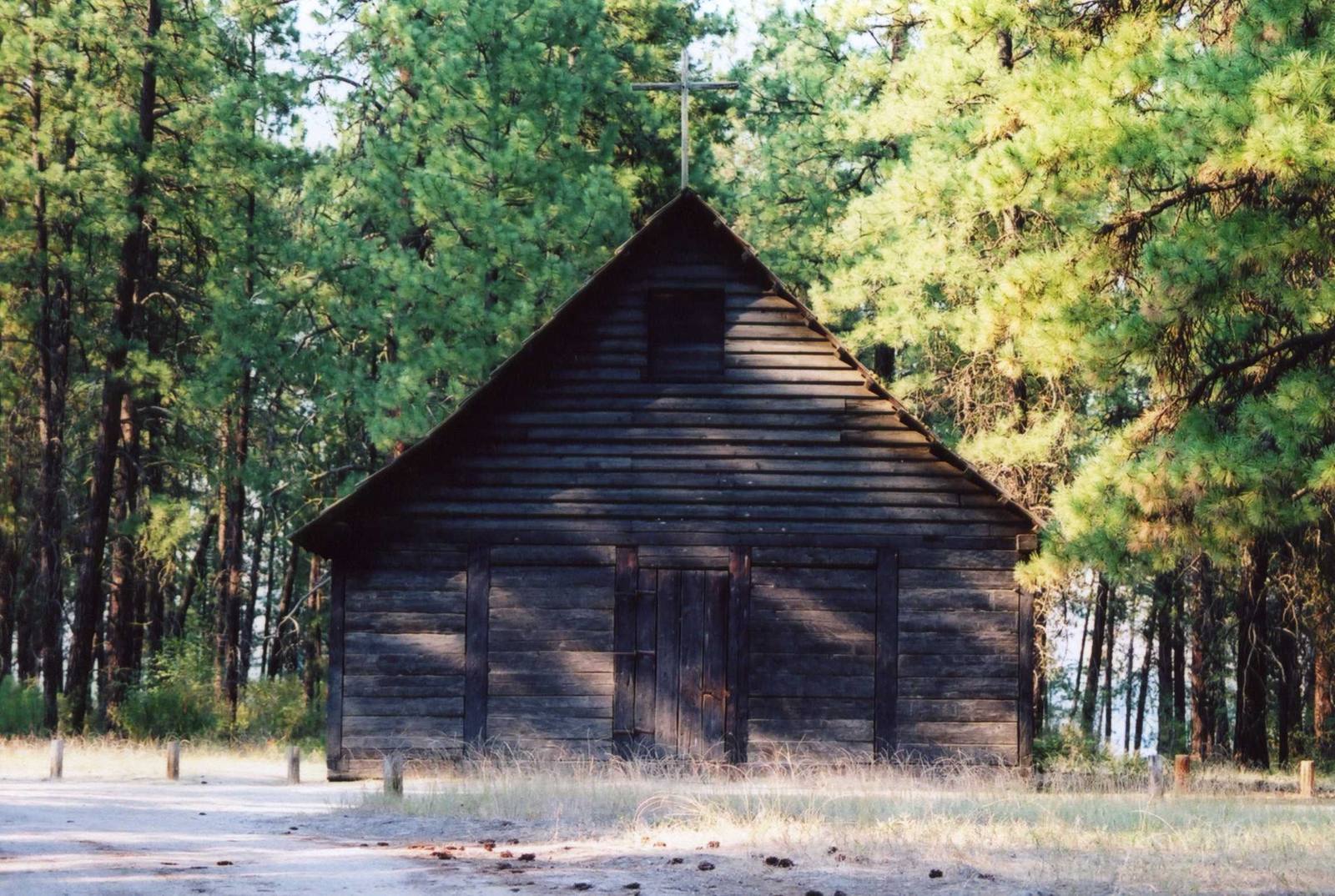
 Broncoman / public domain via Wikimedia Commons
The Story
Every summer before the dams, eight or nine hundred people gathered on the bluff above Kettle Falls for the salmon. In 1845 the Jesuit Pierre-Jean de Smet spent eight days among them, put up a shelter of logs and boughs in the middle of the village, baptized more than a hundred people, and, he wrote, gave the name of St. Paul to the Skoyelpi, the Colville people of the falls. Antonio Ravalli began a chapel a month later and was called away within weeks. In 1847 Peter De Vos, helped by the traders at Fort Colvile, built the church whose form stands here: hand-hewn cedar beams pegged without nails, walls chinked with white mud, glass in the windows, two wood stoves.
The mission's aim was to settle a people who moved with the seasons, teaching farming in place of the fishing round. De Vos recorded 491 baptisms before ill health retired him in 1851. Through the 1850s the priests, with the Hudson's Bay trader Angus McDonald, spoke for the tribes to the Army and the territorial governor, and when war broke out to the south in 1858 their mediation kept the fighting out of the Kettle Falls country. After 1863 the church served mostly settlers and soldiers; a new mission five miles east took over in 1869, and worship here had ended by the mid-1880s. Visitors carried off the wood, the doors and the windows. By 1938 three walls stood.
That year Bishop Charles White of Spokane started a rebuilding to mark a century since the first priests stopped at Fort Colvile in 1838. He died before it began, and a Northport priest finished it in 1939 with the Colville Kiwanis Club and Civilian Conservation Corps volunteers. The next year Lake Roosevelt rose behind Grand Coulee Dam over the falls the mission had been built for. The monument to Fort Colvile was moved up onto the mission grounds out of the water's way, and on the point a massive black stone, faceted where tools were honed on it, marks a place people used for some nine thousand years.
Visitor Info
On the Map
Nearby
The closest stops worth working into your route
Historical markers nearby
Roadside plaques and monuments within a short detour