Home / Kentucky / Louisville & the Ohio River / Muhammad Ali Center
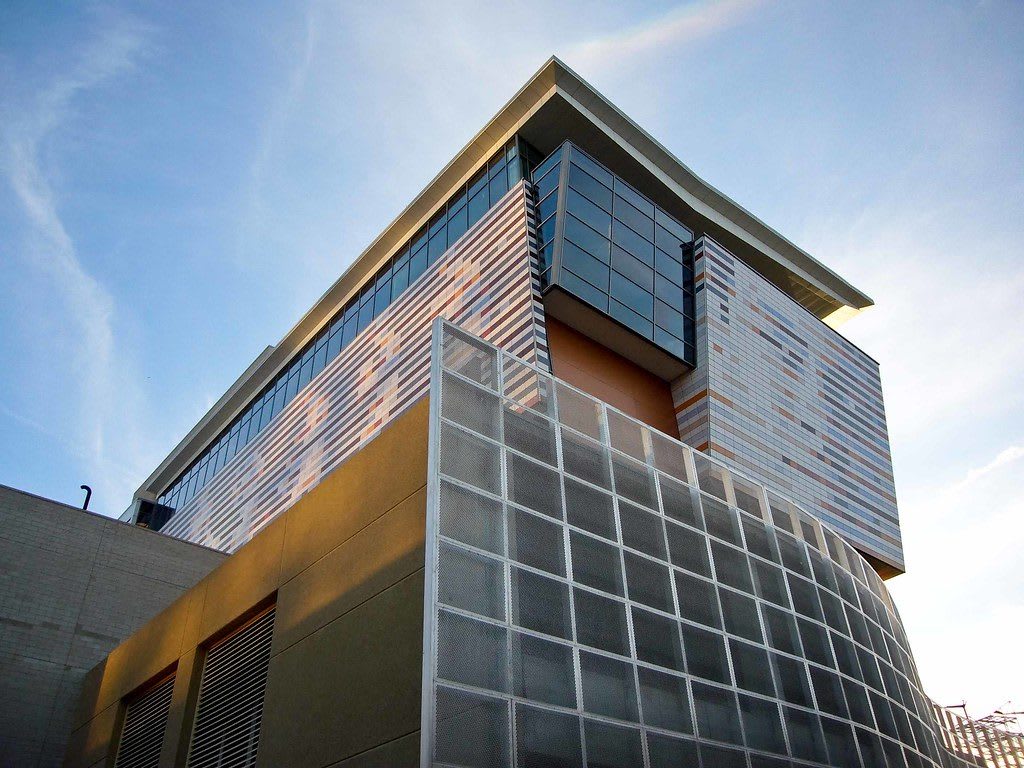
The upper floors of the Muhammad Ali Center, a modern building of glass and colored tile panels, against a blue sky.Paul Joseph / CC BY 2.0 via Flickr
🎭Cultural

Muhammad Ali Center

Part ofLouisville & the Ohio River

Six stories on the riverfront that Muhammad Ali and Lonnie Ali founded to tell how a West End boy became the man who would not go to Vietnam.

⏱
Duration
Two to three hours.
🎟
Admission
Admission charged.
📅
Best Season
Year round.

The Story

Cassius Marcellus Clay Jr. was born in Louisville on January 17, 1942, and grew up in the West End of a segregated city. He was 12 when his bicycle was stolen and he told a police officer, Joe Martin, that he meant to whip the thief. Martin, who trained young boxers, told him he had better learn how to fight first. Six years later the boy from Grand Avenue won the light heavyweight gold medal at the 1960 Olympics in Rome.

He took the name Muhammad Ali in 1964, the year he first won the heavyweight title. In 1967 he refused induction into the Army, citing his faith and his opposition to the war in Vietnam. He was convicted, stripped of his title and kept out of the ring for three and a half years of his prime, until the U.S. Supreme Court overturned the conviction in 1971. He was widely reviled for it then and honored for it later.

Ali and his wife, Lonnie, founded the center, and it opened on November 19, 2005, six stories on the riverfront at Sixth Street, a few blocks from the wharf where Louisville once shipped enslaved people south. The exhibits are arranged around six principles he chose: confidence, conviction, dedication, giving, respect and spirituality. The LeRoy Neiman and Howard Bingham galleries on the third floor hold the painter's and the photographer's long records of him. Ali died on June 3, 2016, and was buried a week later at Cave Hill Cemetery, across town.

Visitor Info

⏱
Time Needed
Two to three hours.
🎟
Admission
Admission charged.
📅
Best Season
Year round.
🛣️
Highway
I-64 / Sixth Street

On the Map

Nearby

The closest stops worth working into your route

historical0.7 mi away
Western Branch Library
The 1908 Carnegie library at Tenth and Chestnut, opened in 1905 as the first public library in the nation run by and for Black residents, still lending books.
historical1.1 mi away
Louisville Waterfront Park
Eighty-five acres of lawn on the Ohio below downtown, where the Falls made a city, the river trade carried people south, and an old railroad bridge now walks you to Indiana.
historical2.1 mi away
Cave Hill Cemetery
A garden cemetery of 1848 on 296 rolling acres and 500 kinds of trees, where George Rogers Clark lies and Muhammad Ali was buried in 2016.
natural3.7 mi away
Cherokee Park
Frederick Law Olmsted's 409-acre park along Beargrass Creek, laid out in 1891, flattened by a tornado in 1974 and replanted to his plan.
cultural3.7 mi away
Churchill Downs and the Kentucky Derby Museum
The 1875 track under the twin spires, where 13 of the 15 riders in the first Kentucky Derby were Black and Isaac Murphy won it three times.
historical5.6 mi away
Farmington Historic Plantation
The Speed family's 1816 hemp plantation house, told through the 20 to 70 people they enslaved here, and the place Lincoln stayed in 1841.

Historical markers nearby

Roadside plaques and monuments within a short detour

Marker0.1 mi away
Evan Williams 1755-1810
Louisville
Marker0.2 mi away
Irene Dunne (1898-1990)
Louisville
Marker0.2 mi away
Lewis and Clark in Kentucky - Louisville
Louisville
Marker0.3 mi away
Jefferson County Courthouse
Louisville
Marker0.3 mi away
Louisville's Steamboat Era
Louisville
Marker0.3 mi away
Louisville City Hall
Louisville