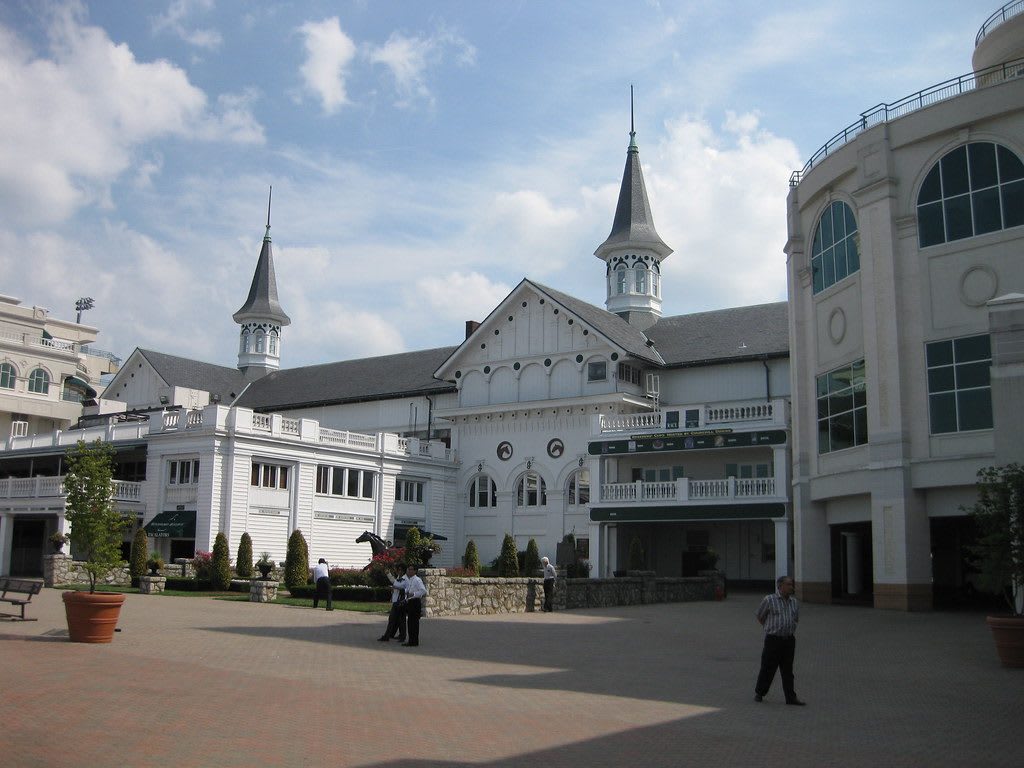
 Lisa Andres / CC BY 2.0 via Flickr
The Story
Meriwether Lewis Clark Jr., a grandson of the explorer William Clark, built this track in 1875 for the Louisville Jockey Club on 80 acres leased from his uncles, John and Henry Churchill. The first Kentucky Derby ran on May 17 that year. Thirteen of the fifteen jockeys in the field were Black. The winner, Aristides, was ridden by Oliver Lewis and trained by Ansel Williamson, also African American.
For the next quarter century Black horsemen were the heart of Kentucky racing. Isaac Murphy won the Derby three times, in 1884, 1890 and 1891, and Jimmy Winkfield won back to back in 1901 and 1902. Winkfield is still the last Black jockey to win it; within a few years the riders who had built the sport were shut out of it. Lewis retired after the 1875 season, worked as a laborer and later as a bookmaker, legal in Kentucky then, moved to Cincinnati soon after 1900 and died there in 1924. He is buried in African Cemetery No. 2 in Lexington.
The twin spires rose on the grandstand commissioned in 1895, and the track has been a National Historic Landmark since 1986. On Derby Day, with the infield open, about 170,000 people crowd in. The rest of the year the Kentucky Derby Museum, beside the gate on Central Avenue, is the way in, with the track's history under one roof. The first chapter of the Derby is a Black one, and it is the part worth asking the guides about.
Visitor Info
On the Map
Nearby
The closest stops worth working into your route
Historical markers nearby
Roadside plaques and monuments within a short detour