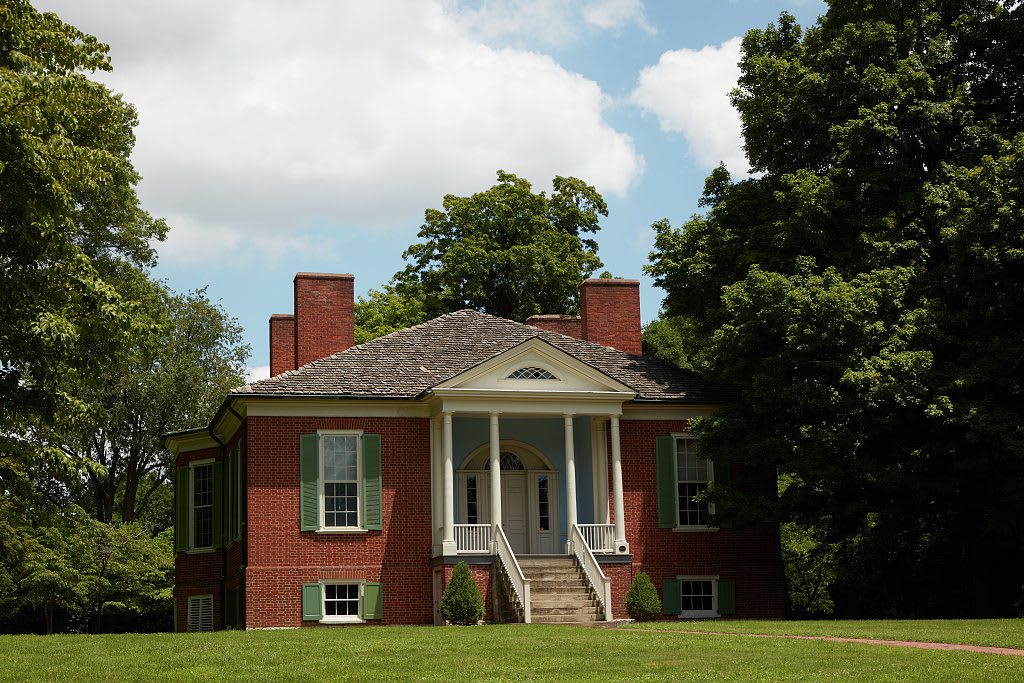
 Carol M. Highsmith / public domain via Library of Congress
The Story
John and Lucy Fry Speed finished this 14-room brick house in 1816 at the center of a hemp plantation on what was then Louisville's rural edge. Paul Skidmore built it, possibly from a Thomas Jefferson plan, which would explain the octagonal rooms and hidden stairs. From 1809 until John Speed's death in 1840, between 20 and 70 enslaved people worked this land, at a time when the average Kentucky slaveholder held fewer than five.
Their labor is the plantation's story. Men cut, hauled and broke hemp against a quota of 80 to 100 pounds a day; women milked, made butter and cheese for sale, kept the hogs, fowl and gardens and ran the house. Harrison and Frazier, two skilled men, escaped in 1826; Speed advertised for them, and their fate is unknown. After Speed's death a 15-year-old named Bartlett was accused of burning the hemp factory and sold to be taken out of the state. Diana Thompson, threatened with sale at Arterburn's pen in Louisville, escaped with her two youngest children, Dinnie and Henry, to Indianapolis three years before the Civil War. After it she came back, took in laundry and bought a house in Smoketown.
Abraham Lincoln spent three weeks here in 1841 with his closest friend, Joshua Speed, who kept enslaving people until the war ended. On a steamboat leaving the Louisville wharf Lincoln saw enslaved people chained together, and in an 1855 letter he told Speed the sight still tormented him. The house, saved in 1958, is seen by guided tour.
Visitor Info
On the Map
Nearby
The closest stops worth working into your route
Historical markers nearby
Roadside plaques and monuments within a short detour