Home / Kentucky / Louisville & the Ohio River / Cave Hill Cemetery
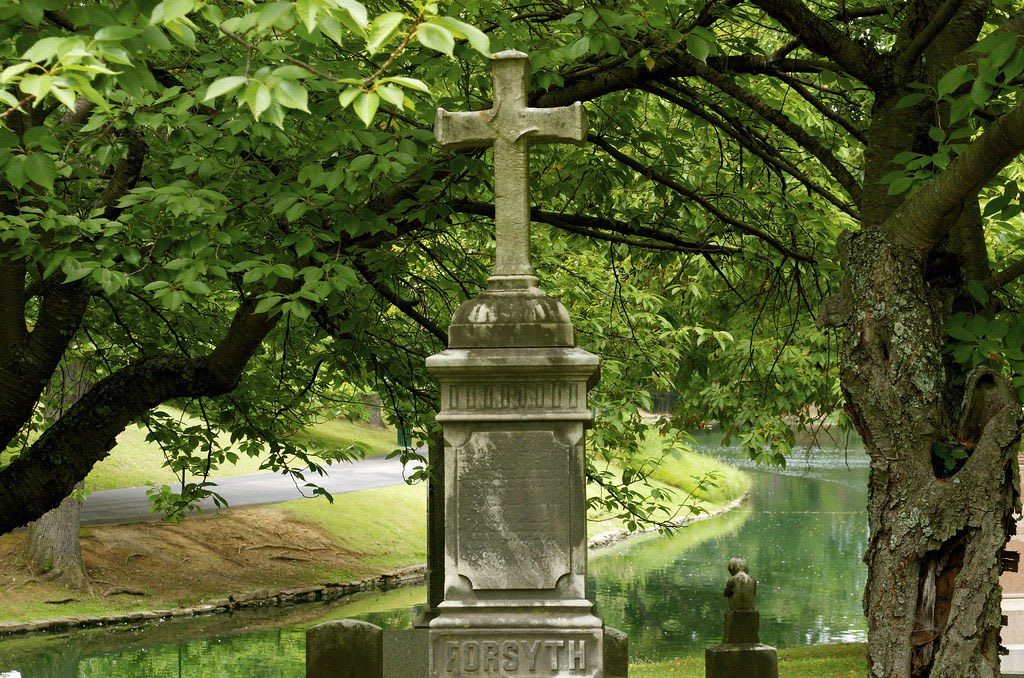
A gravestone topped with a cross beside a pond, framed by the branches of old trees at Cave Hill Cemetery.Garden State Hiker / CC BY 2.0 via Flickr
🏛️Historical

Cave Hill Cemetery

Part ofLouisville & the Ohio River

A garden cemetery of 1848 on 296 rolling acres and 500 kinds of trees, where George Rogers Clark lies and Muhammad Ali was buried in 2016.

⏱
Duration
One to two hours; the grounds are large enough to drive.
🎟
Admission
Free.
📅
Best Season
Spring for the flowering trees, fall for color.

The Story

The Cave Hill Cemetery Company was chartered in February 1848 and dedicated its ground on July 25 that year, east of the town on hilly ground named for a small cave and the spring beside it, the source of a stream that runs to Beargrass Creek. The company hired Edmund Francis Lee, a civil engineer from Hartford, to lay out the plots. When he saw the hills and hollows he changed the plan to a rural garden cemetery, with lanes following the land instead of a grid, the style then spreading from Boston and Brooklyn.

It has grown to 296 acres, with more than 500 species of trees and shrubs, and it is kept as an arboretum. George Rogers Clark, whose regiment began Louisville in 1778, is buried here. During the Civil War the company sold several acres for Union soldiers' graves, now Cave Hill National Cemetery. Patty and Mildred Hill, the Louisville kindergarten teachers whose song became "Happy Birthday," lie here, and so does Harland Sanders, the fried-chicken colonel.

Muhammad Ali was buried here on June 10, 2016, after his funeral procession wound through the West End where he grew up. Enter from Baxter Avenue, drive slowly, and leave time to walk; the cave itself is closed, but the spring basins and the old trees are the quiet heart of the place. A second entrance is on Grinstead Drive.

Visitor Info

⏱
Time Needed
One to two hours; the grounds are large enough to drive.
🎟
Admission
Free.
📅
Best Season
Spring for the flowering trees, fall for color.
🛣️
Highway
I-64 / Baxter Avenue

On the Map

Nearby

The closest stops worth working into your route

historical1.6 mi away
Louisville Waterfront Park
Eighty-five acres of lawn on the Ohio below downtown, where the Falls made a city, the river trade carried people south, and an old railroad bridge now walks you to Indiana.
natural1.6 mi away
Cherokee Park
Frederick Law Olmsted's 409-acre park along Beargrass Creek, laid out in 1891, flattened by a tornado in 1974 and replanted to his plan.
cultural2.1 mi away
Muhammad Ali Center
Six stories on the riverfront that Muhammad Ali and Lonnie Ali founded to tell how a West End boy became the man who would not go to Vietnam.
historical2.3 mi away
Western Branch Library
The 1908 Carnegie library at Tenth and Chestnut, opened in 1905 as the first public library in the nation run by and for Black residents, still lending books.
historical3.5 mi away
Farmington Historic Plantation
The Speed family's 1816 hemp plantation house, told through the 20 to 70 people they enslaved here, and the place Lincoln stayed in 1841.
cultural3.6 mi away
Churchill Downs and the Kentucky Derby Museum
The 1875 track under the twin spires, where 13 of the 15 riders in the first Kentucky Derby were Black and Isaac Murphy won it three times.

Historical markers nearby

Roadside plaques and monuments within a short detour

Marker0.4 mi away
Governor Thomas E. Bramlette
Louisville
Marker0.4 mi away
Highlands Neighborhood
Louisville
Marker0.5 mi away
George Rogers Clark
Louisville
Marker0.5 mi away
Artist of Confederacy
Louisville
Marker0.7 mi away
Father Herman Felhoelter
Louisville
Marker0.9 mi away
Louisville Legion
Louisville