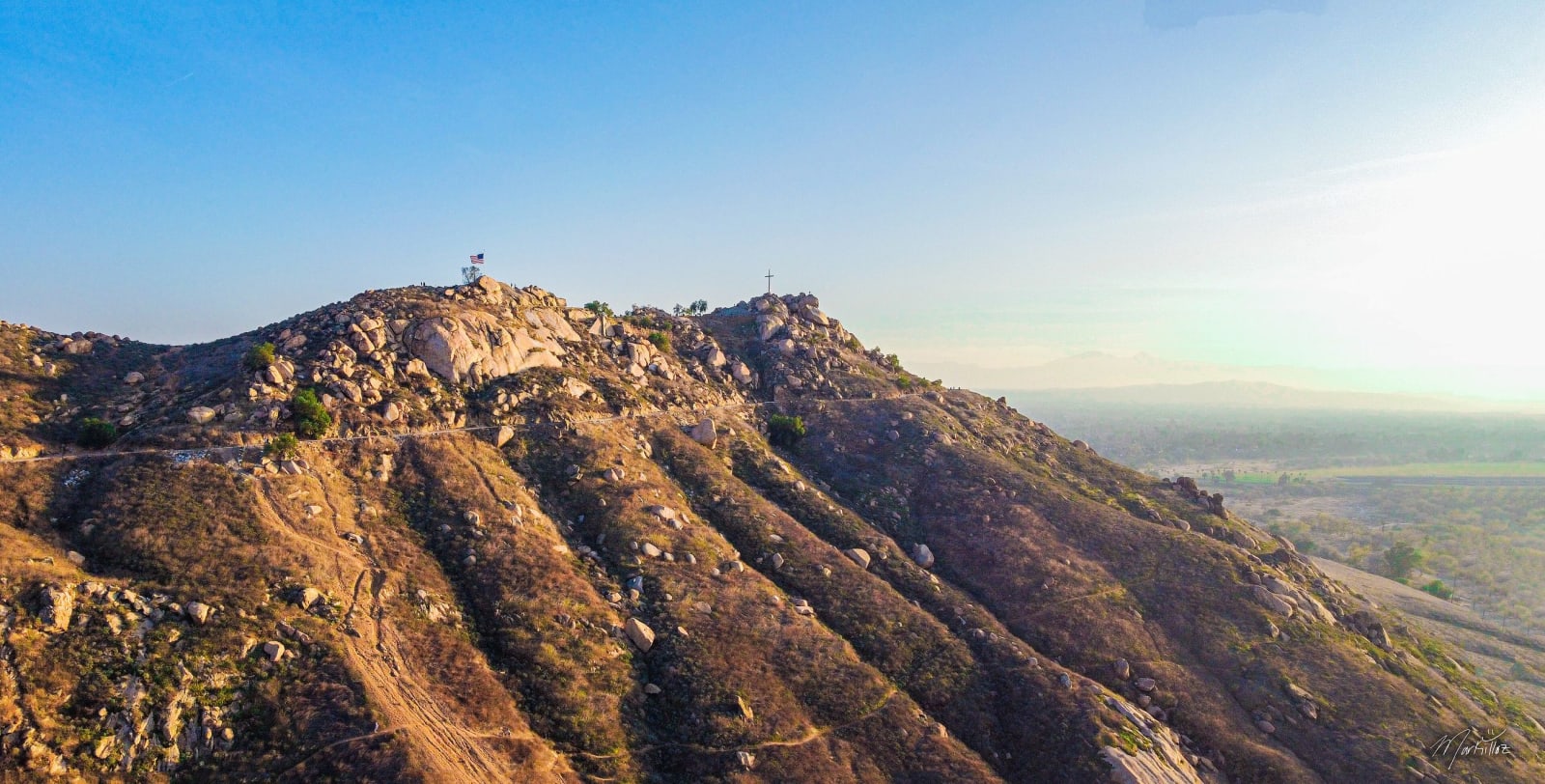
 Marco Antonio Alvarado / CC BY-SA 4.0 via Wikimedia Commons
The Story
Riverside walks up this mountain, on a road built to sell things. In 1906 Frank Miller, Henry Huntington and Charles Loring formed the Huntington Park Association, bought the granite hill west of downtown, and hired Hiram Chittenden, the Army engineer behind the Yellowstone road, to wind a carriage road to the 1,331-foot summit. Hotel guests would ride up. Lots at the base would sell.
Three months later Miller raised twenty-two feet of cedar at the top in memory of Junipero Serra, and in 1909 William Howard Taft climbed up to unveil a tablet beneath it. Serra has no connection to this hill. He died in 1784, half a century before Rancho Jurupa was granted, and he was simply the figure that mission-revival Riverside wanted. That same spring two hundred people met at the cross at dawn for Easter. Twenty thousand came by 1926, and the service has run every year since, the longest-running outdoor sunrise service in the country. Vandals burned the cedar in 1958; the concrete cross standing now went up for the 1963 service.
In 2012 Americans United for Separation of Church and State told the city that a cross standing alone on public parkland was an establishment of religion. Riverside sold it rather than argue it. On April 11, 2013 the city auctioned the top 0.43 acres, and a coalition of local groups that had raised roughly a quarter of a million dollars from five hundred donors took it for $10,500. The other 161 acres are still a city park, open dawn to dusk.
Partway up, the 1925 Peace Tower and its Friendship Bridge carry a tablet to Shunzo Kido, the Japanese cavalry officer who quit the 1932 Olympic three-day event to spare a failing horse. It credits him with mercy over glory. The press credited him a gold medal he was not actually about to win.
Visitor Info
On the Map
Nearby
The closest stops worth working into your route
Historical markers nearby
Roadside plaques and monuments within a short detour