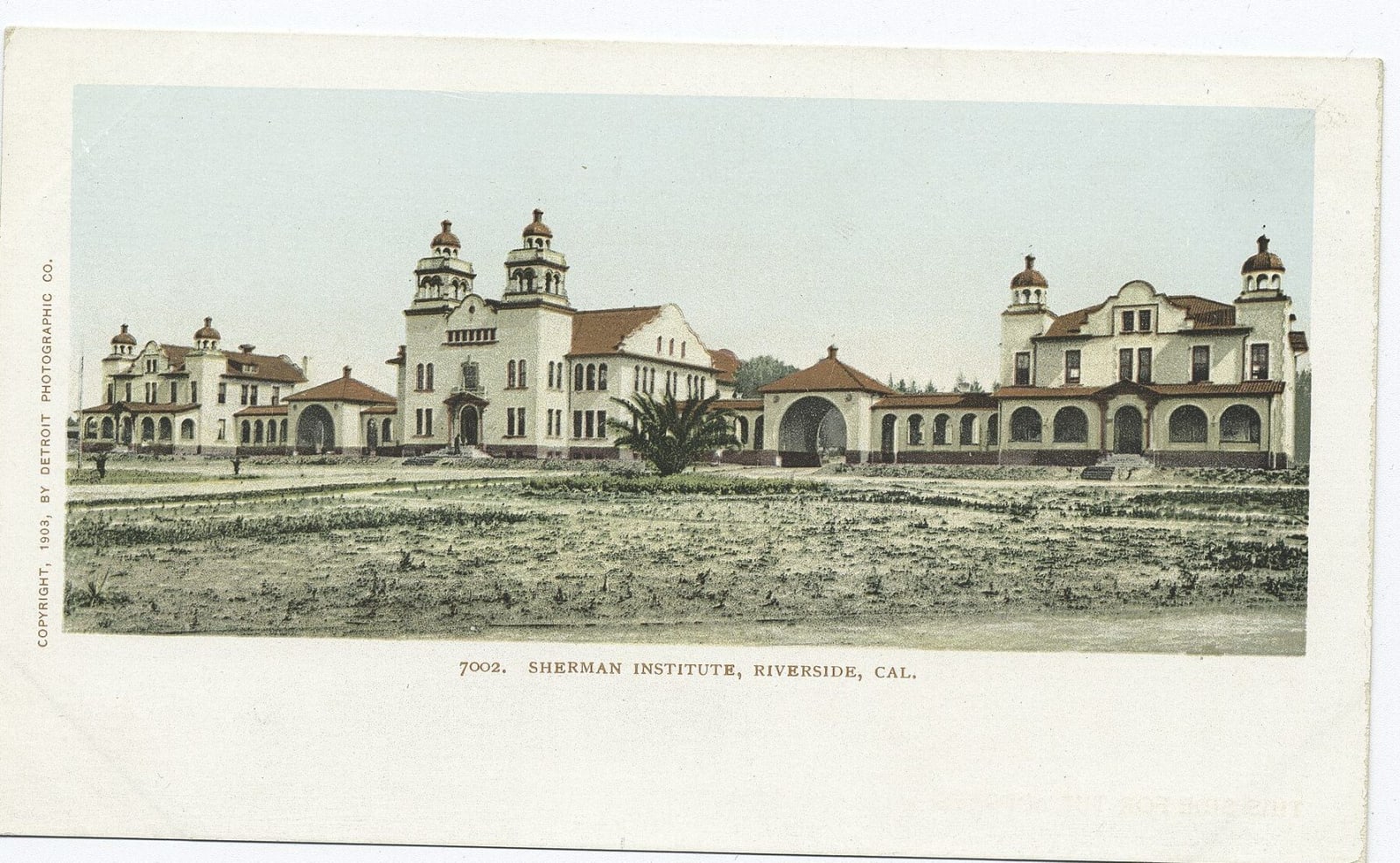
 Detroit Publishing Company / public domain via Wikimedia Commons
The Story
Children as young as five were brought here from nations across California and the Southwest, and the school was built partly to be looked at. Frank Miller, who owned the Mission Inn a few miles east, campaigned to move the government's Indian school from Perris to Riverside. His stated argument was Perris's poor water supply. His other expectation was that tourists would pay to come and see Native children. James Schoolcraft Sherman, chairman of Indian affairs in the House, got Congress to authorize seventy-five thousand dollars in 1900; the cornerstone went down in July 1901, and nine buildings opened under his name in May 1902.
The students built much of what followed, thirty-four buildings by 1908, and were trained as farmhands, carpenters, cooks, seamstresses and nurses. Through the outing system the school hired them out to households and growers by the season. Between 1946 and 1961 a Special Navajo Five-Year Program brought Diné teenagers here who had had little or no schooling.
Some never went home. The campus cemetery holds students who died at Sherman, and every third of May the school keeps Indian Flower Day, the local practice of dressing graves with flowers and replacing the crosses.
It is still a school. Sherman Indian High School serves Native students today, and the 1902 administration building is now the Sherman Indian Museum, holding the ledgers, rosters and photographs of nearly everyone who passed through. A few afternoons a week; call first.
Visitor Info
On the Map
Nearby
The closest stops worth working into your route
Historical markers nearby
Roadside plaques and monuments within a short detour