Home / Missouri / The Lake of the Ozarks & the Osage River / Maramec Spring Park and the Maramec Iron Works
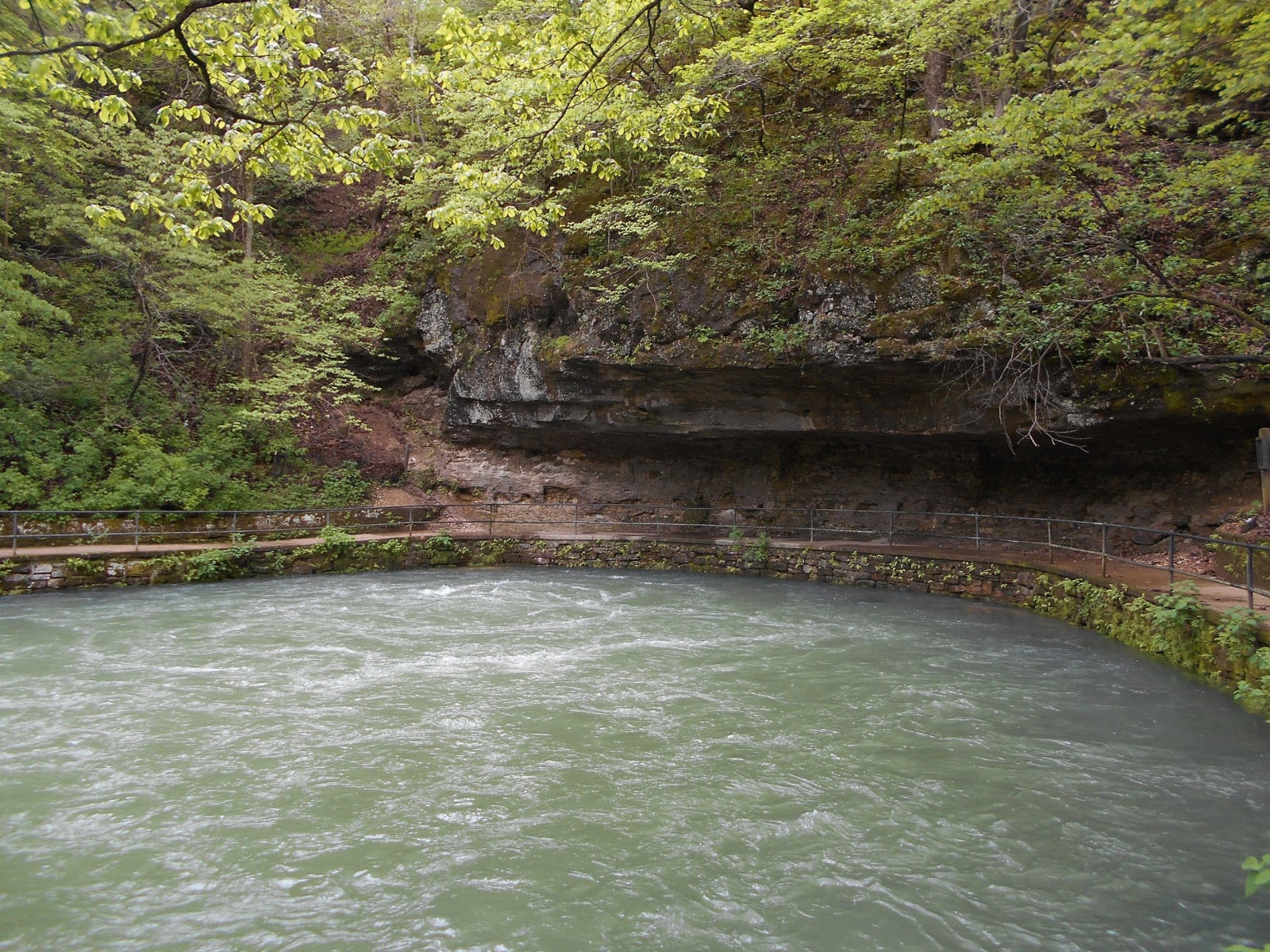
The blue-green pool of Maramec Spring below a mossy limestone bluff.NPS / public domain
🏛️Historical

Maramec Spring Park and the Maramec Iron Works

Part ofThe Lake of the Ozarks & the Osage River
On this driveRoute 66 Across Missouri: St. Louis to Joplin

Missouri's fifth-largest spring, which powered the first successful ironworks west of the Mississippi from 1826, kept whole and opened to the public by an ironmaster's granddaughter.

⏱
Duration
Two to three hours.
🎟
Admission
$5 per car per day; a $50 season pass per car includes the Old Iron Works festival.
📅
Best Season
Open year-round with gate hours that change by month, from 5:30 a.m. to 9 p.m. in summer to 7:30 a.m. to 5 p.m. in November and December; trout harvest season runs March to October, and Old Iron Works Days is held on an October weekend.

The Story

Maramec Spring is private land open to the public because of one woman's plans. The fifth-largest spring in Missouri, averaging about 153 cubic feet a second, close to 100 million gallons a day, it flows to the Meramec River near St. James, and it was named a National Natural Landmark in October 1971.

In 1826 settlers came to the spring to start what became the first successful ironworks west of the Mississippi. The Maramec Iron Works used the spring's flow to power its machinery and smelted high-grade hematite dug from a pit nearby. It made iron from 1826 to 1876, and during the Civil War it supplied iron for cannonballs and for the gunboats James B. Eads built at St. Louis. The company went bankrupt, and the ruins of the works still stand by the spring branch. The district was listed on the National Register in 1969.

Lucy Wortham James, granddaughter of William James, who developed the works, spent childhood summers here with her grandmother. With an inheritance from Dun and Bradstreet shares, she bought more than 1,300 acres in Phelps and Crawford counties, including the spring and the ironworks site, and turned away proposals to run a state highway and a power line through it. She died in 1938, and the James Foundation she funded opened the park in 1965. A museum explains the spring and the ironworks, a drive passes the old iron pit, and the Missouri Department of Conservation runs a trout hatchery at the spring.

Visitor Info

⏱
Time Needed
Two to three hours.
🎟
Admission
$5 per car per day; a $50 season pass per car includes the Old Iron Works festival.
📅
Best Season
Open year-round with gate hours that change by month, from 5:30 a.m. to 9 p.m. in summer to 7:30 a.m. to 5 p.m. in November and December; trout harvest season runs March to October, and Old Iron Works Days is held on an October weekend.
🛣️
Highway
MO-8

On the Map

Nearby

The closest stops worth working into your route

geological18 mi away
Onondaga Cave State Park
A Meramec River show cave entered first by boat from a millpond, split by barbed wire in a property war, saved from a dam that would have drowned it, and held sacred by the Osage Nation.
industrial24 mi away
Dillard Mill State Historic Site
A red gristmill on Huzzah Creek, built by Emil Mischke from 1904 to 1908 with steel roller mills and a turbine, the center of a guest lodge from 1930, and still run for visitors.
roadside30 mi away
Devils Elbow Bridge (Route 66)
A 1923 steel truss with a dogleg over the Big Piney, on the original 1926 line of Route 66 at a bend the tie rafters named, still carrying cars after its 2014 rehabilitation.
attraction31 mi away
Meramec Caverns
A saltpeter cave turned show cave by Lester Dill in 1933, who sold it to Route 66 with barns painted in 14 states, bumper signs and a Jesse James story.
geological47 mi away
Johnson's Shut-Ins State Park
The East Fork of the Black River squeezed through chutes and potholes in ancient rhyolite, and a valley rebuilt after a mountaintop reservoir gave way before dawn on December 14, 2005.
historical47 mi away
Washington State Park
Big River hills with the largest group of petroglyphs found in Missouri and the stonework of Company 1743, an African American Civilian Conservation Corps company that named its camp for a carved thunderbird.

Historical markers nearby

Roadside plaques and monuments within a short detour

Marker16 mi away
Crawford County
Marker21 mi away
Salem
Marker28 mi away
Maries County