 Missouri State Parks / public domain via Wikimedia Commons
The Story
Onondaga Cave was found from a mill. In 1886 Charles Christopher, who worked at the Davis mill on the spring near the Meramec, realized a cave lay beyond the spring's outlet in the millpond, and he and two friends borrowed a boat and squeezed in for a day. For most of the next century the cave was fought over. It was surveyed for cave onyx, opened to tourists along the Frisco, and given an Iroquois name around 1904. In 1930 Dr. William Mook learned that about half of it ran under land he leased, dug his own tunnel and strung barbed wire across the Big Room. In 1932 he opened his half as Missouri Caverns, the first electrically lit cave in the Missouri Ozarks, and in 1935 the Missouri Supreme Court ruled for his side, months after he had died.
Lester Dill and Lyman Riley bought the cave in 1953 and promoted it hard. Then the Corps of Engineers' Meramec dam project turned out to flood up to 80 percent of it. Dill joined the opposition in 1973, 64 percent of voters opposed the dam in a nonbinding 1978 referendum, and Congress shut it down. The park was dedicated in 1982 with its National Natural Landmark plaque.
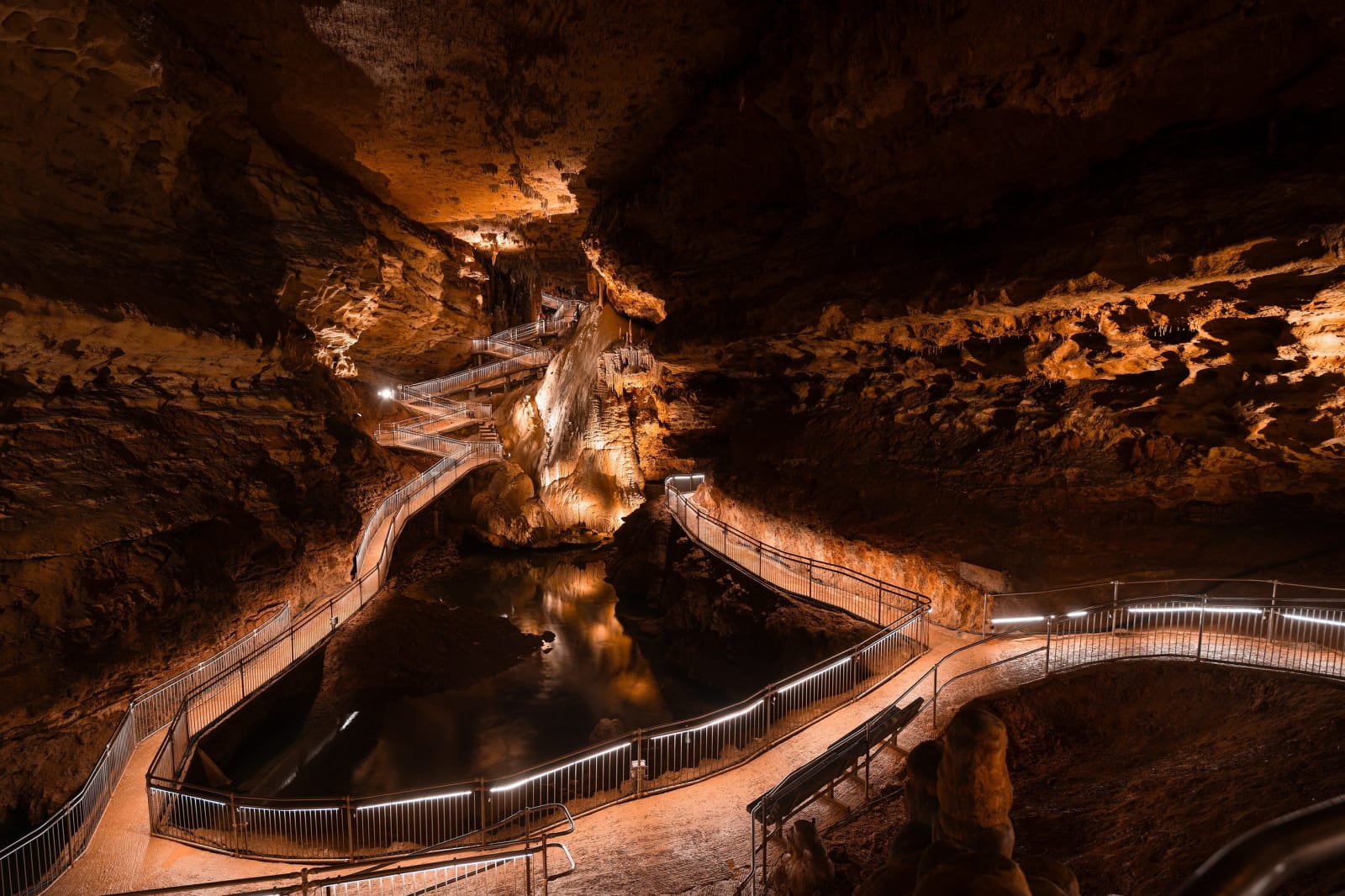
The park notes that the Osage Nation, descendants of the river's early people, recognizes Onondaga as one of many sacred sites in Missouri, where water and cave together carry great meaning. Tours cover just under a mile of lighted, paved walkway in about 75 minutes, at 57 degrees year-round.
Visitor Info
On the Map
Nearby
The closest stops worth working into your route
Historical markers nearby
Roadside plaques and monuments within a short detour