Home / Kentucky / Louisville & the Ohio River / Historic Locust Grove
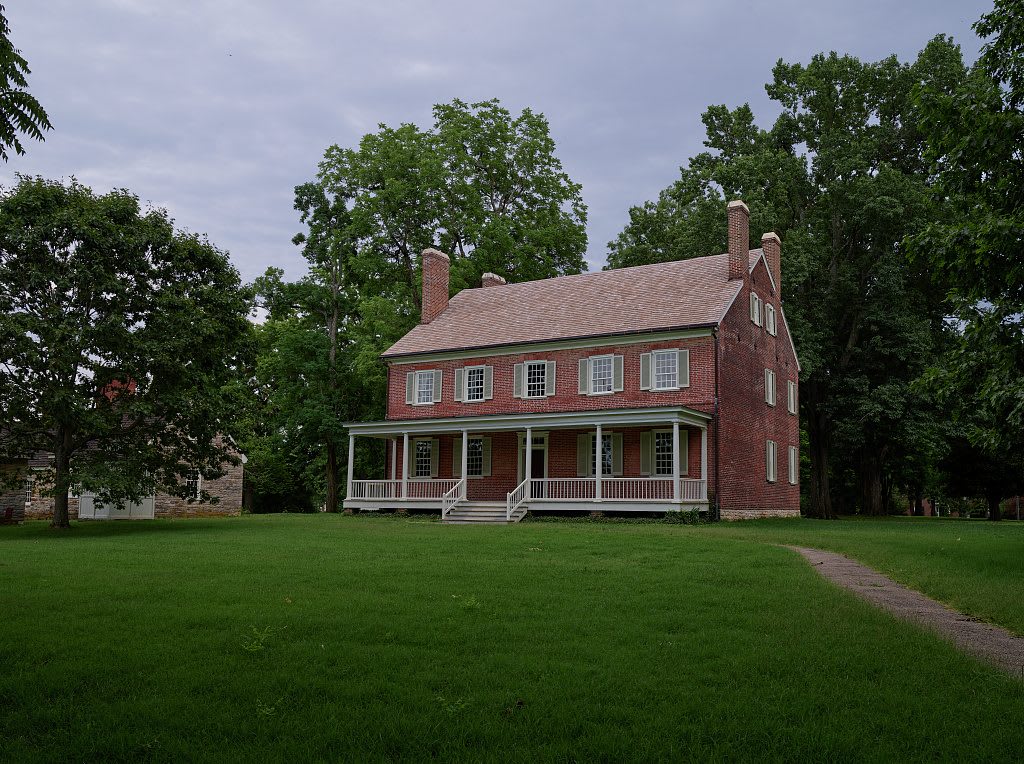
A two-story Georgian brick house with a long white front porch on a broad lawn, a stone outbuilding at left under the trees.Carol M. Highsmith / public domain via Library of Congress
🏛️Historical

Historic Locust Grove

Part ofLouisville & the Ohio River

A Georgian farmhouse of about 1790 built by enslaved craftsmen, where George Rogers Clark spent his last years and Lewis and Clark stopped on the way home from the Pacific.

⏱
Duration
One to two hours.
🎟
Admission
Admission charged for house tours; the visitors center museum is included.
📅
Best Season
Year round.

The Story

Enslaved craftsmen built this Georgian brick house about 1790 for William Croghan, a Virginia officer and chief surveyor of the soldiers' bounty lands, and his wife, Lucy Clark Croghan, who raised nine children here. Over the family's years on the farm at least 30 to 45 enslaved men, women and children worked it, more than 40 at the peak in 1820. They built the house and its outbuildings and did the field work and the household labor. Their names are still being recovered, and Locust Grove works on that with Farmington, Oxmoor and Riverside, the Farnsley-Moremen Landing, as the Louisville Coalition on the History of Enslavement.

Lucy's brother George Rogers Clark, whose regiment's landing at the Falls in 1778 began Louisville, came to live here in 1809 after losing a leg, and he died here in 1818. On November 8, 1806, his younger brother William Clark and Meriwether Lewis arrived at the house on their way back from the Pacific. Locust Grove is the only surviving residence west of the Appalachians that sheltered the two of them. Later the Croghans' son John bought Mammoth Cave, in 1838.

The estate once ran to nearly 700 acres along the Ohio; 55 remain, with the house, its outbuildings and a visitors center that holds a museum. It has been a National Historic Landmark since 1986. Start in the museum, then walk the grounds: the fields and the outbuildings are where most of the people who lived here spent their days.

Visitor Info

⏱
Time Needed
One to two hours.
🎟
Admission
Admission charged for house tours; the visitors center museum is included.
📅
Best Season
Year round.
🛣️
Highway
US 42 / I-71

On the Map

Nearby

The closest stops worth working into your route

natural3.8 mi away
Cherokee Park
Frederick Law Olmsted's 409-acre park along Beargrass Creek, laid out in 1891, flattened by a tornado in 1974 and replanted to his plan.
historical4.5 mi away
Louisville Waterfront Park
Eighty-five acres of lawn on the Ohio below downtown, where the Falls made a city, the river trade carried people south, and an old railroad bridge now walks you to Indiana.
historical4.6 mi away
Cave Hill Cemetery
A garden cemetery of 1848 on 296 rolling acres and 500 kinds of trees, where George Rogers Clark lies and Muhammad Ali was buried in 2016.
historical5.1 mi away
Farmington Historic Plantation
The Speed family's 1816 hemp plantation house, told through the 20 to 70 people they enslaved here, and the place Lincoln stayed in 1841.
cultural5.7 mi away
Muhammad Ali Center
Six stories on the riverfront that Muhammad Ali and Lonnie Ali founded to tell how a West End boy became the man who would not go to Vietnam.
historical6.3 mi away
Western Branch Library
The 1908 Carnegie library at Tenth and Chestnut, opened in 1905 as the first public library in the nation run by and for Black residents, still lending books.

Historical markers nearby

Roadside plaques and monuments within a short detour

Marker0.9 mi away
Zachary Taylor Home
Louisville
Marker1.3 mi away
Zachary Taylor National Cemetery
Louisville
Marker1.7 mi away
Early Jewish Congregations
Louisville
Marker1.8 mi away
Mockingbird Valley
Louisville
Marker2.2 mi away
Water Works Pumping Station
Louisville
Marker2.4 mi away
Gilman's Point
St. Matthews