Home / Alabama / Montgomery, Selma & the Black Belt / Edmund Pettus Bridge
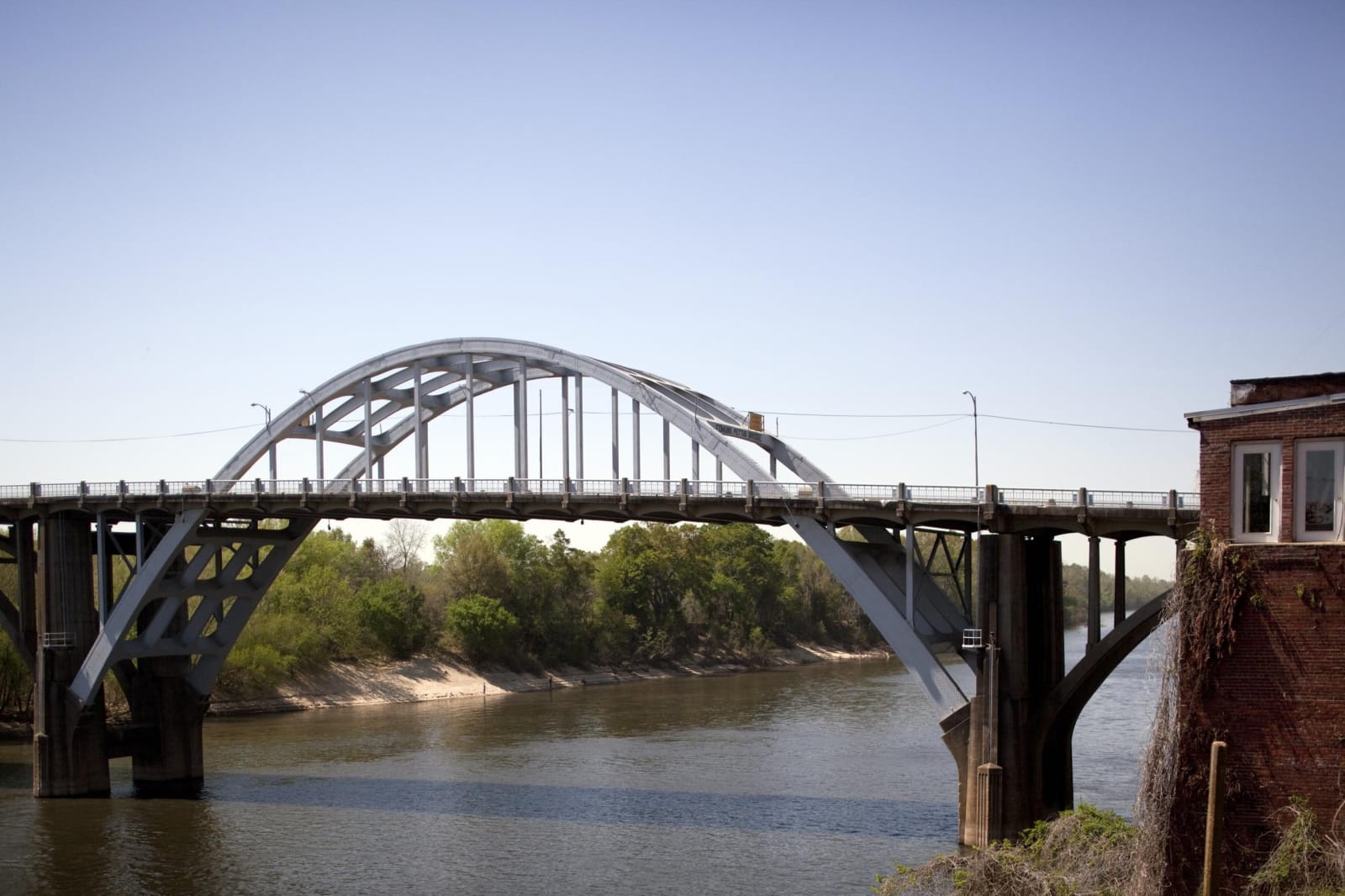
A gray steel arch bridge spanning the brown Alabama River between wooded banks under a clear sky.Carol M. Highsmith / public domain via Library of Congress
🏛️Historical

Edmund Pettus Bridge

Part ofMontgomery, Selma & the Black Belt
On this driveThe Selma to Montgomery National Historic Trail: US 80 from Brown Chapel to the Capitol

The 1940 steel arch over the Alabama River where state troopers and a mounted posse beat voting-rights marchers on Bloody Sunday, March 7, 1965.

⏱
Duration
Thirty minutes to an hour.
🎟
Admission
Free.
📅
Best Season
Year round. The Park Service's Selma Interpretive Center at the foot of the bridge is closed for rebuilding until 2028, with exhibits moved for now to the Selma welcome center (NPS, 2026).

The Story

The bridge opened in 1940, a steel through-arch over the Alabama River designed by Selma native Henson Stephenson. It carries the name of Edmund Pettus, a Confederate brigadier general, United States senator and Grand Dragon of the Alabama Ku Klux Klan. Because Selma sits on a bluff, the roadway climbs from the town side to a crest about 100 feet above the water before dropping to the east bank, so anyone walking out of Selma cannot see what waits on the far side until they reach the top.

On Sunday, March 7, 1965, about 600 marchers led by Hosea Williams of the SCLC and John Lewis of SNCC set out for Montgomery to press for the vote and to protest the killing of Jimmie Lee Jackson, shot by a state trooper during a night march in Marion. On the far side waited about 65 state troopers, at least ten sheriff's deputies and 15 mounted possemen. They used clubs, horses and tear gas, and 56 marchers went to the hospital, among them organizer Amelia Boynton Robinson. Two days later Martin Luther King Jr. led about 2,500 people to the same spot and turned them back under a federal restraining order. On March 21, with Judge Frank M. Johnson Jr.'s order protecting them, the marchers crossed and kept walking.

The bridge was named a National Historic Landmark in 2013. Calls to rename it have come up again and again, and changing the name would take an act of the Alabama Legislature. Walk across on the sidewalk from Broad Street; the climb to the crest is the point.

Visitor Info

⏱
Time Needed
Thirty minutes to an hour.
🎟
Admission
Free.
📅
Best Season
Year round. The Park Service's Selma Interpretive Center at the foot of the bridge is closed for rebuilding until 2028, with exhibits moved for now to the Selma welcome center (NPS, 2026).
🛣️
Highway
US 80 Business (Broad Street)

On the Map

Nearby

The closest stops worth working into your route

historical0.4 mi away
Brown Chapel AME Church
The 1908 church a freed congregation built in Selma, headquarters of the 1965 voting-rights campaign and the starting point of all three marches toward Montgomery.
historical7.8 mi away
Old Cahawba Archaeological Park
Alabama's first state capital, at the mouth of the Cahaba River: a cotton town that faded into ruin and, for a few years after the Civil War, a center of Black political life.
historical19 mi away
Lowndes Interpretive Center
The National Park Service center on US 80 built where Tent City sheltered sharecroppers evicted for registering to vote, midway along the Selma to Montgomery route through "Bloody Lowndes."
cultural28 mi away
Gee's Bend
A Black farming community in a deep bend of the Alabama River, cut off from its county seat for 44 years after residents tried to vote, whose quilts are now shown in major museums.
historical40 mi away
Safe House Black History Museum
Two shotgun houses in Greensboro's Depot neighborhood, one of them where neighbors hid Martin Luther King Jr. from the Klan on March 21, 1968.
historical40 mi away
Magnolia Grove
An 1840 temple-form Greek Revival townhouse in Greensboro, built for a cotton planter, with its original kitchen and a one-room slave house still standing behind it.

Historical markers nearby

Roadside plaques and monuments within a short detour

Marker0.6 mi away
First Baptist Church (Selma)
Selma
Marker0.7 mi away
Sturdivant Hall
Selma
Marker0.9 mi away
Tabernacle Baptist Church
Selma
Marker19 mi away
Holy Ground Battlefield
White Hall
Marker20 mi away
Holy Ground Battlefield
White Hall
Marker20 mi away
Albert J. Pickett (1810-1858)
Autaugaville