 Carol M. Highsmith / public domain via Library of Congress
The Story
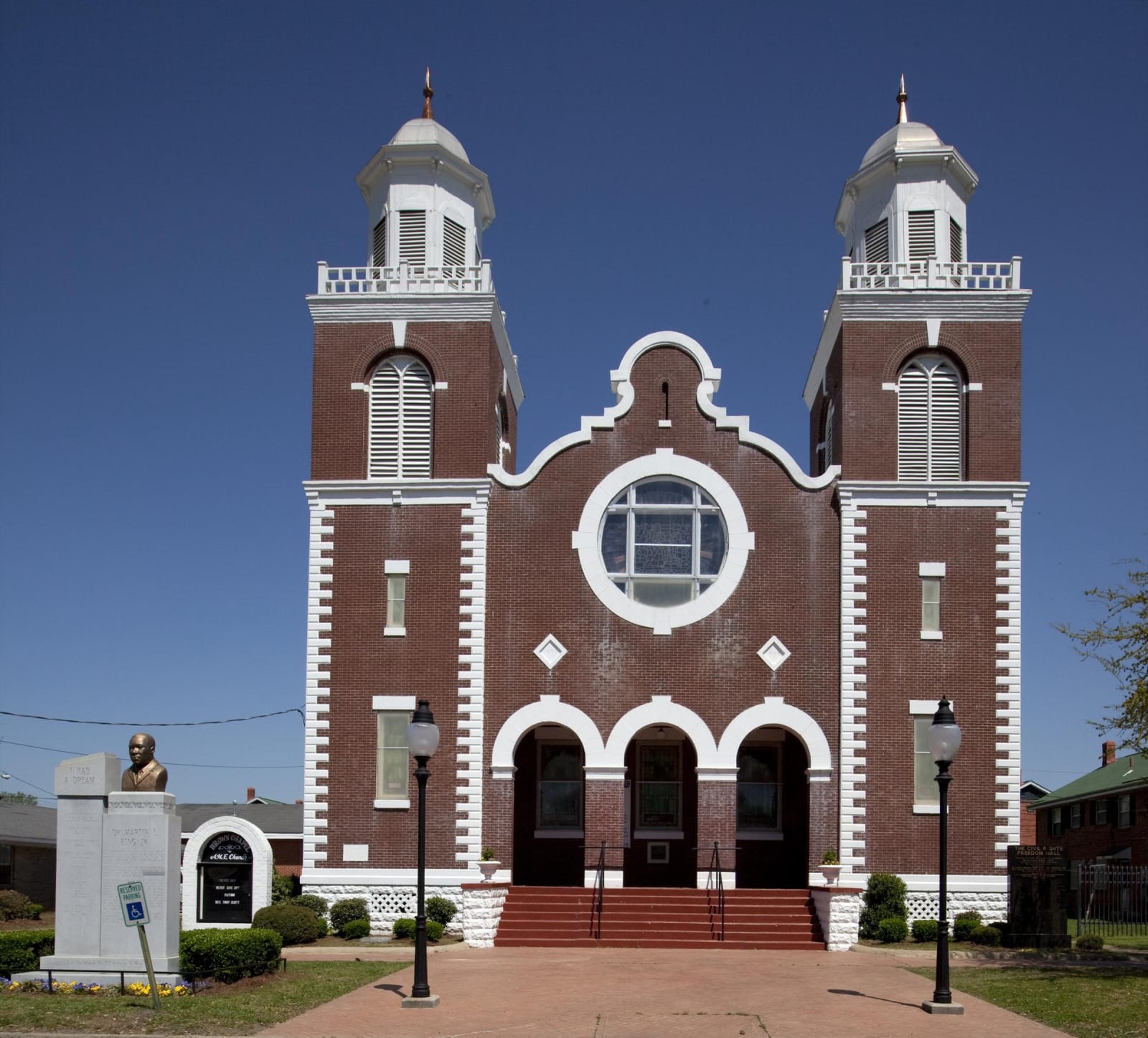
Before emancipation, enslaved people in Selma attended a white Methodist church with their enslavers. In 1866 the freed congregation moved into the basement of the Broad Street Hotel, joined the African Methodist Episcopal Church the next year and took the name of Bishop John Mifflin Brown, who held the first AME conference in Alabama in 1868. A frame church went up on this lot in 1869. The twin-towered Romanesque Revival church of 1908 was built by A. J. Farley, a Black builder from nearby Beloit.
In the first months of 1965 Brown Chapel was the headquarters of the Selma campaign, which the Dallas County Voters League had asked the Southern Christian Leadership Conference to join. It stayed open despite injunctions against mass meetings in Black churches. Martin Luther King Jr. spoke here on January 2, and Malcolm X on February 4. All three marches of March 1965 set out from this street. On the night of March 9, after the turned-back march, the Reverend James Reeb, a white minister from Boston who had come to march, was beaten by white men and died two days later. Three Selma men were tried for his murder, and an all-white jury acquitted them that December.
A granite monument dedicated in front of the church in 1979 carries a bust of King and the names of Jimmie Lee Jackson, James Reeb and Viola Gregg Liuzzo, who were killed in the campaign. A black marble Freedom Wall added in 2005 names people in the struggle from 1950 to 2000. Brown Chapel became a National Historic Landmark in 1997.
Visitor Info
On the Map
Nearby
The closest stops worth working into your route
Historical markers nearby
Roadside plaques and monuments within a short detour