 Carol M. Highsmith / public domain via Library of Congress
The Story
Hale County was Choctaw land, ceded in the 1816 Treaty of Fort St. Stephens, and in the rush of planters called Alabama Fever it filled with cotton plantations worked by enslaved people. Isaac Croom, a North Carolina lawyer and planter, built this house around 1840 as a townhouse on 20 acres in Greensboro. His fortune lay elsewhere: two plantations of about 2,000 acres some 15 miles south of town, and more land in Greene and Marengo counties.
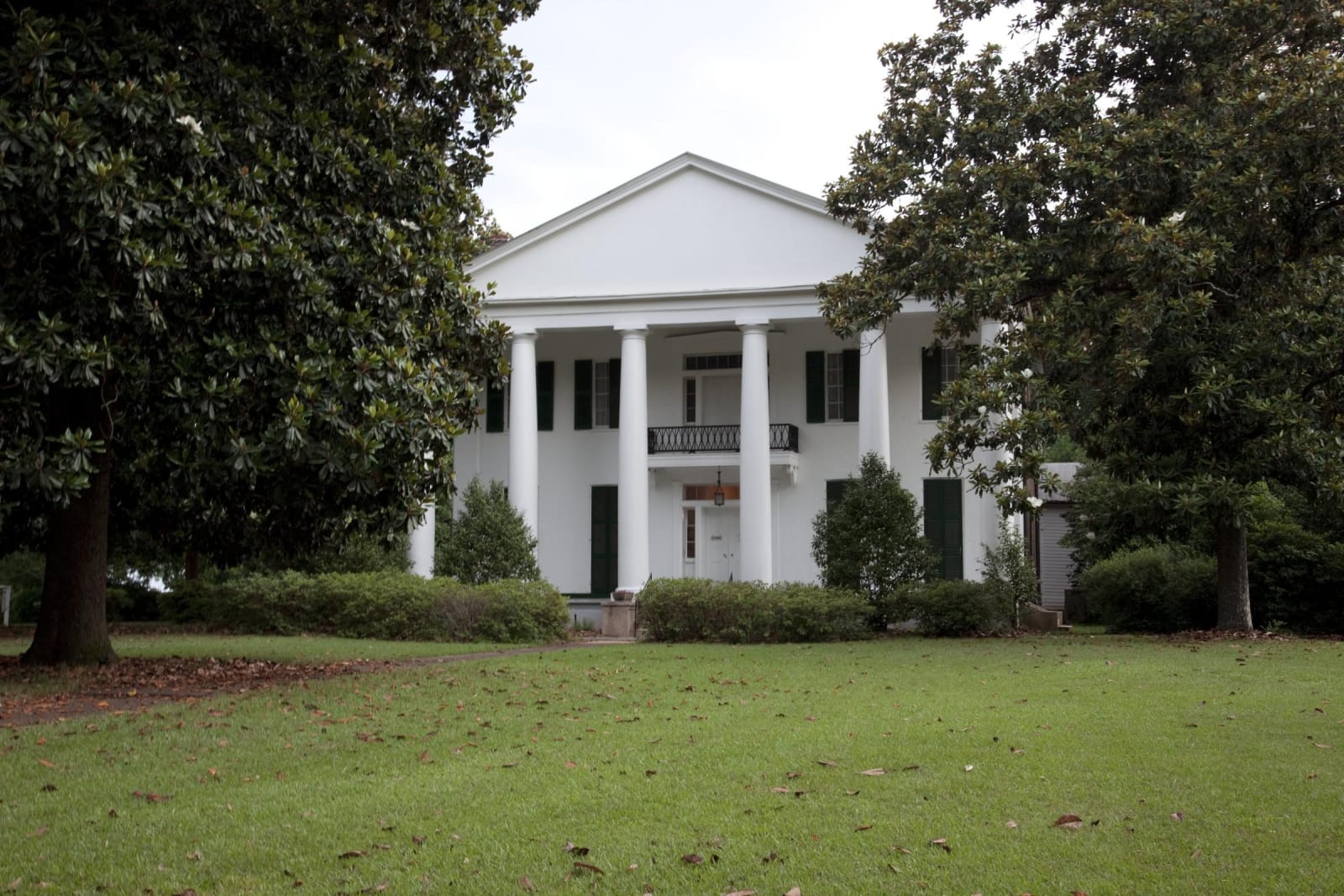
The house is a rare Alabama example of the full temple form, with a pediment carried on six Doric columns and a free-standing spiral stair inside. Family records credit Tuscaloosa physician John Drish with the design. Behind it stands the original two-story brick kitchen, with the cook's living quarters above the cooking room, and at the southwest corner of the lot a one-room frame house where enslaved people lived. A second quarters is gone. As a town household, Magnolia Grove probably held no more than a dozen enslaved people, among them cooks, gardeners and a carriage driver, and the Alabama Historical Commission now interprets the kitchen and slave house with exhibits.
Croom died in 1863. His wife's niece Sallie Pearson Hobson and her husband James later bought the house, and their son Richmond Pearson Hobson, the Spanish-American War naval officer and congressman, grew up here. The family deeded it to the state in 1943, and it opened as a shrine to him; the furnishings are largely those of the Croom and Hobson households, and the grounds keep their magnolias and a boxwood garden.
Visitor Info
On the Map
Nearby
The closest stops worth working into your route
Historical markers nearby
Roadside plaques and monuments within a short detour