 Jllm06 / CC BY-SA 4.0
The Story
Cove Fort sits at the crossroads of two interstates in central Utah, and that location is not a coincidence. The fort was built in 1867 at the intersection of two critical pioneer-era travel routes — the north-south corridor connecting Salt Lake City to the southern settlements and the east-west road linking the Sevier Valley to the mining districts of western Utah. The same geographical logic that placed the fort here in the nineteenth century placed the interchange of I-15 and I-70 here in the twentieth, and the fort still stands between the two highways like a stone reminder that infrastructure follows geography and geography does not change. South on I-15 lies the town of Beaver, with its 1882 volcanic-rock courthouse; east on I-70, Fremont Indian State Park guards the largest Fremont village ever found, in Clear Creek Canyon.
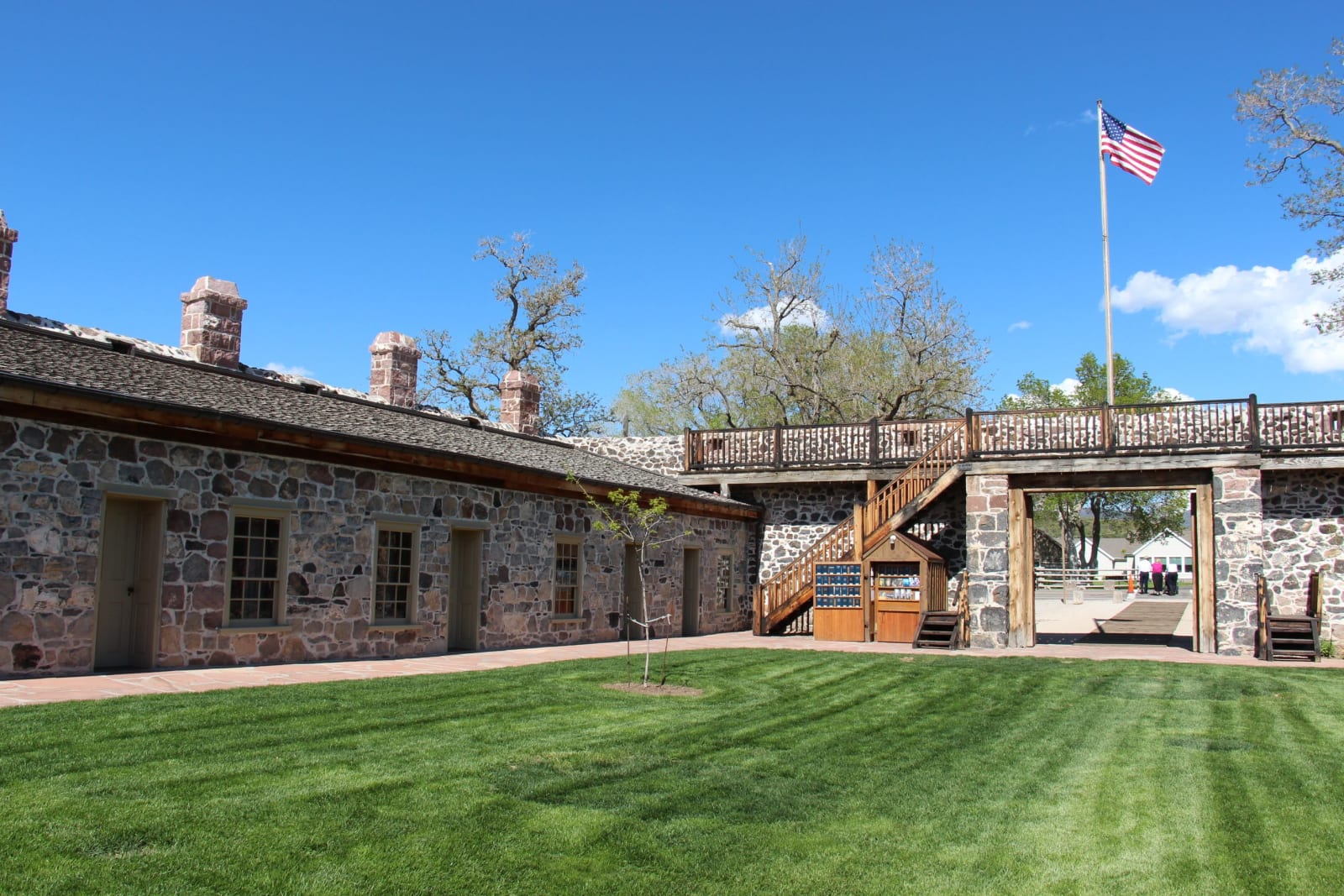
The fort was constructed under the direction of Ira Hinckley — grandfather of Gordon B. Hinckley, who would later become president of The Church of Jesus Christ of Latter-day Saints — and the construction reflects both the urgency and the resourcefulness of the pioneer era. The walls are built from dark volcanic rock quarried nearby, with timber from the surrounding mountains providing the roof beams, lintels, and interior framing. The fort is roughly 100 feet square, with 18-inch-thick walls enclosing a courtyard surrounded by 12 rooms that served as living quarters, a telegraph office, a dining hall, and a way station for travelers, Pony Express riders, and freight haulers passing through.
The fort was not primarily a military installation, though the design reflects the defensive concerns of the era. Relations between the settlers and the indigenous peoples of the region — primarily Ute and Paiute bands — were tense and occasionally violent in the 1860s, and the fortified design provided security for travelers and residents during periods of conflict. The thick walls, the limited entrance points, and the interior courtyard all reflect a community that was building with one eye on hospitality and the other on defense.
What makes Cove Fort remarkable today is the quality of its restoration. The fort has been meticulously rebuilt and furnished to its 1867 appearance, with period-appropriate furniture, tools, textiles, and equipment filling each of the 12 rooms. The telegraph office contains a working replica of the equipment that connected this remote outpost to the broader world. The kitchen is stocked with the cast iron, crockery, and provisions that a frontier way station would have maintained. The sleeping quarters are furnished with the simple beds and storage that travelers would have found after a long day on the road.
Guided tours are offered by volunteer missionaries who lead visitors through each room, explaining the fort's history, its construction, and the daily life of the people who lived and worked here. The tours are free, thorough, and delivered with the warm hospitality that characterizes LDS historical sites. The guides are knowledgeable about both the specific history of the fort and the broader context of pioneer-era Utah, and they welcome questions from visitors of all backgrounds.
The fort's position at the intersection of two interstates makes it one of the most accessible historical sites in rural Utah. Travelers on I-15 heading between Salt Lake City and St. George pass within a few hundred yards of the fort, and the I-70 junction is immediately adjacent. The detour takes less than 30 minutes, and the combination of genuine historical substance, free admission, and clean restrooms makes Cove Fort an ideal road trip break — a chance to stretch your legs, learn something, and stand inside a building that has been sheltering travelers at this crossroads for over 150 years.
The surrounding landscape reinforces the fort's historical context. The terrain is high desert — sagebrush, juniper, and volcanic rock — and the distances between settlements are long enough to understand why a way station at this location was essential. In the 1860s, the nearest communities were days of travel in any direction, and the fort provided food, shelter, fresh horses, and human company in a landscape that offered none of these things naturally. The isolation that made the fort necessary is still palpable. Step outside the walls, look past the interstate, and the desert stretches to the mountains in every direction, empty and indifferent.
Cove Fort is not a dramatic ruin or a grand monument. It is a small, solidly built stone fort at a crossroads, restored with care and presented with sincerity. Its significance lies not in architectural grandeur but in the story it tells about how people moved through this landscape, how they sheltered each other, and how the routes they established still carry travelers today. The interstates have replaced the wagon roads. The trucks have replaced the mule teams. But the crossroads is the same crossroads, and the fort still stands at its center, doing what it was built to do.
Visitor Info
On the Map
Nearby
The closest stops worth working into your route
Historical markers nearby
Roadside plaques and monuments within a short detour