 An Errant Knight / CC BY-SA 4.0
The Story
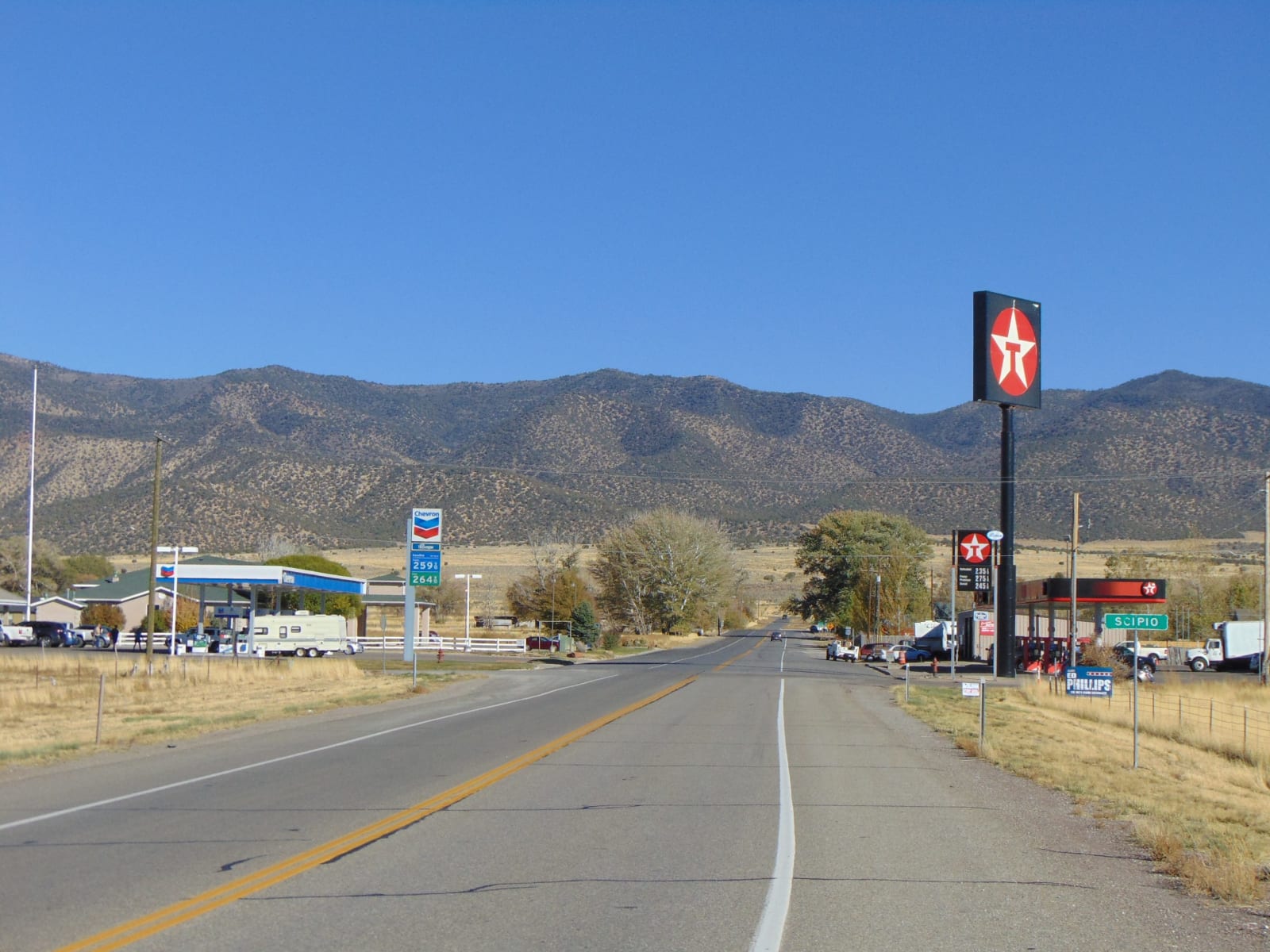
Scipio is a town of about 300 people at the intersection of Interstate 15 and Highway 50, and its entire reason for existing — at least from the perspective of the travelers who stop here — is that it breaks up the longest, most monotonous stretch of I-15 in Utah. The 130-mile drive between Provo and Cedar City crosses a high desert plateau that is beautiful in an austere, empty way but offers few services, and Scipio sits near the midpoint like an oasis of gas pumps and restrooms in a sea of sagebrush. Twenty-five miles south, the freeway reaches Cove Fort, the pioneer way station at the I-15 and I-70 interchange.
The town's gas stations and small diners have been fueling road trippers for decades, and the transaction is simple — fill your tank, use the bathroom, maybe grab a sandwich, and get back on the highway. But Scipio offers something beyond fuel if you are paying attention. The surrounding landscape is genuine basin-and-range country — broad valleys separated by low mountain ranges, covered in sagebrush and bunch grass, with a quality of light and distance that is entirely different from the red rock country to the south or the Wasatch Front to the north. The emptiness is not barren. It is vast, and vastness has its own beauty.
The town was settled in the 1850s by Mormon pioneers and named after the Roman general Scipio Africanus, which is an extraordinarily ambitious name for a community of 300 people in the Utah desert. The ambition of the name, set against the modesty of the town, captures something essential about the pioneer-era settlements of rural Utah — small communities with large aspirations, building in the wilderness and naming their creations after the heroes of civilization. Scipio has not conquered Carthage. But it has been selling gas and coffee to travelers for over a century, and in the economy of the American road trip, that is its own form of victory.
Visitor Info
On the Map
Nearby
The closest stops worth working into your route
Historical markers nearby
Roadside plaques and monuments within a short detour