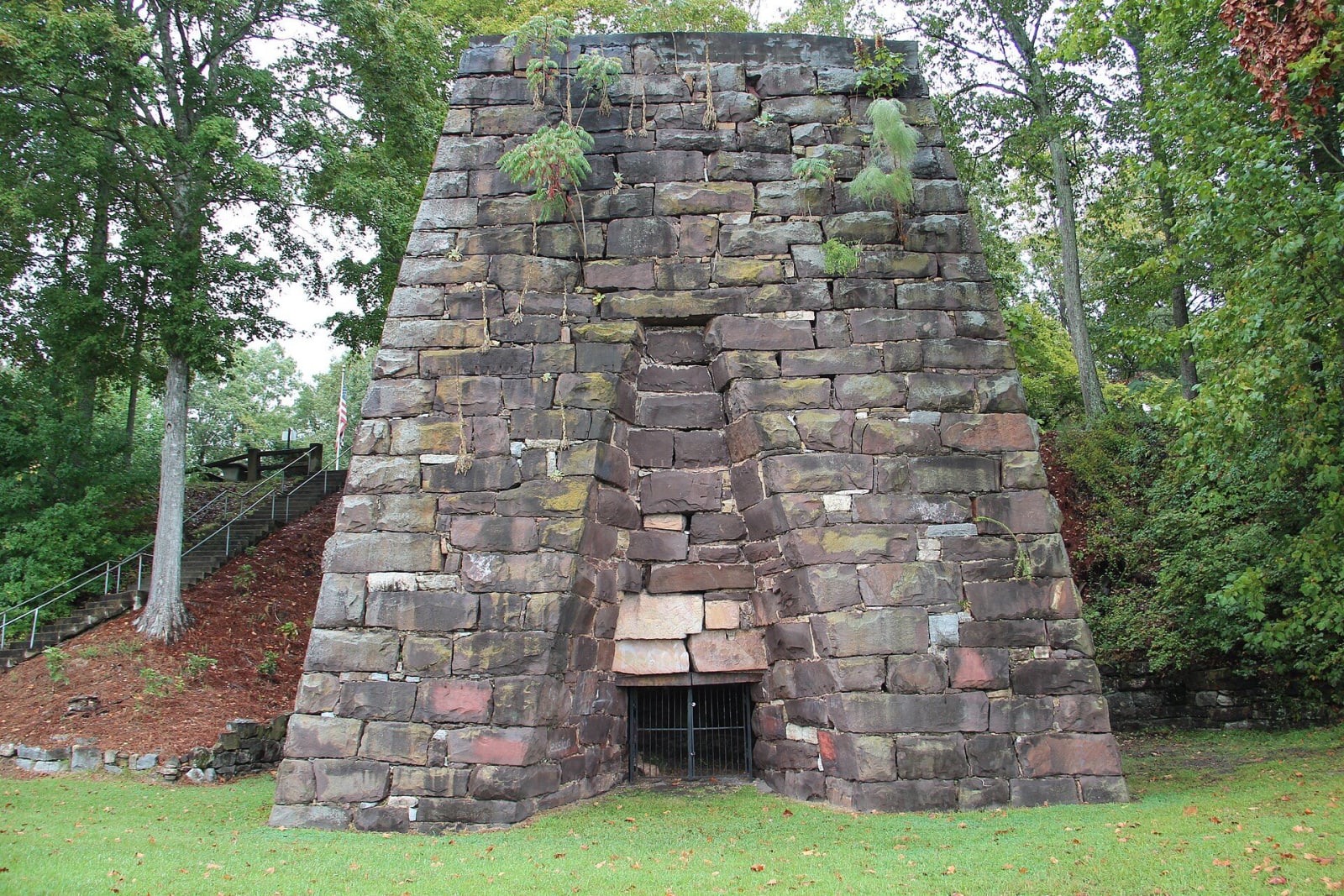
 Thomson200 / CC0 via Wikimedia Commons
The Story
The Cherokee lost this valley of the Chattooga and the Coosa in the Treaty of New Echota, and by 1838 the families who had farmed it were gone west. Settlers had been arriving since 1832, and when the county was formed in 1836 its first seat was the village that became Cedar Bluff. Twenty-five years later the hills held what the Confederacy wanted, red hematite ore, limestone and timber for charcoal.
In 1862 the Confederate government commissioned the Noble brothers of Rome, Georgia, to build a blast furnace two miles northeast of Cedar Bluff, and they named it for their home county in England. The skilled hands came from the army; the rest of the labor was enslaved people hired from their owners on nearby plantations, hundreds of them, in a workforce the National Register nomination puts at perhaps a thousand. They cut a tunnel through the hill and a canal half a mile to the Chattooga River for water power, and hauled ore by ox cart from Dirt Cellar Mountain. The iron went by boat to Rome to be cast into cannon. In October 1864 Union troops occupied Cedar Bluff, and Gen. Frank Blair's men destroyed everything at Cornwall that would burn.
The Nobles rebuilt it in 1867, but it never paid and was blown out for good in 1875. By then the same family had founded the Woodstock Iron Company and the town of Anniston, in 1872. What remains is the stack, about 45 feet high of blocks weighing perhaps three tons each, in a small county park.
Visitor Info
On the Map
Nearby
The closest stops worth working into your route
Historical markers nearby
Roadside plaques and monuments within a short detour