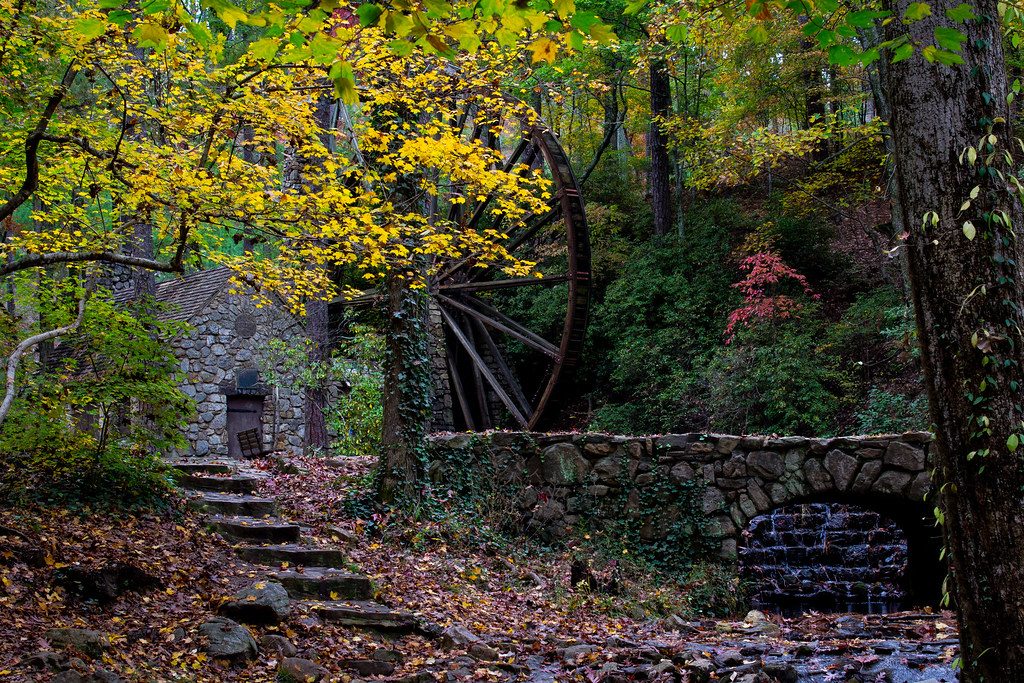
 ShaneClementsC.Ht / CC BY 2.0 via Flickr
The Story
Martha Berry, the daughter of a wealthy Floyd County planter, began teaching Bible stories to mountain boys who wandered up to her cabin retreat, and when her Sunday school and four day schools fell short she used 83 acres inherited from her father to open the Boys' Industrial School in 1902. A girls' school followed in 1909 and a junior college in 1926, which graduated its first senior class in 1932. She took only rural children, refusing even those from Rome. From 1914 students worked two days a week and studied four, building the campus with their own hands and paying their way with labor, under her motto of an education for the head, the heart and the hands.
Her fund-raising drew the nation's rich and powerful. Henry Ford gave buildings, the schools bought land for security, and by the 1930s they held nearly 30,000 acres, the largest campus of any school anywhere. After her death in 1942 the money thinned and enrollment fell; the girls' school closed in 1955, the college turned to the liberal arts under John Bertrand from 1956 and opened to students from the cities, and the boys' academy closed in 1983.
The campus still covers more than 27,000 acres, with Lavender Mountain, a large deer herd and parts open for hiking, cycling and riding. Oak Hill, the 1880s house where she grew up and later lived, keeps the rooms she left in the 1930s and the gardens she added. Beside it the Martha Berry Museum, opened in 1972, tells the schools' story for free.
Visitor Info
On the Map
Nearby
The closest stops worth working into your route
Historical markers nearby
Roadside plaques and monuments within a short detour