 King of Hearts / CC BY-SA 4.0 via Wikimedia Commons
The Story
Settlers who came into the Animas valley in the 1870s found a ruin of shaped stone on the river's north bank and decided that only the Aztecs of Mexico could have built it. The name stuck to the ruin and then to the town, though the Aztec capital was founded generations after these walls were finished.
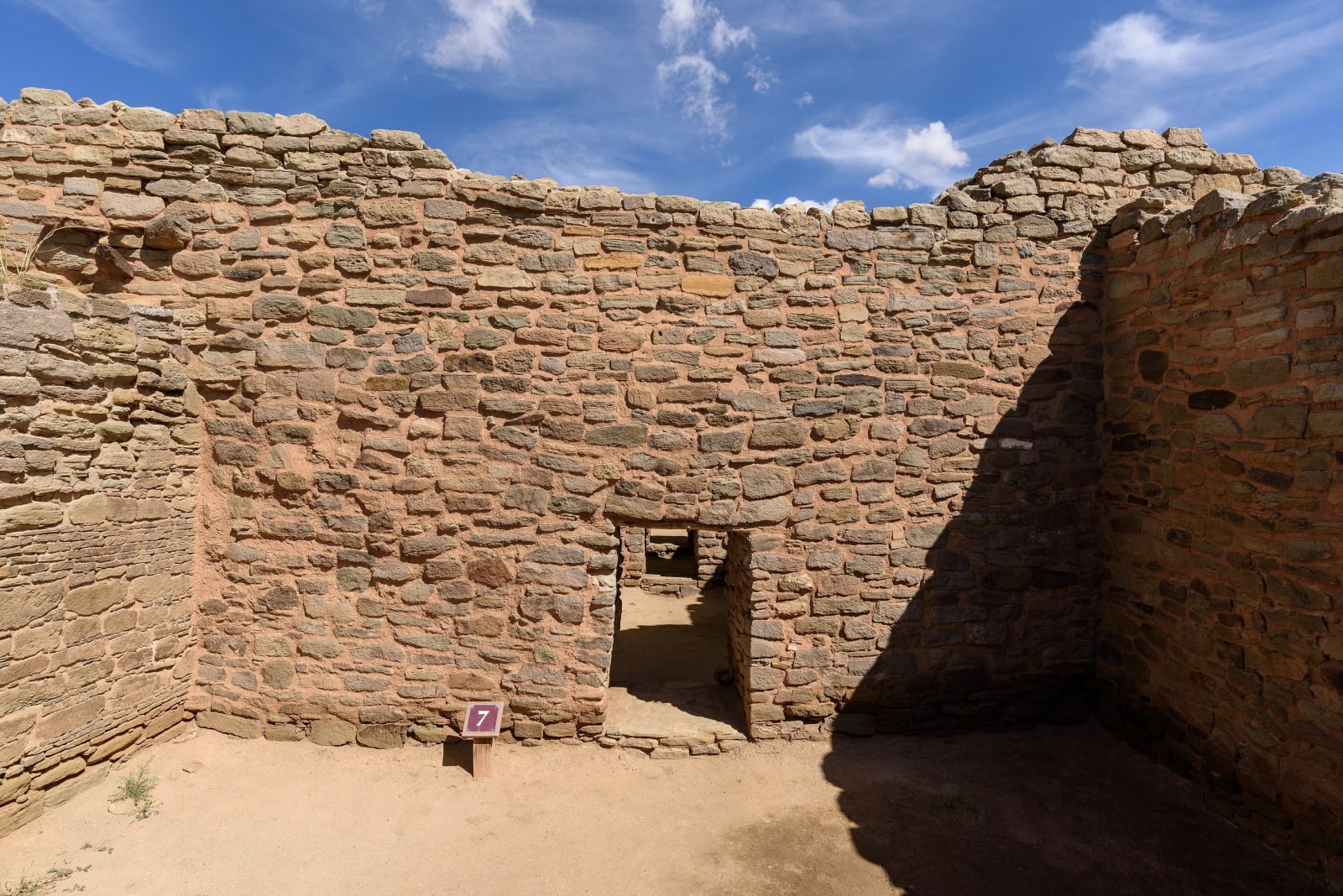
Ancestral Pueblo builders laid out the great house now called West Ruin between about 1110 and 1120, in the manner of Chaco Canyon: a D-shaped block of roughly four hundred rooms around a plaza, its walls of carefully coursed sandstone, its timbers cut in distant mountains and carried here without wheels or draft animals. Some rooms still have their original roofs. It is the largest great house known outside Chaco itself. In the 1200s people with ties to Mesa Verde lived in it, and by about 1300 the valley was empty.
The settlers carted off stone for their own houses, and in the 1880s townspeople broke into the first-floor rooms hunting for relics. Earl Morris of the American Museum of Natural History began excavating in 1916, the national monument was proclaimed in 1923, and in 1934 Morris rebuilt the great kiva in the plaza, a round sunken chamber nearly fifty feet across. It is the only great kiva in the Southwest reconstructed whole. The visitor center was his house, built partly with stone and timbers from the site.
A short trail leads through low rooms and T-shaped doorways and down into the kiva. Aztec has been part of the Chaco World Heritage Site since 1987.
Visitor Info
On the Map
Nearby
The closest stops worth working into your route