Along the Way · Interstate 40
I-40 in Oklahoma
I-40 runs about 331 miles through Oklahoma, from the Texas line to the Arkansas line. Along it: 12 places to stop and 4 historical markers, listed in the order you reach them heading east.
Plan this drive →Road line from the Census Bureau's TIGER roads and OpenStreetMap. Miles count from the Texas line; they are this guide's distances, not the posted mileposts.
Stop by stop, west to east
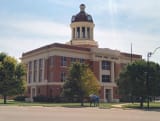
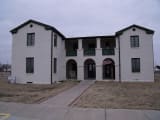
- 23mileArchitectural · SayreBeckham County CourthouseSayre's domed 1911 courthouse, built to impress people stepping off the train and filmed by John Ford for The Grapes of Wrath once Route 66 came through the square.0.9 mi off the road
- 36mileHistorical · Elk CityElk City Museum ComplexElk City's museums on old 66: the National Route 66 and Transportation Museum's drive through all eight states, a pioneer Old Town, a farm and ranch hall and a blacksmith shop.1.8 mi off the road
- 46mileErected 1994CanuteBefore Canute there was Keen, a general store four miles off kept by Robert Keen, which moved to Oak and then, in 1899, to this town's site.by the road
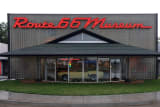
- 64mileHistorical · ClintonOklahoma Route 66 MuseumThe Oklahoma Historical Society's museum of the road in Clinton, decade by decade from the 1926 designation through the Dust Bowl and the war to the 1950s diner.0.6 mi off the road
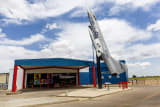
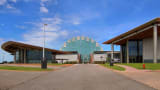
- 82mileCultural · WeatherfordStafford Air & Space MuseumWeatherford's museum for its astronaut son, Thomas P. Stafford, grown from an airport display case into 75,000 square feet of flight beside I-40 and old Route 66.0.6 mi off the road
- 119mileHistorical · El RenoHistoric Fort RenoThe Army post beside the Cheyenne and Arapaho agency at Darlington, from which troops chased the Northern Cheyenne north in 1878, later a remount station and a prisoner-of-war camp.2.3 mi off the road
- 135mileErected 1965Chisholm TrailThe road under these herds was older than its name. The Lenape scout Black Beaver laid out a pathway in 1861, and Jesse Chisholm's wagon road of…0.6 mi off the road
- 149mileHistorical markerDelmar GardenThe Sinopoulo brothers came from Magoula, near Sparta, emigrated in 1893 and reached Oklahoma City in 1902 by way of New York, Chicago and St. Louis.0.3 mi off the road
- 150mileHistorical · Oklahoma CityOklahoma City National Memorial & MuseumThe outdoor memorial and museum on the site of the Alfred P. Murrah Federal Building, where 168 people were killed at 9:02 a.m. on April 19, 1995, shaped by the families and survivors.1.2 mi off the road
- 152mileCultural · Oklahoma CityFirst Americans MuseumThe museum of the 39 First American nations in Oklahoma today, on the Oklahoma River, with galleries shaped by each nation, Smithsonian objects brought home and a 90-foot mound.0.4 mi off the road
- 185mileCultural · ShawneeCitizen Potawatomi Nation Cultural Heritage CenterThe Citizen Potawatomi Nation's national museum and archive in Shawnee, telling a Great Lakes people's road through Kansas to Indian Territory in the Nation's own words and objects.6 mi off the road
- 210mileHistorical · BoleyBoley Historic DistrictThe downtown of the largest of Oklahoma's All-Black towns, praised by Booker T. Washington, squeezed by Jim Crow and white land oaths, bankrupt in 1939 and still living today.7.3 mi off the road
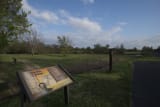
- 268mileHistorical · ChecotahHoney Springs BattlefieldThe July 17, 1863 battlefield on the Texas Road, the largest fight in Indian Territory, where Cherokee and Muscogee regiments fought on both sides and the 1st Kansas Colored Infantry held.4.6 mi off the road
- 304mileErected 1995Dwight MissionThe school outlived its founders by a century. Several buildings burned during the Civil War, the last service was held in November 1862, and by 1884…0.7 mi off the road
- 315mileHistorical · SallisawSequoyah's Cabin MuseumThe log cabin near Akins where Sequoyah, who gave the Cherokee language its syllabary, settled in 1829, kept since 2016 by the Cherokee Nation inside a stone shelter of 1936.6.9 mi off the road
- 322mileHistorical · SpiroSpiro Mounds Archaeological CenterA Mississippian ceremonial center on the Arkansas River, about 850 to 1450, whose burial mound was mined in the 1930s, now run in consultation with the Caddo Nation and the Wichita and Affiliated Tribes.5.6 mi off the road