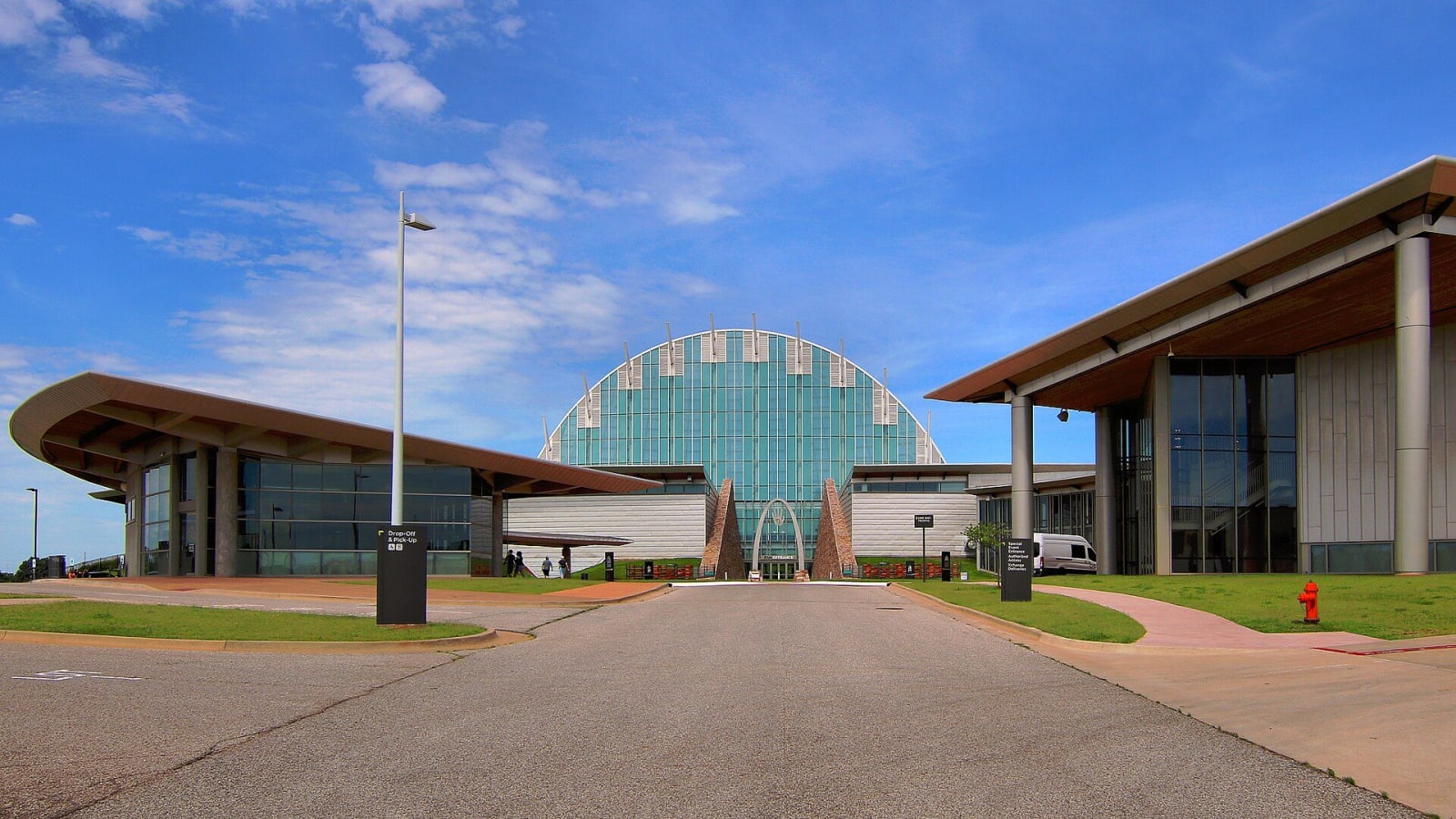
 Larry D. Moore / CC BY 4.0 via Wikimedia Commons
The Story
The museum begins by naming whose ground it stands on: the Wichita, whose villages lay in the same river shed, the Caddo, who built mounds nearby, the Apache, Comanche, Kiowa, Osage, Quapaw and Tonkawa, and the Muscogee (Creek) and Seminole, to whom treaties once assigned this land. Then it says plainly that of the 39 nations in Oklahoma today, only a few are indigenous to it. 'We are not in Oklahoma by choice.' The state's name is Choctaw, okla and homma, red people.
OKLA HOMMA, the 18,000-square-foot Tribal Nations gallery, came out of more than a decade of consultation with each of the 39 tribes and was built by an all-Native curatorial team that chose many voices over one official narrative. Its 270-degree Origins Theater plays four origin stories scripted and narrated by community members, and you can try chunkey and the hand game. Upstairs, WINIKO, the Caddo word for everything on earth and beyond, shows more than 100 objects collected from Oklahoma nations in the early 1900s, when museums were buying up supposedly vanishing cultures. They come from the Smithsonian's National Museum of the American Indian and are back in Oklahoma for the first time in 100 years.
Outside, the FAM Mound rises 90 feet and works as a sun clock along its path, honoring the mound-building cultures from which many Oklahoma nations descend. The two-thirds-mile walk up it is free during museum hours and closes in bad weather or winds over 25 mph.
Visitor Info
On the Map
Nearby
The closest stops worth working into your route
Historical markers nearby
Roadside plaques and monuments within a short detour