 Balon Greyjoy / CC0 via Wikimedia Commons
The Story
Thomas Patten Stafford was born in Weatherford on September 17, 1930, the only child of a dentist and a former teacher, and his mother had come to Oklahoma by covered wagon. He graduated from the Naval Academy in 1952, flew as an Air Force test pilot and joined NASA's second astronaut group in 1962. In 1965 he and Wally Schirra flew Gemini 6A to the first rendezvous in space, with Gemini 7. He commanded Gemini 9A, then Apollo 10 in 1969, the rehearsal that took a lunar module to within about nine miles of the Moon, and in 1975 the American crew of Apollo-Soyuz, the first international space mission. He died on March 18, 2024.
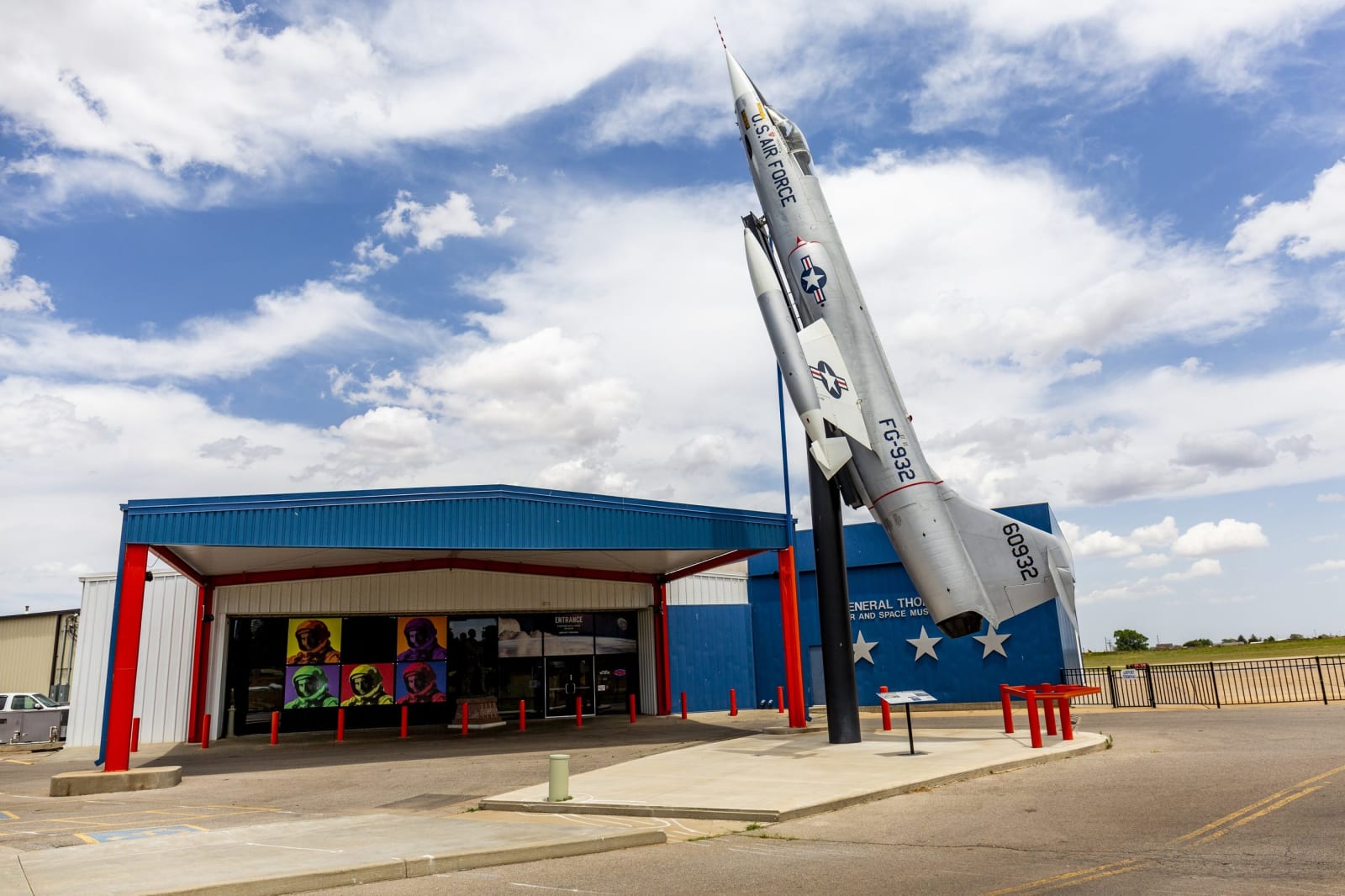
The museum began in the late 1970s as a six-foot case of his belongings in the lobby of the Weatherford airport, which now carries his name. It became a two-room museum in 1993 and after six expansions fills 75,000 square feet, a Smithsonian Affiliate since 2011. The Gemini 6A spacecraft he flew is here, with his flown pressure suits from Gemini and Apollo 10, a Titan II rocket, an F-1 engine of the Saturn V, F-1 turbine wheels from Apollo 11 and a flown Space Shuttle main engine. The aircraft run from a Sopwith Pup to an F-16 and a MiG-21. Outside, an F-104 Starfighter stands nose up, six stories high.
The museum is at exit 84 of I-40 on Historic Route 66 and is operated by the City of Weatherford.
Visitor Info
On the Map
Nearby
The closest stops worth working into your route
Historical markers nearby
Roadside plaques and monuments within a short detour