Home / Oklahoma / Route 66 West & the Washita / Elk City Museum Complex
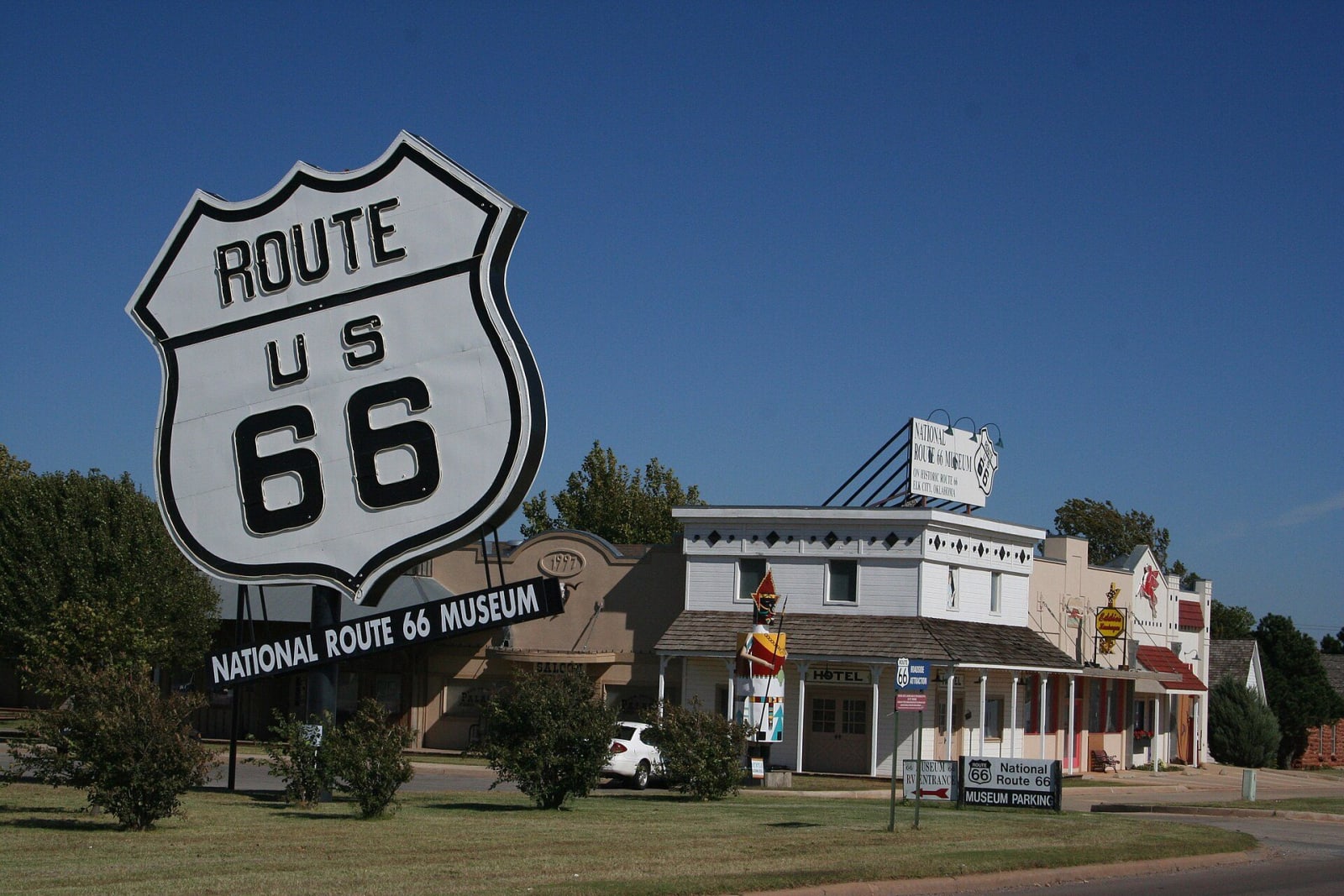
A large Route 66 shield sign in front of the museum buildings of the Elk City complex.NARA / public domain via Wikimedia Commons
🏛️Historical

Elk City Museum Complex

Part ofRoute 66 West & the Washita
On this driveRoute 66 Across Oklahoma: Quapaw to Texola

Elk City's museums on old 66: the National Route 66 and Transportation Museum's drive through all eight states, a pioneer Old Town, a farm and ranch hall and a blacksmith shop.

⏱
Duration
One to two hours.
🎟
Admission
Adults $5, children 6-16 $4, under 5 free, seniors (60+ or AAA) $4; school groups free.
📅
Best Season
Year round. Monday through Saturday 9 a.m. to 5 p.m.; Sundays 1 to 5 p.m. from Memorial Day to Labor Day only.

The Story

Before there was a town, cattle drives on the Western Trail from Texas to Kansas passed through this country along Elk Creek. The townsite was platted on March 18, 1901, and the post office opened under the name Busch, which was too close to another office's name and became Elk City in July 1907. Broomcorn, cotton and livestock went out on the railroads, and in August 1931 Dr. Michael Shadid opened one of the first cooperative hospitals in Oklahoma here, where a farm family bought a fifty-dollar share and paid twenty-five dollars a year for its medical care.

The city's museum complex sits on Route 66. Its National Route 66 Museum and National Transportation Museum take the road through each of the eight states it crossed, from Illinois to California, with a 1955 pink Cadillac to sit in and a black-and-white film to watch from a Chevy Impala at a mock drive-in. The Old Town Museum is a Victorian-era house of settlers' rooms and belongings, with replicas of a schoolhouse, opera house, doctor's office and chapel around it, and there are a Farm and Ranch Museum and a Blacksmith Museum as well.

The newest exhibit in the Old Town Museum shows the water drums, sanitation kits and radiation detectors that the federal government stocked in Elk City's fallout shelters from the 1960s until the 1990s, gathered by the historian Landry Brewer.

Visitor Info

⏱
Time Needed
One to two hours.
🎟
Admission
Adults $5, children 6-16 $4, under 5 free, seniors (60+ or AAA) $4; school groups free.
📅
Best Season
Year round. Monday through Saturday 9 a.m. to 5 p.m.; Sundays 1 to 5 p.m. from Memorial Day to Labor Day only.
🛣️
Highway
I-40 / Business 40 (old Route 66)

On the Map

Nearby

The closest stops worth working into your route

architectural14 mi away
Beckham County Courthouse
Sayre's domed 1911 courthouse, built to impress people stepping off the train and filmed by John Ford for The Grapes of Wrath once Route 66 came through the square.
historical20 mi away
Washita Battlefield National Historic Site
The bend of the Washita where the 7th Cavalry attacked Black Kettle's Cheyenne village at dawn on November 27, 1868, kept by the Park Service with a trail to the village site.
historical26 mi away
Oklahoma Route 66 Museum
The Oklahoma Historical Society's museum of the road in Clinton, decade by decade from the 1926 designation through the Dust Bowl and the war to the 1950s diner.
natural37 mi away
Quartz Mountain State Park
The granite Quartz Mountains, the low western range of the Wichitas, rising from Lake Altus-Lugert, with a CCC-built park of 1937, a rebuilt lodge and the climbing rock of Baldy Point.
historical53 mi away
Museum of the Western Prairie
The Oklahoma Historical Society's museum in Altus, telling southwest Oklahoma from the granite uplift through the Western Trail, Texas's Greer County, dugouts, irrigation and the air base.
natural67 mi away
Wichita Mountains Wildlife Refuge
Worn granite peaks and mixed-grass prairie in Comanche and Kiowa homeland, set aside in 1901 and restocked in 1907 with fifteen bison sent by train from the New York Zoological Park.

Historical markers nearby

Roadside plaques and monuments within a short detour

Marker9.3 mi away
Canute
Marker13 mi away
Sandstone Creek Area
Marker19 mi away
Battle of the Washita
Marker27 mi away
First Shelterbelt in the United States