Home / Oklahoma / No Man's Land & the Northwest / Sod House Museum
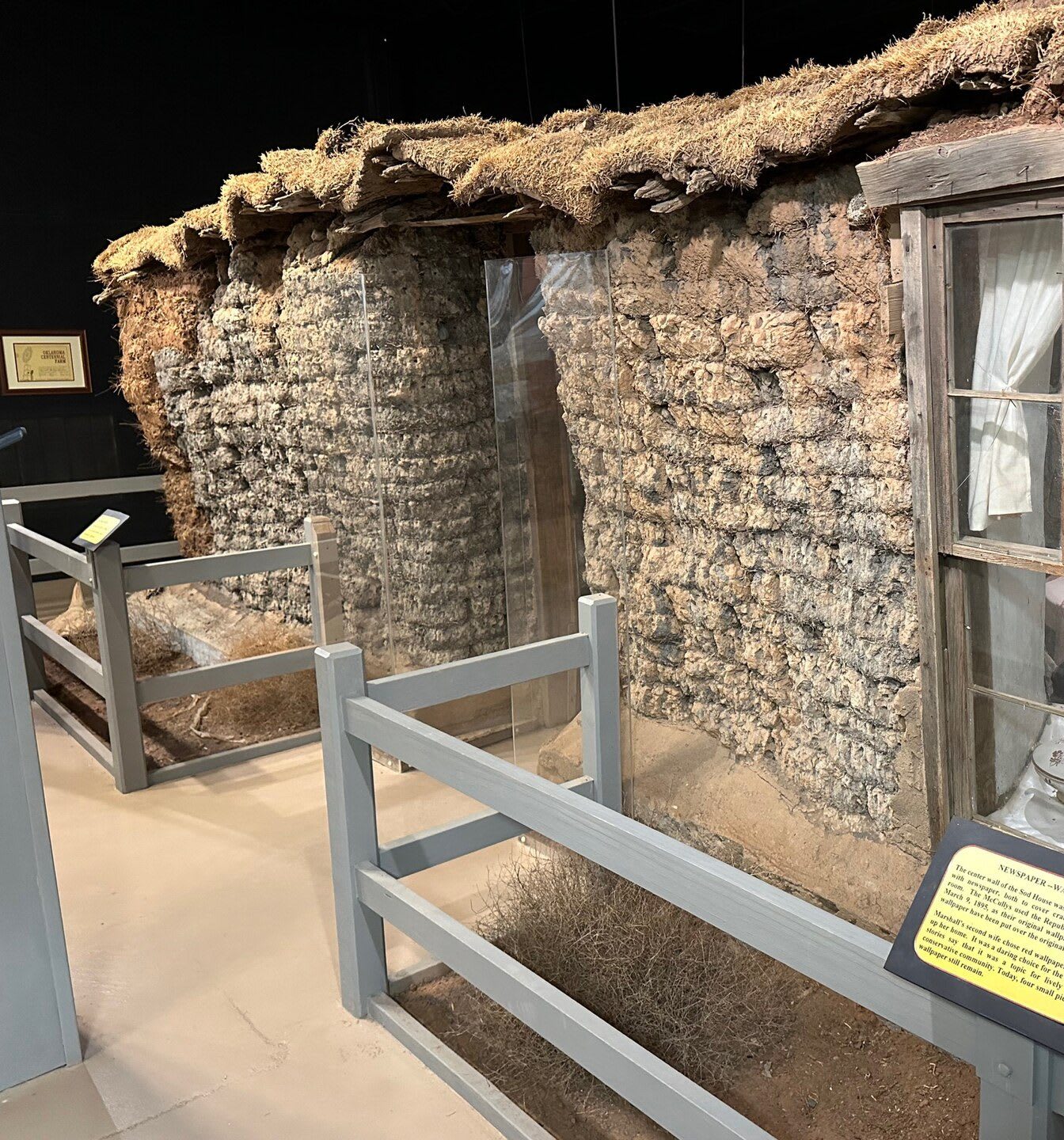
The stacked-sod walls and window of the 1894 sod house, preserved inside the museum shelter.TulGuy / CC0 via Wikimedia Commons
🏗️Architectural

Sod House Museum

Part ofNo Man's Land & the Northwest

Marshal McCully's two-room soddy of 1894 near Aline, the one sod house left in Oklahoma that a homesteader built, under a protective cover where it has always stood.

⏱
Duration
One hour.
🎟
Admission
Adults $10, seniors (62+) $8, students (6-18) $5, children 5 and under, veterans and active military free; OHS members free.
📅
Best Season
Year round. Open Tuesday through Saturday, 9 a.m. to 5 p.m.; staffing is limited, and the OHS recommends calling ahead.

The Story

Marshal McCully made the run into the Cherokee Outlet at noon on September 16, 1893, and spent his first year here in a one-room dugout cut into the bank of a ravine. In August 1894 he built a house of the prairie itself. He hitched his team to a 14-inch sod plow, turned the buffalo grass into long rows, chopped the rows into 18-inch blocks with a flat shovel, and laid them like bricks. For rafters he split poles from the few trees nearby and laid twelve inches of sod across them for the roof. Unlike most builders of soddies, he plastered the inside walls with alkali clay. The museum reckons the two rooms took half an acre of sod, ninety-six tons of it.

McCully received his homestead certificate on April 15, 1902, and his patent on December 31, 1903. The family lived in the soddy until 1909, when they built a two-story frame house, and used it for storage until 1963. On December 31, 1963, sixty years to the day after the patent, the Oklahoma Historical Society acquired it, and it was listed in the National Register in 1970.

Thousands of sod houses once stood on the plains, and this is the only one in Oklahoma left that a homesteader built. It is still on its original ground, inside a building that protects it. Visitors walk through the furnished rooms and the root cellar, and a second building holds horse-drawn equipment, including a steel-beam plow of the kind that cut the sod.

Visitor Info

⏱
Time Needed
One hour.
🎟
Admission
Adults $10, seniors (62+) $8, students (6-18) $5, children 5 and under, veterans and active military free; OHS members free.
📅
Best Season
Year round. Open Tuesday through Saturday, 9 a.m. to 5 p.m.; staffing is limited, and the OHS recommends calling ahead.
🛣️
Highway
OK-8

On the Map

Nearby

The closest stops worth working into your route

geological11 mi away
Gloss Mountain State Park
Red buttes of the Blaine Escarpment beside US-412, capped with gypsum whose selenite flashes in the sun, with a trail up Cathedral Mountain and a park kept by its neighbours.
geological19 mi away
Salt Plains National Wildlife Refuge
About twelve thousand acres of salt flat near Jet where visitors dig hourglass selenite crystals in season, and where the Cherokee Outlet treaty kept the salt open to every tribe.
geological26 mi away
Little Sahara State Park
More than 1,600 acres of bare, moving dunes south of Waynoka, blown from the Cimarron's Ice Age terraces, begun as a park with two circus camels in 1958.
historical31 mi away
Cherokee Strip Regional Heritage Center
The Oklahoma Historical Society's Enid museum of the September 1893 run into the Cherokee Outlet, with the town's original land office among the old buildings out back.
natural37 mi away
Roman Nose State Park
A canyon of gypsum cliffs and three springs north of Watonga, one of Oklahoma's first seven state parks, named for Henry Roman Nose, a Cheyenne chief who survived Fort Marion.
geological43 mi away
Alabaster Caverns State Park
A three-quarter-mile gypsum cave under Cedar Canyon near Freedom, with selenite, rare black alabaster, five kinds of bats and a past as a 1950s fallout shelter.

Historical markers nearby

Roadside plaques and monuments within a short detour

Marker0 mi away
Sod House