Home / Alabama / Huntsville & the Tennessee Valley / Scottsboro Boys Museum and Cultural Center
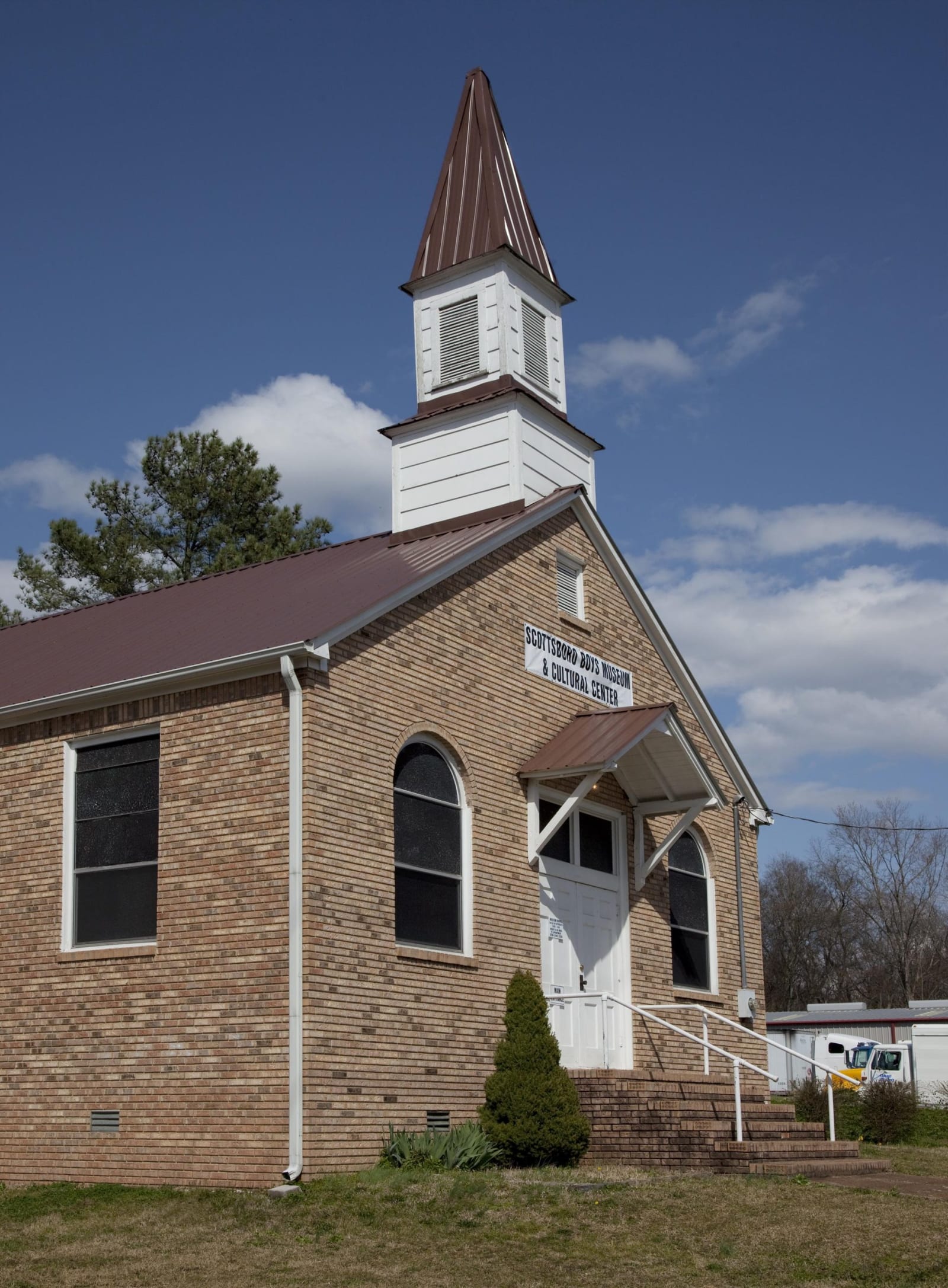
A tan brick church with a white steeple and arched windows under a blue sky, a sign for the museum over its door.Carol M. Highsmith / public domain via Library of Congress
🏛️Historical

Scottsboro Boys Museum and Cultural Center

Part ofHuntsville & the Tennessee Valley

A former Methodist church a few blocks from the Jackson County courthouse, telling the 1931 case of nine young men falsely accused of rape and the Supreme Court rulings it produced.

⏱
Duration
One hour.
🎟
Admission
Paid admission (2026).
📅
Best Season
Year round; open limited Saturday hours and by appointment, so call ahead.

The Story

On March 25, 1931, a fight between Black and white youths on a freight train ended when local police and a mob met the train at Paint Rock and took nine young Black men off it: Olen Montgomery, Clarence Norris, Haywood Patterson, Ozie Powell, Willie Roberson, Charlie Weems, Eugene Williams and the brothers Andy and Roy Wright, the youngest thirteen. Two white women on the train, Victoria Price and Ruby Bates, accused them of rape to avoid vagrancy charges. Within three weeks, with the National Guard holding back a crowd outside the courthouse here, all-white juries had sentenced eight of them to death.

The case went to the U.S. Supreme Court twice. Powell v. Alabama in 1932 held that the defendants had been denied adequate counsel, and Norris v. Alabama in 1935 that Black citizens had been kept off Jackson County juries. At the 1933 retrial in Decatur, Ruby Bates recanted on the stand and Judge James Horton set aside Patterson's guilty verdict. Alabama tried the men again anyway. Four were freed in 1937 after six years in jail; the others served long terms, and Norris was pardoned only in 1976.

Sheila Washington spent seventeen years working toward this museum, founded in 2010 in the former Joyce Chapel United Methodist Church. It holds a jury chair from the trials, a metal table from the defendants' cell and a boxcar, and it was here, in April 2013, that the governor signed the law exonerating all nine.

Visitor Info

⏱
Time Needed
One hour.
🎟
Admission
Paid admission (2026).
📅
Best Season
Year round; open limited Saturday hours and by appointment, so call ahead.
🛣️
Highway
US-72

On the Map

Nearby

The closest stops worth working into your route

geological12 mi away
Cathedral Caverns State Park
The largest commercial cave entrance on record, Goliath's 45-foot stalagmite and a river in the dark, a state park since 2000.
natural21 mi away
Lake Guntersville State Park
Six thousand acres of ridge above the TVA lake at Guntersville, once Gunter's Landing, Cherokee land and an 1838 departure point on the Trail of Tears.
historical24 mi away
Fort Payne Depot Museum
An 1891 sandstone depot in the town that grew around the 1838 stockade where Cherokee families from Willstown were held for removal, now a museum of the valley.
historical25 mi away
Russell Cave National Monument
A limestone shelter in Doran Cove where people camped for roughly ten thousand years, from the end of the Ice Age to the Cherokee, set aside by Kennedy in 1961.
natural27 mi away
DeSoto State Park
A CCC park of stone cabins and lodge on Lookout Mountain, quarried from its own ground, with Alabama's tallest waterfall on a separate tract near Mentone.
natural27 mi away
Monte Sano State Park
Huntsville's mountain park: an 1877 health resort gone, CCC stone cabins and lodge still standing, and twenty miles of trail above the Tennessee Valley.

Historical markers nearby

Roadside plaques and monuments within a short detour

Marker0.7 mi away
Robert E. Jones, Jr. / Jones House
Scottsboro
Marker15 mi away
Kate Duncan Smith - Daughters of the American Revolution School
Grant
Marker17 mi away
Fort Harker
Stevenson
Marker18 mi away
Stevenson Depot and Hotel
Stevenson
Marker18 mi away
Union Army Headquarters
Stevenson
Marker18 mi away
Averyville
Stevenson