Home / Texas / San Antonio & the Missions / San Antonio Missions National Historical Park
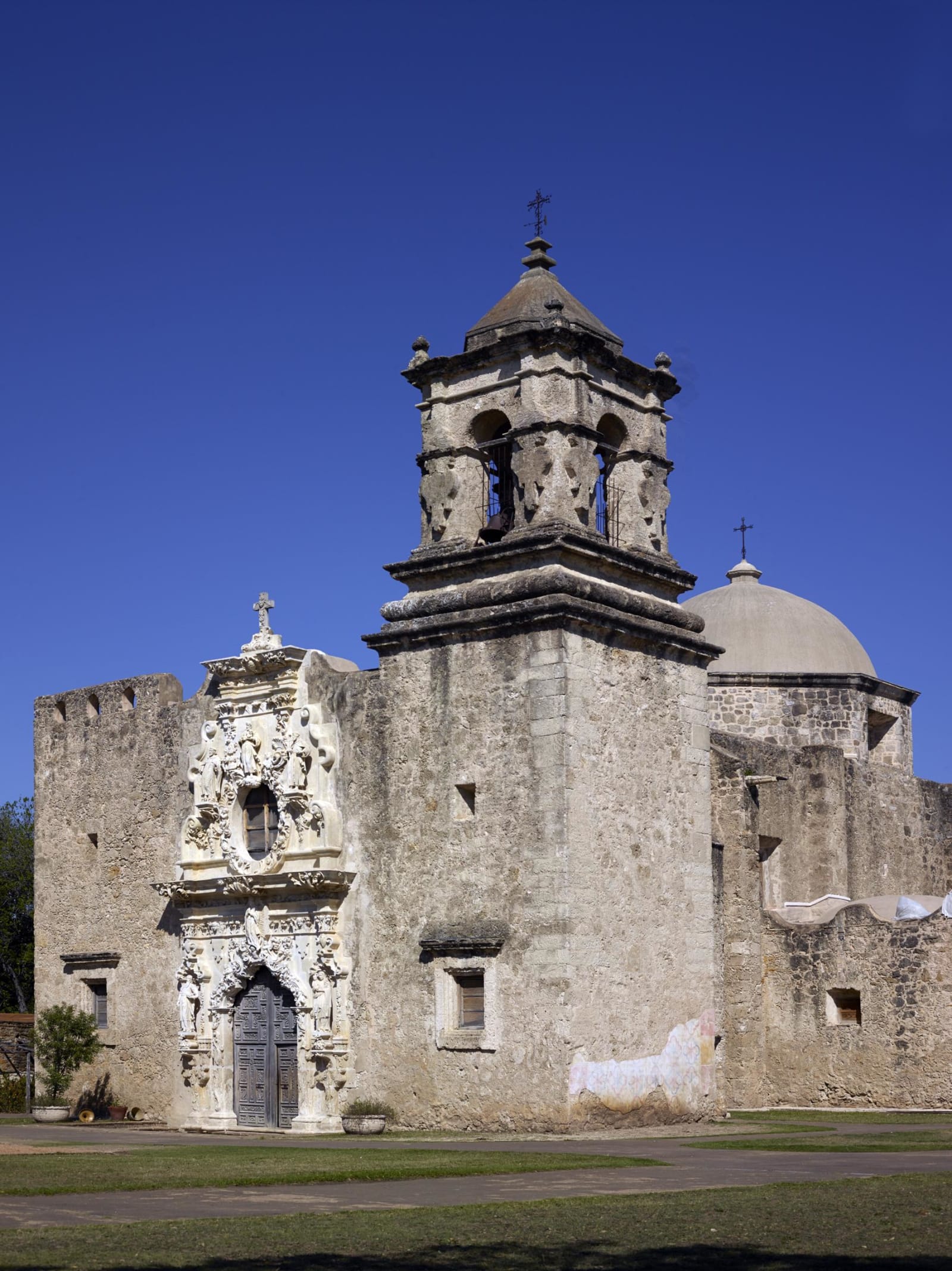
The stone bell tower, carved entrance and dome of the church at Mission San Jose in San Antonio under a clear sky.Carol M. Highsmith / public domain via the Library of Congress
🏛️Historical

San Antonio Missions National Historical Park

Part ofSan Antonio & the Missions

Four working parish churches on the Mission Trail south of downtown, with the visitor center at Mission San Jose, the Queen of the Missions, and the descendants who still worship there.

⏱
Duration
An hour or two at San José; half a day to a full day for all four missions by car or bike.
🎟
Admission
Free; no entrance pass is required.
📅
Best Season
Year round; spring and fall are cooler for the trail. Visitor center open daily 9 a.m. to 5 p.m.; grounds sunrise to sunset. Closed Thanksgiving, Christmas and New Year's Day.

The Story

San Antonio Missions National Historical Park strings four Spanish mission communities along the eight-mile Mission Trail south of downtown: Concepción, San José, San Juan and Espada. With the Alamo, the Rancho de las Cabras and the acequias, they make up the San Antonio Missions World Heritage Site, inscribed in 2015 and still the only one in Texas. All four churches are active Catholic parishes, and the National Park Service describes the missions as communities, schools, workplaces, churches and now sacred burial grounds.

Start at Mission San José, where the park visitor center, museum and film are. Antonio Margil de Jesús asked for the mission in December 1719, and it was founded in 1720 for about 240 Pampopa, Pastia and Sulujam people. At its height in 1768, 350 people lived inside its stone walls, each family in a room and kitchen built into the wall. The church begun that year earned San José its name as the Queen of the Missions. Its dome and roof fell in December 1868, and the church, walls and granary were rebuilt from 1932 with Works Progress Administration help, so San José is the most restored of the four. The carved sacristy window known as the Rose Window was restored between 1947 and 1952.

The builders were Indigenous South Texans from many bands, collectively called Coahuiltecans. Some came for food and protection; some fled and were forced back. Their descendants still baptize, marry and pray at these churches, and the park exhibit We're Still Here records their memories of growing up behind the mission walls.

Visitor Info

⏱
Time Needed
An hour or two at San José; half a day to a full day for all four missions by car or bike.
🎟
Admission
Free; no entrance pass is required.
📅
Best Season
Year round; spring and fall are cooler for the trail. Visitor center open daily 9 a.m. to 5 p.m.; grounds sunrise to sunset. Closed Thanksgiving, Christmas and New Year's Day.
🛣️
Highway
Loop 410 / Roosevelt Avenue

On the Map

Nearby

The closest stops worth working into your route

historical2.2 mi away
Mission Concepción
A stone church dedicated in 1755 that has never fallen into ruin, its convento ceilings still painted, and the ground where the Texas Revolution's fight for San Antonio began.
historical2.4 mi away
Mission San Juan
The mission near the river bend where the San Antonio got its name in 1691, with an unfinished church foundation and farm fields still watered by an eighteenth-century acequia.
historical3.4 mi away
Mission Espada and the Espada Aqueduct
The southernmost San Antonio mission and the oldest Spanish aqueduct in the United States, still carrying river water over Sixmile Creek to the fields after nearly three centuries.
architectural3.8 mi away
King William Historic District
Mission farmland turned German merchants' quarter on the San Antonio River, renamed in World War I, then saved by a neighbor who restored fourteen houses, starting with his own.
historical4.2 mi away
La Villita Historic Arts Village
The little village across the river from the presidio, where Cos surrendered San Antonio in 1835, rebuilt by Depression-era youth crews as a working crafts village.
architectural4.2 mi away
San Antonio River Walk
A Depression-era park one level below downtown, built because San Antonio refused to pave its river after the 1921 flood, and designed by an architect the project later fired.

Historical markers nearby

Roadside plaques and monuments within a short detour

Marker1.7 mi away
Stinson Airport
San Antonio
Marker1.7 mi away
Mission San Franscico Xavier de Najera
San Antonio
Marker2.5 mi away
Edward H. White II Memorial Hangar, Brooks Air Force Base
San Antonio
Marker2.5 mi away
Mission San Juan Capistrano
San Antonio
Marker2.6 mi away
Old Mill on the Pajalache Acequia
San Antonio
Marker3.2 mi away
Salado Valley
San Antonio