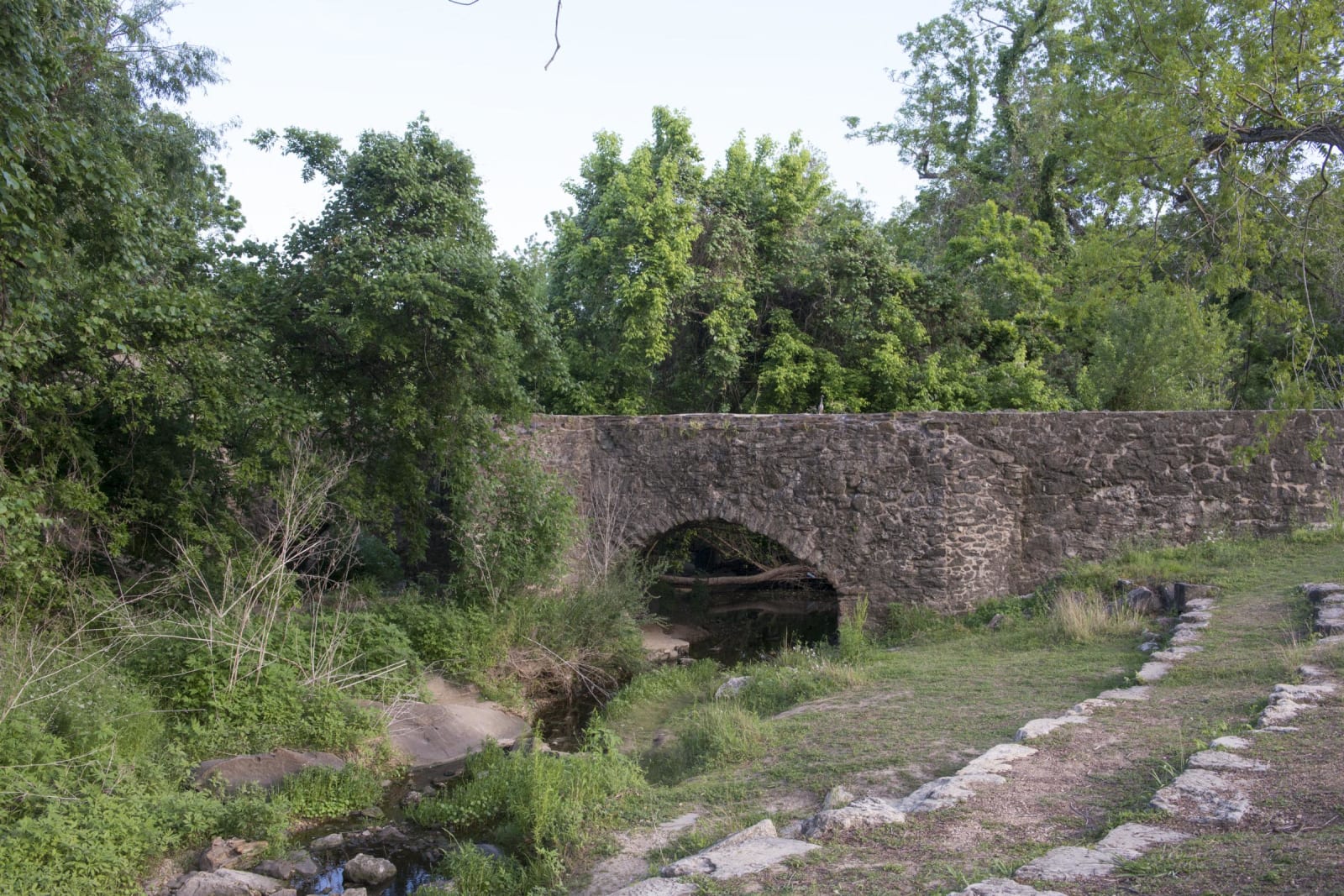
 Carol M. Highsmith / public domain via the Library of Congress
The Story
Espada traces its line to Mission San Francisco de los Tejas, founded in 1690 near present Weches among the Nabedache people, who resisted the missionaries' rules; the friars abandoned it in 1693. Refounded on the San Antonio River in 1731 as San Francisco de la Espada, the mission was made over by contract to the Pacao people. Life here was precarious. Fear of Lipan Apache raids emptied it of all 230 residents in 1737, and smallpox and measles killed many who came back in 1739.
Water was its achievement. Spanish craftsmen and Indigenous laborers built a 270-foot dam across the river and, between 1740 and 1745, the Espada Aqueduct, two arches and a pier carrying the acequia over Sixmile Creek, once called Piedras Creek. It is the oldest Spanish aqueduct in the United States, and water still crosses it on the way south to the mission fields; the Espada acequia is the oldest such ditch still in continuous irrigation use. The San Antonio Conservation Society bought the land around the aqueduct in 1941, and it was named a National Historic Landmark in 1965.
At secularization in 1794 the lands were divided among fifteen mostly old and lame residents. Father Francis Bouchu, pastor from 1858 to 1907, rebuilt much of the compound, and the church is an active parish. Descendant families still gather here; one remembers Christmas at Espada with piñatas, chocolate and galletas. The aqueduct, on Espada Road north of the mission, has its own small parking area.
Visitor Info
On the Map
Nearby
The closest stops worth working into your route
Historical markers nearby
Roadside plaques and monuments within a short detour