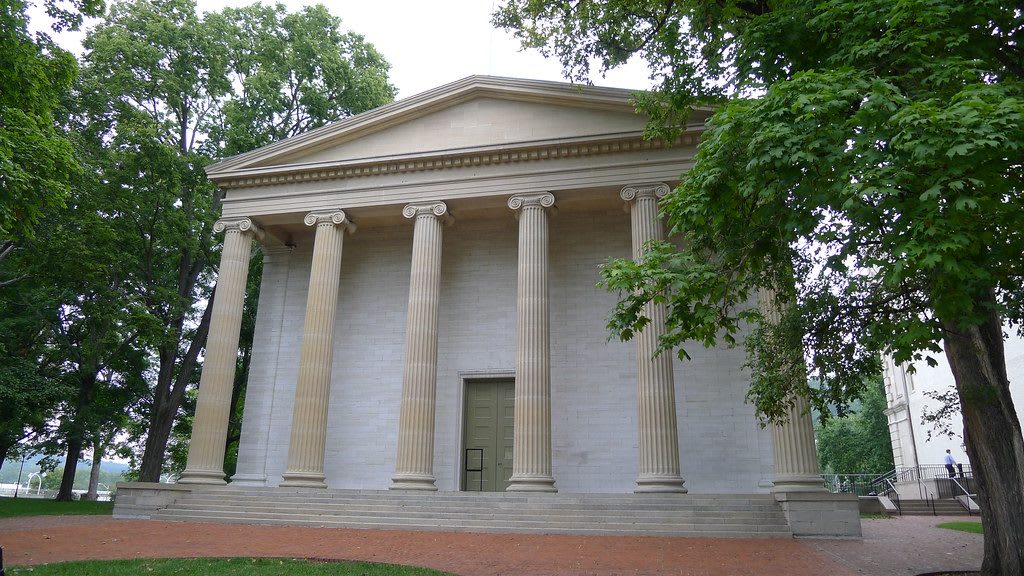
 Lee Wright / CC BY-SA 2.0 via Flickr
The Story
Gideon Shryock was a Lexington architect of about 25, with no building of his own yet to show, when the legislature voted in 1827 for a new capitol and took his design. He gave Kentucky a Greek Revival temple front modeled on the Temple of Minerva Polias at Priene, with no windows on the facade, and inside a self-supporting stone stairway rising beneath a domed lantern that lets in daylight. The General Assembly met here from 1830 to 1910.
The building's darkest day came out of the disputed governor's race of 1899. On January 30, 1900, William Goebel, the Democratic claimant, was shot on his way into the capitol, and a plaque near the front entrance marks where he fell. By then state government had outgrown the hall. In 1904 the legislature confirmed Frankfort, over Lexington and Louisville, as the capital and paid for the present Capitol in south Frankfort, dedicated in 1910, which is closed for renovation until about 2029 while its grounds stay open.
The Kentucky Historical Society has used the old building as a museum since 1920 and restored it to its Civil War-era appearance, and it became a National Historic Landmark in 1971. Short guided tours run most days. The society's Thomas D. Clark Center for Kentucky History stands on the same street, home to its A Kentucky Journey exhibit, and the 1850 State Arsenal nearby holds the Kentucky Military History Museum. Downtown Frankfort is small enough to see all three on foot.
Visitor Info
On the Map
Nearby
The closest stops worth working into your route
Historical markers nearby
Roadside plaques and monuments within a short detour