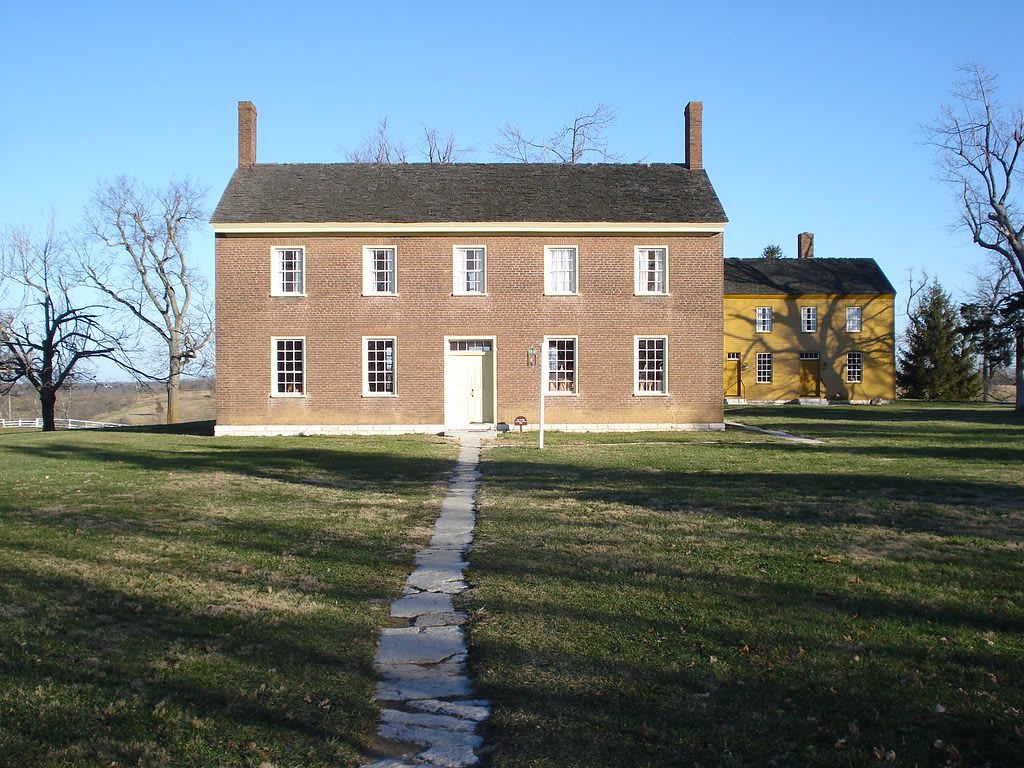
 Timothy Brown / CC BY 2.0 via Flickr
The Story
Three Shaker missionaries walked from New York to Kentucky in 1805, and their first converts here, Elisha Thomas and Samuel and Henry Banta, gathered on Thomas's 140-acre Mercer County farm. Forty-four believers signed the first family covenant in December 1806, and two years later they moved to this hilltop and named it Pleasant Hill. The United Society of Believers in Christ's Second Appearing held property in common, lived celibate lives and taught the equality of women and men and of the races. By 1823 there were 491 members on about 4,500 acres.
Over 105 years they raised more than 260 structures, among them one of Kentucky's earliest municipal water systems, and from 1816 they shipped brooms, preserves and seeds down the rivers to New Orleans. They opposed slavery and bought enslaved people in order to free them, which angered their neighbors, and a mob attacked the village in 1825. As pacifists in a divided border state they would not fight, yet they fed thousands of hungry soldiers from both armies in the weeks around the Battle of Perryville in 1862. Debt and an aging membership ended the society in 1910, and the last Pleasant Hill Shaker, Sister Mary Settles, died in 1923.
The Meeting House became a Baptist church and the Farm Deacon's Shop a gas station before a nonprofit formed in 1961 to buy back and restore the village, and U.S. 68 was rerouted around it in 1965. Today 34 original buildings stand on about 2,800 acres reaching down to the Kentucky River, and the village is a National Historic Landmark District.
Visitor Info
On the Map
Nearby
The closest stops worth working into your route
Historical markers nearby
Roadside plaques and monuments within a short detour