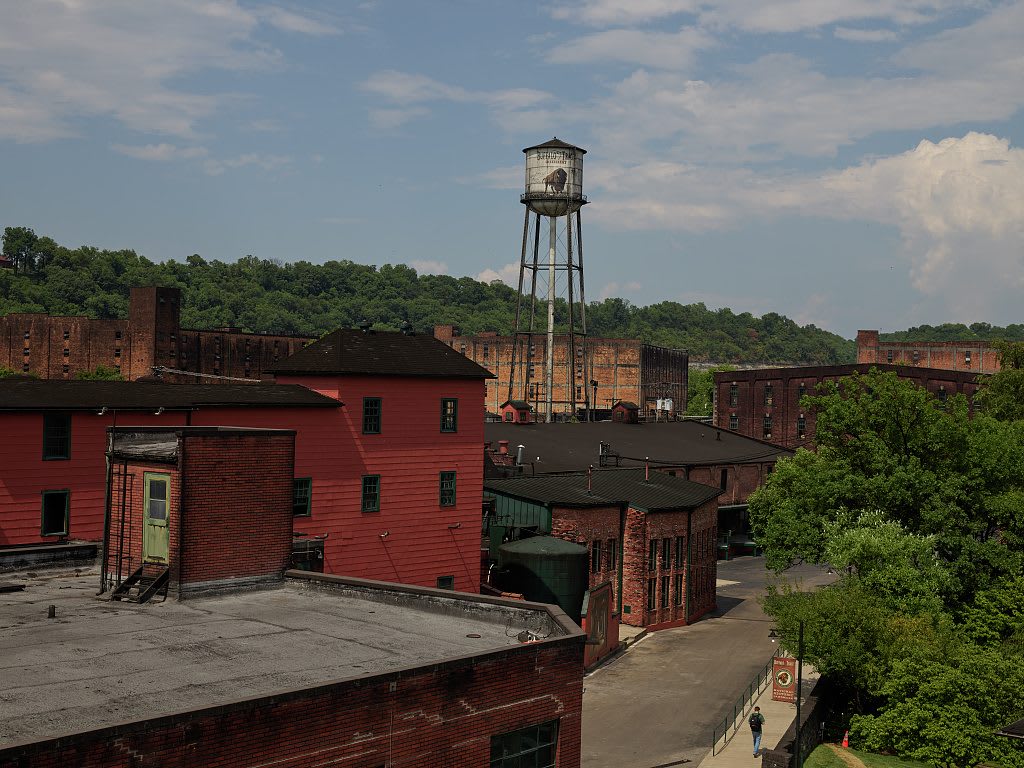
 Carol M. Highsmith / public domain via Library of Congress
The Story
The name comes from the buffalo trace, the ancient animal trackway that crossed the Kentucky River here in Franklin County. The distillery dates whiskey-making on the site to 1775, when, by its account, Hancock Lee and his brother Willis distilled here, and Harrison Blanton put up the first distillery building in 1812. In 1870 Edmund H. Taylor Jr. bought the works and named it the Old Fire Copper, or O.F.C., Distillery, and eight years later he sold it to George T. Stagg.
Stagg's name stayed on the place for more than a century. In 1886 he put steam heat into the storage warehouses, the first climate-controlled warehouses for aging whiskey in the country, and during Prohibition the distillery was allowed to keep making whiskey for medicinal use. The Sazerac Company bought it in 1992, and in 1999 the distillery and a new bourbon both took the name Buffalo Trace. Listed as the George T. Stagg Distillery, it was named a National Historic Landmark in 2013, and the company calls it the oldest continuously operating distillery in the United States. In 2016 workers renovating a building found the foundations of the 1873 distillery, which burned in 1882, and left them open to visitors.
The river shapes the place. In April 2025 it rose above 48 feet at Frankfort and flooded much of the campus, the second-highest water in the distillery's history. Free tours with tastings run daily, with reservations recommended, and the warehouses along the river are worth a slow look on their own.
Visitor Info
On the Map
Nearby
The closest stops worth working into your route
Historical markers nearby
Roadside plaques and monuments within a short detour