Home / Kentucky / Lexington, Frankfort & the Bluegrass / Cheapside and Henry A. Tandy Centennial Park
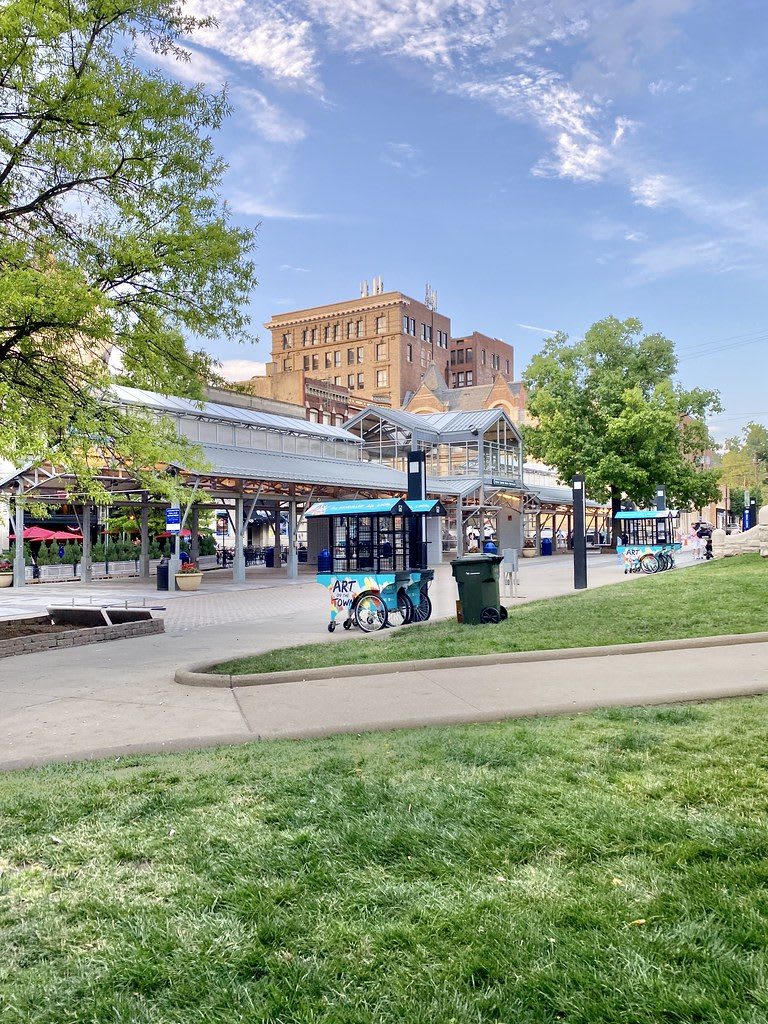
The open-sided market pavilion and lawn at Cheapside in downtown Lexington, with brick buildings behind.Warren LeMay / CC BY-SA 2.0 via Flickr
🏛️Historical

Cheapside and Henry A. Tandy Centennial Park

Part ofLexington, Frankfort & the Bluegrass
On this driveOld Frankfort Pike: Lexington to Frankfort through the Horse Farms

Lexington's old courthouse square, for decades the center of Kentucky's slave trade, renamed in 2020 for Henry A. Tandy, a formerly enslaved builder.

⏱
Duration
Twenty to forty minutes.
🎟
Admission
Free; an open public park.
📅
Best Season
Year round; the Lexington Farmers Market uses the park.

The Story

For decades before the Civil War, the public square beside the Fayette County courthouse was the center of Kentucky's slave trade. The market called Cheapside, an old English word for a marketplace, sold enslaved people alongside goods and produce, and thousands of Kentuckians were sold here. The Fayette Circuit Court ordered sales to settle debts, estates sold people who had not been willed to heirs, and enslavers sold those they counted as surplus. Newspaper advertisements named some of them: Sallie, a 42-year-old cook, and Lize, 23, sold with her infant child. An 1845 deed records the sale of a man called Bill.

Traders Silas Marshall, William Talbott and Lewis Robards kept pens and holding jails near the block and dealt with buyers in New Orleans, Memphis and Natchez, so a sale here often meant being sent down the rivers to the Deep South, where prices ran higher. Young women of mixed ancestry were sold here as "fancy girls," a trade in sexual slavery. In 1846 Robert Todd, father of Mary Todd Lincoln, bought five people at Cheapside. A whipping post stood nearby from 1847.

In 2003 the Lexington Alumni Chapter of Kappa Alpha Psi dedicated state historical marker 2122 at Short and Upper streets for the auction block. The city council voted in 2017 to remove two Confederate statues from the square, and after a campaign by the Take Back Cheapside group it renamed the park in 2020 for Henry A. Tandy, a formerly enslaved man who became a builder; his company laid the brick beneath the courthouse's stone facade.

Visitor Info

⏱
Time Needed
Twenty to forty minutes.
🎟
Admission
Free; an open public park.
📅
Best Season
Year round; the Lexington Farmers Market uses the park.
🛣️
Highway
Main Street

On the Map

Nearby

The closest stops worth working into your route

historical1.6 mi away
Ashland, the Henry Clay Estate
Henry Clay's Lexington estate, rebuilt by his son in the 1850s, where the guided tours now tell the lives of the more than 140 people Clay enslaved.
cultural7.2 mi away
Kentucky Horse Park
The state's 1,224-acre horse farm and museum north of Lexington, where the great jockey Isaac Burns Murphy is buried near Man o' War.
natural12 mi away
Raven Run Nature Sanctuary
Lexington's largest park, more than 700 acres of woods, meadow and stone fences where Raven Run Creek drops through the Kentucky River Palisades.
historical16 mi away
Fort Boonesborough State Park
The Transylvania Company's 1775 fort on the Kentucky River, built on country the Shawnee hunted, and the site of the Shawnee siege of September 1778.
historical18 mi away
Camp Nelson National Monument
The 1863 Union depot above the Kentucky River where more than 10,000 enslaved men enlisted in the U.S. Colored Troops and their families fought for a place to live.
historical21 mi away
Shaker Village of Pleasant Hill
The hilltop Shaker community of 1806-1910 in Mercer County, with 34 original buildings, a working farm and preserve trails to the Kentucky River.

Historical markers nearby

Roadside plaques and monuments within a short detour

Marker0 mi away
Silversmith Shop
Lexington
Marker0.1 mi away
First Inauguration
Lexington
Marker0.1 mi away
African-American Physicians
Lexington
Marker0.1 mi away
First Presbyterian Church
Lexington
Marker0.1 mi away
Henry Clay's Law Office
Lexington
Marker0.2 mi away
Lexington, 1850-1875
Lexington