Home / Kentucky / Lexington, Frankfort & the Bluegrass / Ashland, the Henry Clay Estate
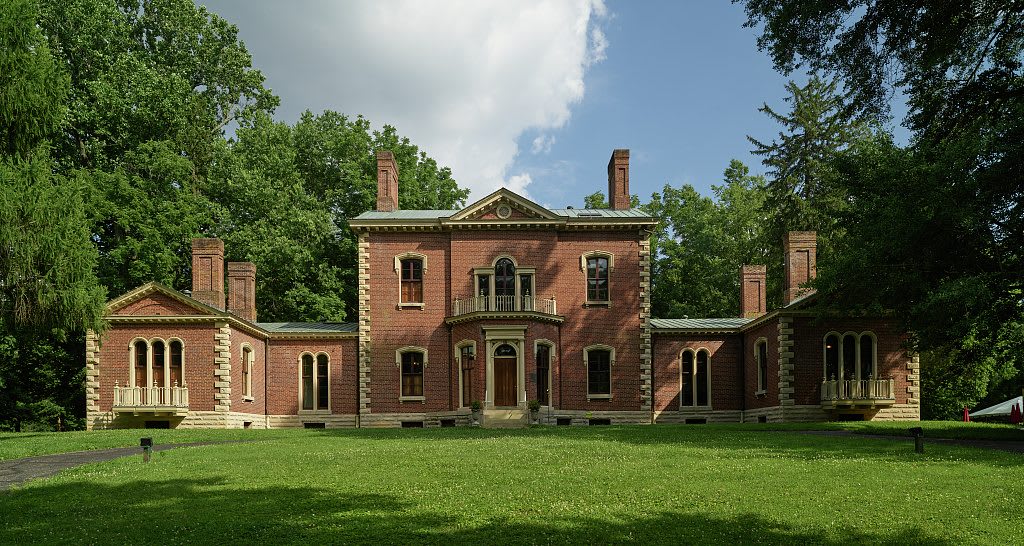
A two-story red brick Italianate mansion with a central pediment and two side wings, set back across a wide lawn among tall trees.Carol M. Highsmith / public domain via Library of Congress
🏛️Historical

Ashland, the Henry Clay Estate

Part ofLexington, Frankfort & the Bluegrass

Henry Clay's Lexington estate, rebuilt by his son in the 1850s, where the guided tours now tell the lives of the more than 140 people Clay enslaved.

⏱
Duration
One to two hours.
🎟
Admission
Guided mansion tours $25 adults, $15 students 6 through college, free under 5; the grounds are open to walk (Ashland, 2026).
📅
Best Season
March to December. The mansion is open Tuesday to Sunday and closed Mondays and all of January and February (Ashland, 2026).

The Story

Henry Clay began buying land on the edge of Lexington in 1804 and built a Federal-style house here soon after, with wings added by Benjamin Latrobe. The farm grew past 600 acres of hemp, livestock and Thoroughbreds, and it was the people Clay enslaved who built its buildings, worked its fields and cooked and cleaned in the house. Over his life Clay enslaved more than 140 people, about 60 of them at Ashland at a time. The unstable old house was razed in 1854 by his son James B. Clay, who had Thomas Lewinski design the present Italianate house on the same footprint.

Aaron Dupuy, Clay's valet and coachman, married Charlotte in 1806, and Clay paid $450 for her. In 1829, living with the Clays in Washington, Charlotte Dupuy sued Clay, then Secretary of State, for her freedom and her children's. She lost, was jailed and sent to New Orleans, and was freed only in 1840; her son Charles in 1844. Her grandson Henry was sold at 15. Lewis Richardson escaped in 1846 after a lashing for returning an hour late from visiting his wife, and in Ontario he told what life at Ashland was like. Tom Todd, a shoemaker, took his own life in 1844.

The Henry Clay Memorial Foundation opened the house in 1950, and it is a National Historic Landmark. The main tour treats slavery as the defining issue of Clay's life, and the Traces tour, the first guided slavery tour in Kentucky, takes visitors to the places where enslaved people lived and worked on the 17 acres that remain.

Visitor Info

⏱
Time Needed
One to two hours.
🎟
Admission
Guided mansion tours $25 adults, $15 students 6 through college, free under 5; the grounds are open to walk (Ashland, 2026).
📅
Best Season
March to December. The mansion is open Tuesday to Sunday and closed Mondays and all of January and February (Ashland, 2026).
🛣️
Highway
Richmond Road (US 25)

On the Map

Nearby

The closest stops worth working into your route

historical1.6 mi away
Cheapside and Henry A. Tandy Centennial Park
Lexington's old courthouse square, for decades the center of Kentucky's slave trade, renamed in 2020 for Henry A. Tandy, a formerly enslaved builder.
cultural8.7 mi away
Kentucky Horse Park
The state's 1,224-acre horse farm and museum north of Lexington, where the great jockey Isaac Burns Murphy is buried near Man o' War.
natural11 mi away
Raven Run Nature Sanctuary
Lexington's largest park, more than 700 acres of woods, meadow and stone fences where Raven Run Creek drops through the Kentucky River Palisades.
historical15 mi away
Fort Boonesborough State Park
The Transylvania Company's 1775 fort on the Kentucky River, built on country the Shawnee hunted, and the site of the Shawnee siege of September 1778.
historical17 mi away
Camp Nelson National Monument
The 1863 Union depot above the Kentucky River where more than 10,000 enslaved men enlisted in the U.S. Colored Troops and their families fought for a place to live.
historical20 mi away
Shaker Village of Pleasant Hill
The hilltop Shaker community of 1806-1910 in Mercer County, with 34 original buildings, a working farm and preserve trails to the Kentucky River.

Historical markers nearby

Roadside plaques and monuments within a short detour

Marker0 mi away
Ashland
Lexington
Marker0 mi away
Madeline M. Breckinridge
Lexington
Marker0.3 mi away
Mentelle Park
Lexington
Marker0.8 mi away
Clay Villa, ca. 1845
Lexington
Marker0.9 mi away
Second Presbyterian Church
Lexington
Marker1.1 mi away
Pope Villa
Lexington