 Sharon Mollerus / CC BY 2.0 via Wikimedia Commons
The Story
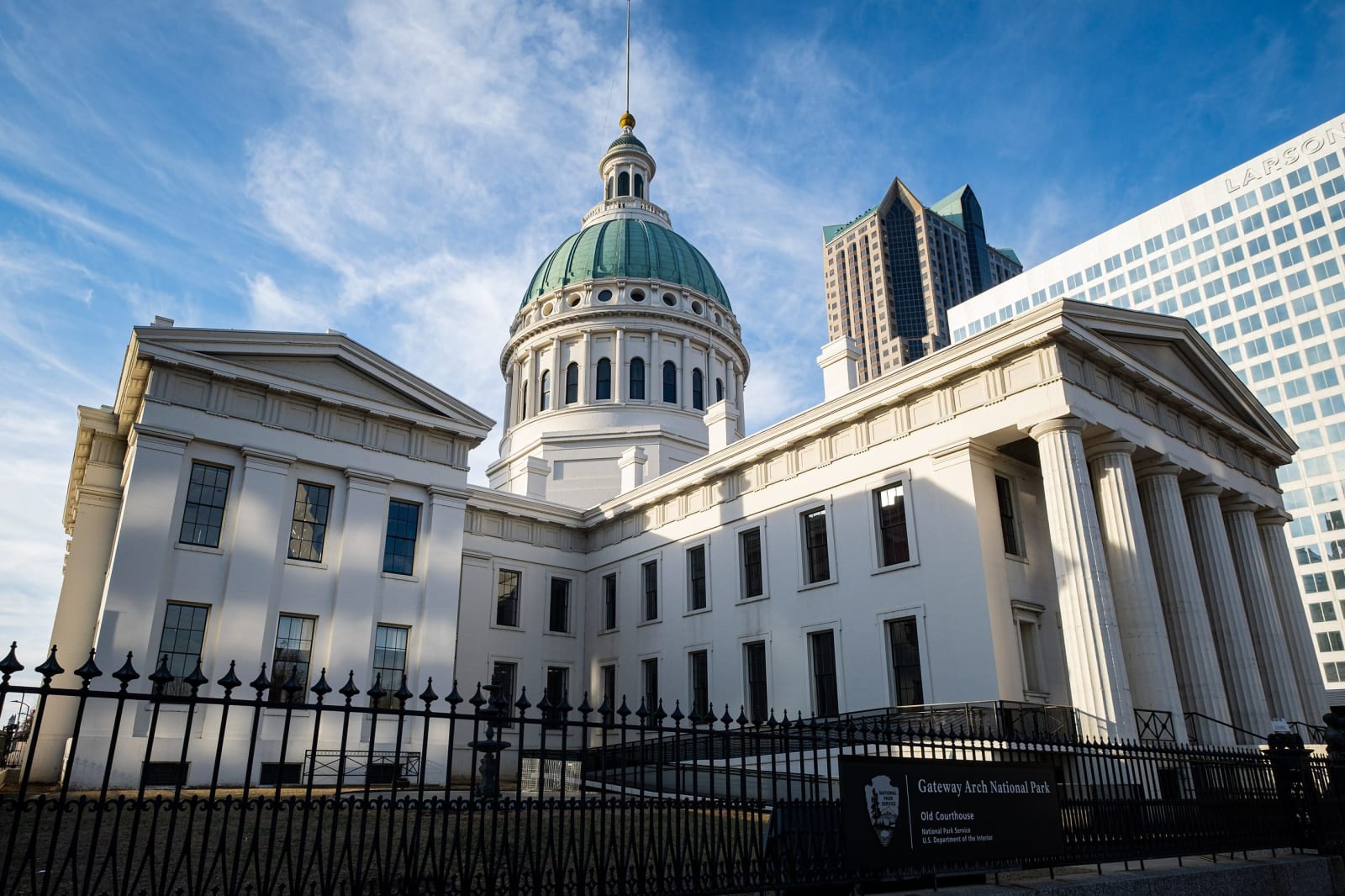
Enslaved people were sold at the east door of this courthouse in the settlement of estates, the last time in 1861, and in the same building more than three hundred enslaved people sued for their freedom between 1812 and 1865. Missouri law, built on a territorial statute of 1807, let a person held in bondage petition to sue if they had been taken onto free soil, freed by a will or a purchase, or born to a mother who was not legally enslaved. The burden of proof was theirs, and fewer than half won. Lucy Delaney was seventeen when she sued here in 1844.
On April 6, 1846, Dred and Harriet Scott filed suit against Irene Emerson. Dred Scott had been born enslaved in Virginia around 1799 and brought to St. Louis by the Blow family, who sold him to John Emerson, an army surgeon. Emerson took him to posts in Illinois and the Wisconsin Territory, where slavery was barred, and at Fort Snelling he married Harriet Robinson. The first two trials, in 1847 and 1850, were heard here. After nearly eleven years of litigation the Supreme Court ruled against the Scotts in 1857, holding that no African American could be a citizen.
The building was finished under its cast-iron dome in 1864, and in the 1870s it heard Virginia Minor's case for a woman's right to vote. After a $24.5 million renovation it reopened on May 3, 2025, with two restored courtrooms and four new galleries, two of them on Black St. Louis and on the Scotts' case.
Visitor Info
On the Map
A story featuring this place
Go deeper into the history and character of this stop
Nearby
The closest stops worth working into your route
Historical markers nearby
Roadside plaques and monuments within a short detour