Home / Missouri / St. Louis & the Confluence / Gateway Arch National Park
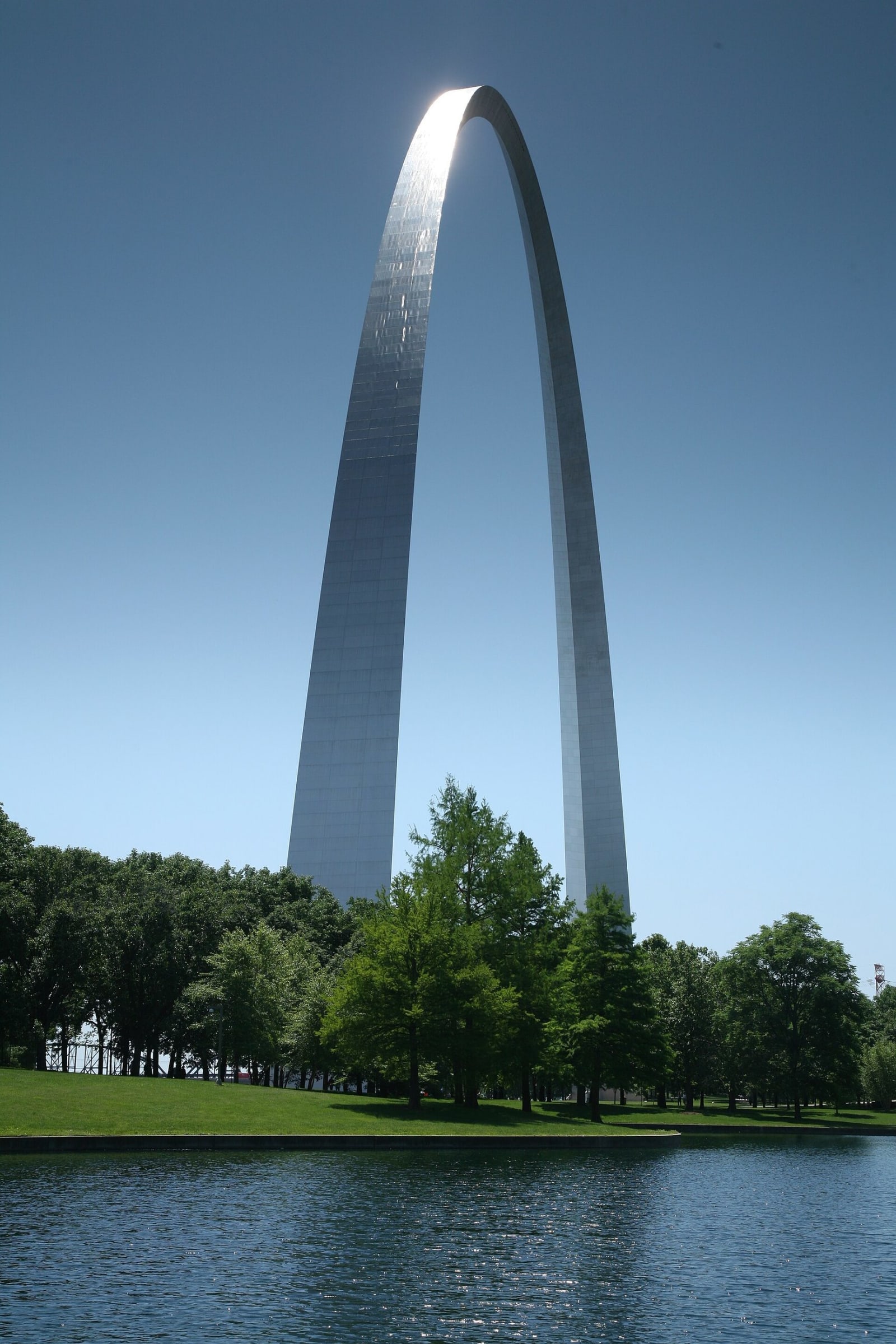
The stainless steel Gateway Arch rising above a line of trees and reflected in a park pond.Daniel Schwen / CC BY-SA 4.0 via Wikimedia Commons
🏗️Architectural

Gateway Arch National Park

Part ofSt. Louis & the Confluence
On this driveThe Great River Road: Hannibal to Ste. Genevieve

Saarinen's 630-foot steel arch on the ground of the old French town, forty blocks razed for it after a rigged bond vote, with a free museum under its legs.

⏱
Duration
Two to three hours with the tram ride.
🎟
Admission
Museum free. Tram ride to the top $15 to $19 for adults depending on the day, by timed ticket.
📅
Best Season
Year-round; the visitor center is open 9 a.m. to 6 p.m.

The Story

The Arch stands on the site of the original French town of St. Louis, and nothing of that town is left. In the 1930s civic leaders proposed clearing the old riverfront for a memorial to westward expansion. Voters approved a $7.5 million bond issue on September 10, 1935, in an election later shown to have been rigged, and that year a Roosevelt executive order set aside forty city blocks. The clearing, meant to be done by 1942, took 486 buildings, among them Manuel Lisa's Old Rock House of 1818, whose site lies under the north stairs.

Eero Saarinen's design won the 1947-48 competition among 172 entries, but excavation did not begin until February 1961, and the first steel section went up on February 12, 1963. On July 14, 1964, Percy Green and Richard Daly of the Congress of Racial Equality climbed partway up a leg to protest the hiring practices that kept Black contractors off the job, and were arrested after four hours. The last section was set on October 28, 1965. The Arch is 630 feet tall and 630 feet wide at its base, and Dick Bowser's trams, each a string of eight five-seat capsules, still tip and level their way to the top.

The museum under the legs reopened in July 2018 with a new entrance facing the Old Courthouse, the same year Congress renamed Jefferson National Expansion Memorial as Gateway Arch National Park. The museum is free. The tram ride takes forty-five minutes to an hour, involves 96 steps, and sells out on busy days.

Visitor Info

⏱
Time Needed
Two to three hours with the tram ride.
🎟
Admission
Museum free. Tram ride to the top $15 to $19 for adults depending on the day, by timed ticket.
📅
Best Season
Year-round; the visitor center is open 9 a.m. to 6 p.m.
🛣️
Highway
I-44/I-55/I-64/I-70

On the Map

Nearby

The closest stops worth working into your route

historical0.2 mi away
Old Courthouse
The courthouse where enslaved people were auctioned at the east door and where Dred and Harriet Scott and some three hundred others sued for their freedom.
cultural1.8 mi away
Scott Joplin House State Historic Site
The Delmar Boulevard flat where Scott Joplin lived after the Maple Leaf Rag made him famous and wrote The Entertainer, saved by Black St. Louis and kept as a state site.
historical3.6 mi away
Mary Meachum Freedom Crossing
A riverbank on the St. Louis Riverfront Trail where, in May 1855, the widow Mary Meachum tried to get nine enslaved people across the Mississippi to Illinois, Missouri's first Network to Freedom site.
architectural3.9 mi away
Cathedral Basilica of Saint Louis
A Romanesque and Byzantine cathedral on Lindell Boulevard begun in 1907, whose mosaics took until 1988 to finish and now hold 41.5 million tesserae.
natural4 mi away
Missouri Botanical Garden
Henry Shaw's 1859 garden in south St. Louis, with his 1849 country house, the geodesic Climatron of 1960 and a Japanese garden laid around a four-acre lake.
architectural9.6 mi away
Old Chain of Rocks Bridge
A mile-long 1929 truss bridge over the Mississippi with a 22-degree bend in the middle, once Route 66's bypass around St. Louis and now a walking and cycling crossing to Illinois.

Historical markers nearby

Roadside plaques and monuments within a short detour

Marker12 mi away
Saint Louis
Marker19 mi away
Saint Charles