Home / Missouri / St. Louis & the Confluence / Missouri Botanical Garden
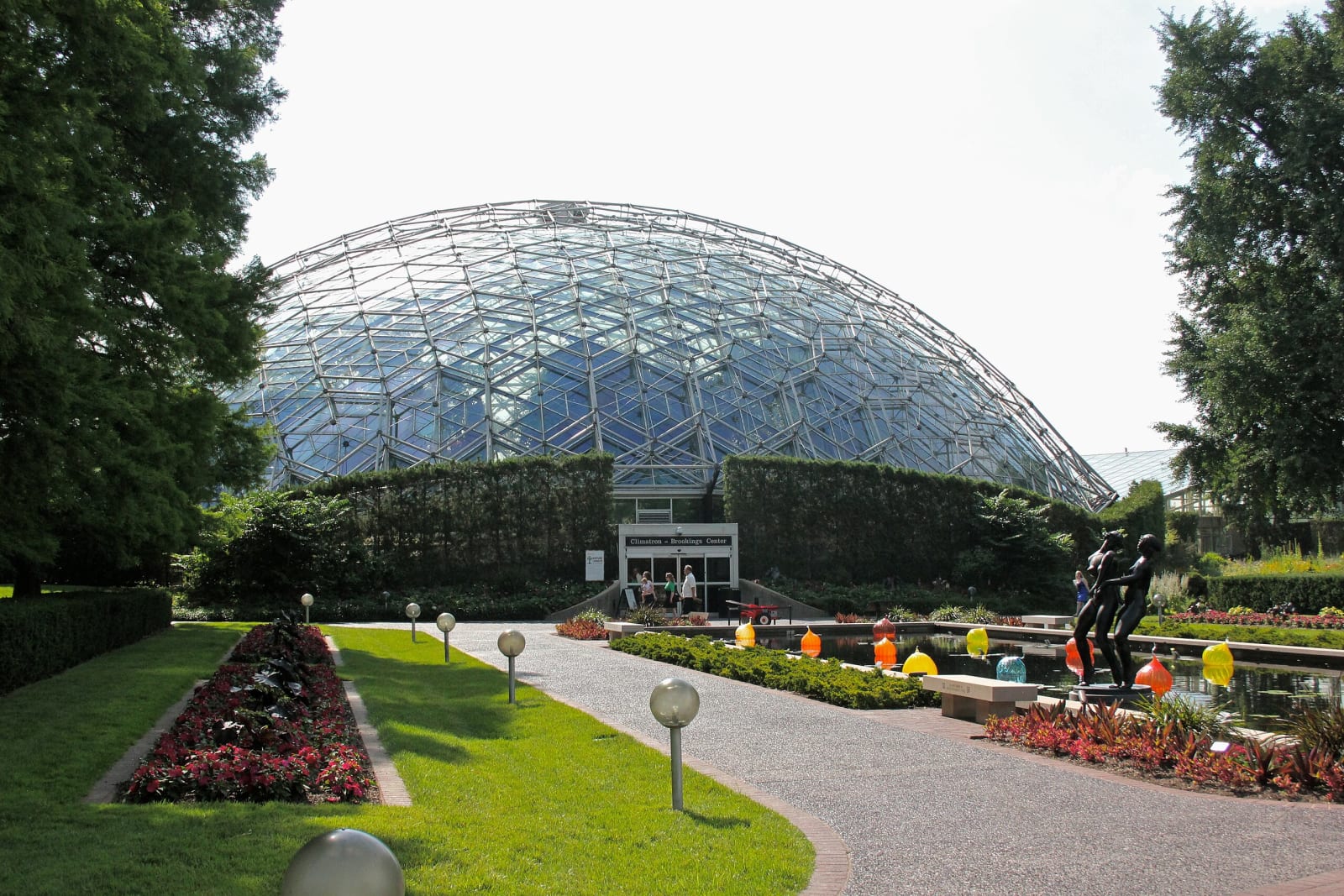
The geodesic glass dome of the Climatron rising behind flower beds and a curving path at the Missouri Botanical Garden.hakkun / CC BY-SA 3.0 via Wikimedia Commons
🌲Natural

Missouri Botanical Garden

Part ofSt. Louis & the Confluence

Henry Shaw's 1859 garden in south St. Louis, with his 1849 country house, the geodesic Climatron of 1960 and a Japanese garden laid around a four-acre lake.

⏱
Duration
Two to three hours.
🎟
Admission
General admission $16 for ages 13 and up, $6 for St. Louis City and County residents, $4 for resident seniors; children 12 and under free. City and County residents get in free on Wednesday and Saturday mornings from 7 a.m. to noon.
📅
Best Season
Year round, 9 a.m. to 5 p.m. daily with last entry at 4:30; closed Thanksgiving and Christmas Day. Spring and early summer for the outdoor gardens.

The Story

Henry Shaw, a British immigrant who reached St. Louis in 1819, began building a garden on his country estate in the 1850s and opened it to the public in 1859, which is why St. Louisans still call it Shaw's Garden. His Italianate country house of 1849, Tower Grove House, designed by George I. Barnett, stands on the grounds. Shaw died in 1889, and his will left the garden to a board of trustees to keep it going.

Shaw also held people in slavery. In 1855 a woman named Esther and her three children, enslaved by Shaw, were among the people who tried to cross the Mississippi with the help of Mary Meachum, and they were captured on the Illinois side. In 2024 Tower Grove House was added to the National Park Service's Underground Railroad Network to Freedom.

The Climatron replaced the old Palm House in 1960. Designed by the St. Louis architects Murphy and Mackey on R. Buckminster Fuller's geodesic principles, it stands 70 feet high and 175 feet across with no interior columns, its weight carried to the ground on five piers. A 22-month renovation from 1988 built a new dome of 2,425 glass panes just inside the original aluminum frame, which was kept, so the building is now a dome within a dome. Seiwa-en, the Japanese garden designed by Koichi Kawana around a four-acre lake, opened in 1977. The garden became a National Historic Landmark in 1976.

Visitor Info

⏱
Time Needed
Two to three hours.
🎟
Admission
General admission $16 for ages 13 and up, $6 for St. Louis City and County residents, $4 for resident seniors; children 12 and under free. City and County residents get in free on Wednesday and Saturday mornings from 7 a.m. to noon.
📅
Best Season
Year round, 9 a.m. to 5 p.m. daily with last entry at 4:30; closed Thanksgiving and Christmas Day. Spring and early summer for the outdoor gardens.
🛣️
Highway
I-44

On the Map

Nearby

The closest stops worth working into your route

architectural2 mi away
Cathedral Basilica of Saint Louis
A Romanesque and Byzantine cathedral on Lindell Boulevard begun in 1907, whose mosaics took until 1988 to finish and now hold 41.5 million tesserae.
cultural2.9 mi away
Scott Joplin House State Historic Site
The Delmar Boulevard flat where Scott Joplin lived after the Maple Leaf Rag made him famous and wrote The Entertainer, saved by Black St. Louis and kept as a state site.
historical3.8 mi away
Old Courthouse
The courthouse where enslaved people were auctioned at the east door and where Dred and Harriet Scott and some three hundred others sued for their freedom.
architectural4 mi away
Gateway Arch National Park
Saarinen's 630-foot steel arch on the ground of the old French town, forty blocks razed for it after a rigged bond vote, with a free museum under its legs.
historical5.7 mi away
Mary Meachum Freedom Crossing
A riverbank on the St. Louis Riverfront Trail where, in May 1855, the widow Mary Meachum tried to get nine enslaved people across the Mississippi to Illinois, Missouri's first Network to Freedom site.
historical6.6 mi away
Ulysses S. Grant National Historic Site
White Haven, the Dent family farm where Grant courted Julia and farmed in the 1850s beside the enslaved people her father held, some of whom the park now names.

Historical markers nearby

Roadside plaques and monuments within a short detour

Marker8.7 mi away
Saint Louis
Marker16 mi away
Saint Charles