Home / Missouri / Ste. Genevieve, Cape Girardeau & the Bootheel / New Madrid Historical Museum
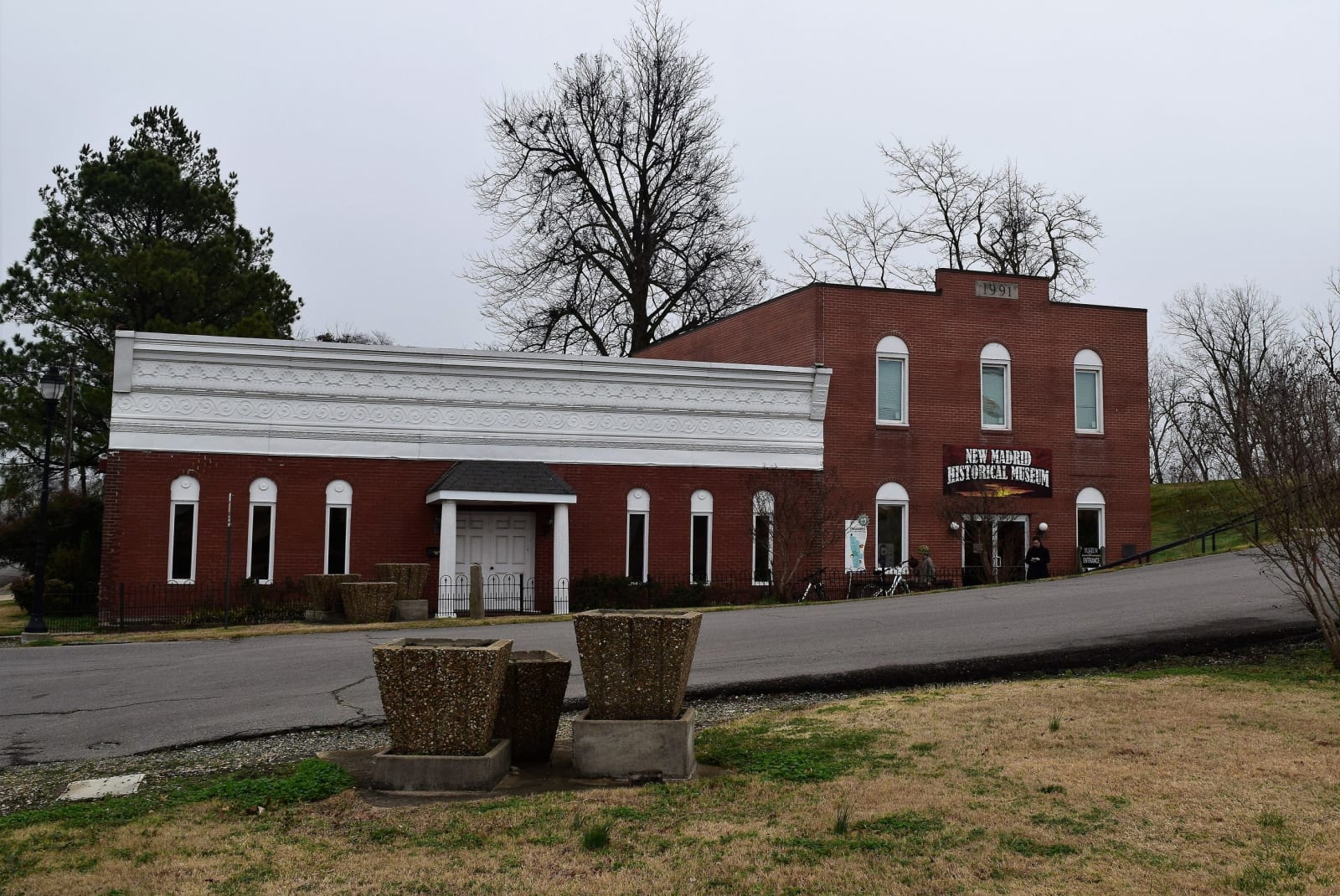
The red brick New Madrid Historical Museum with its arched windows beside a white annex.TheCatalyst31 / CC0 via Wikimedia Commons
๐Ÿœ๏ธGeological

New Madrid Historical Museum

Part ofSte. Genevieve, Cape Girardeau & the Bootheel

A river-town museum in the old Kendall Saloon at the foot of Main Street in New Madrid, centered on the earthquakes of 1811 and 1812 and the seismic risk the town still lives with.

โฑ
Duration
One hour.
๐ŸŽŸ
Admission
Adults $5, students under 18 $3, children 6 and under free, per the museum.
๐Ÿ“…
Best Season
Year-round. Open daily: April through November 9 a.m. to 5 p.m. Monday to Saturday and noon to 5 Sunday; December through March 10 to 4 and Sunday noon to 4.

The Story

The first great shock struck at about 2:15 in the morning on December 16, 1811, centered in northeast Arkansas, at a magnitude the US Geological Survey puts near 7.5. A large aftershock followed at dawn. On January 23, 1812, a quake of about 7.3 centered on New Madrid itself, and on February 7 a third, near 7.5, broke along the Reelfoot fault in Missouri and Tennessee and destroyed the town. By mid-March more than 200 moderate to large aftershocks had been counted. Sand blows, fissures and sinks opened in the ground, bluffs slid, the land dropped as much as six meters where Reelfoot Lake formed, and waves on the Mississippi made the river look as if it ran upstream. Damaging shaking covered some 600,000 square kilometers. In New Madrid, only one life was recorded lost to falling buildings.

The museum stands in the former Kendall Saloon at the foot of Main Street, on the river. Its earthquake exhibit covers the damage of 1811 and 1812 and the hazard that remains, for the central United States is still at risk of large quakes and the ground here still shakes. Other rooms hold hundreds of Mississippian objects, from pottery and jewelry to stone tools and points, and tell of the Lilbourn Fortified Village Site south of town, of the fall of Island No. 10 in the river during the Civil War, of the two world wars and of daily life in the town, down to a kitchen that was state of the art in 1910.

Visitor Info

โฑ
Time Needed
One hour.
๐ŸŽŸ
Admission
Adults $5, students under 18 $3, children 6 and under free, per the museum.
๐Ÿ“…
Best Season
Year-round. Open daily: April through November 9 a.m. to 5 p.m. Monday to Saturday and noon to 5 Sunday; December through March 10 to 4 and Sunday noon to 4.
๐Ÿ›ฃ๏ธ
Highway
US-61/I-55

On the Map

Stories

A story featuring this place

Go deeper into the history and character of this stop

History
Who Lived on the Shaking Ground
Open Road Guide ยท 3 min read

Nearby

The closest stops worth working into your route

natural13 mi away
Big Oak Tree State Park
The last piece of the Bootheel's old bottomland forest, saved in 1938 with schoolchildren's dimes, with a cypress swamp and trees that top 130 feet.
historical18 mi away
Towosahgy State Historic Site
A fortified Mississippian town in the Bootheel fields of Mississippi County, with seven earthen mounds around a plaza and a modern name meant to approximate the Osage and Quapaw words for old town.
industrial56 mi away
Bollinger Mill State Historic Site
A four-story mill of 1867 on an 1825 stone foundation on the Whitewater River, beside Missouri's oldest covered bridge, where farmers broke down the toll gates in 1906.
historical59 mi away
Trail of Tears State Park
Rugged river hills north of Cape Girardeau where nine of the thirteen Cherokee detachments crossed the Mississippi in the winter of 1838 and 1839, and where floating ice left them camped on both banks.
natural85 mi away
Big Spring (Ozark National Scenic Riverways)
A spring at the foot of a dolomite bluff south of Van Buren averaging about 289 million gallons a day into the Current River, dissolving out a cave as it flows, beside a CCC lodge.
historical94 mi away
Battle of Pilot Knob State Historic Site (Fort Davidson)
The hexagonal earthwork in the Arcadia Valley where some 1,500 Union defenders broke Sterling Price's assault in September 1864, then slipped out at night and blew the magazine behind them.

Historical markers nearby

Roadside plaques and monuments within a short detour

Marker0 mi away
New Madrid