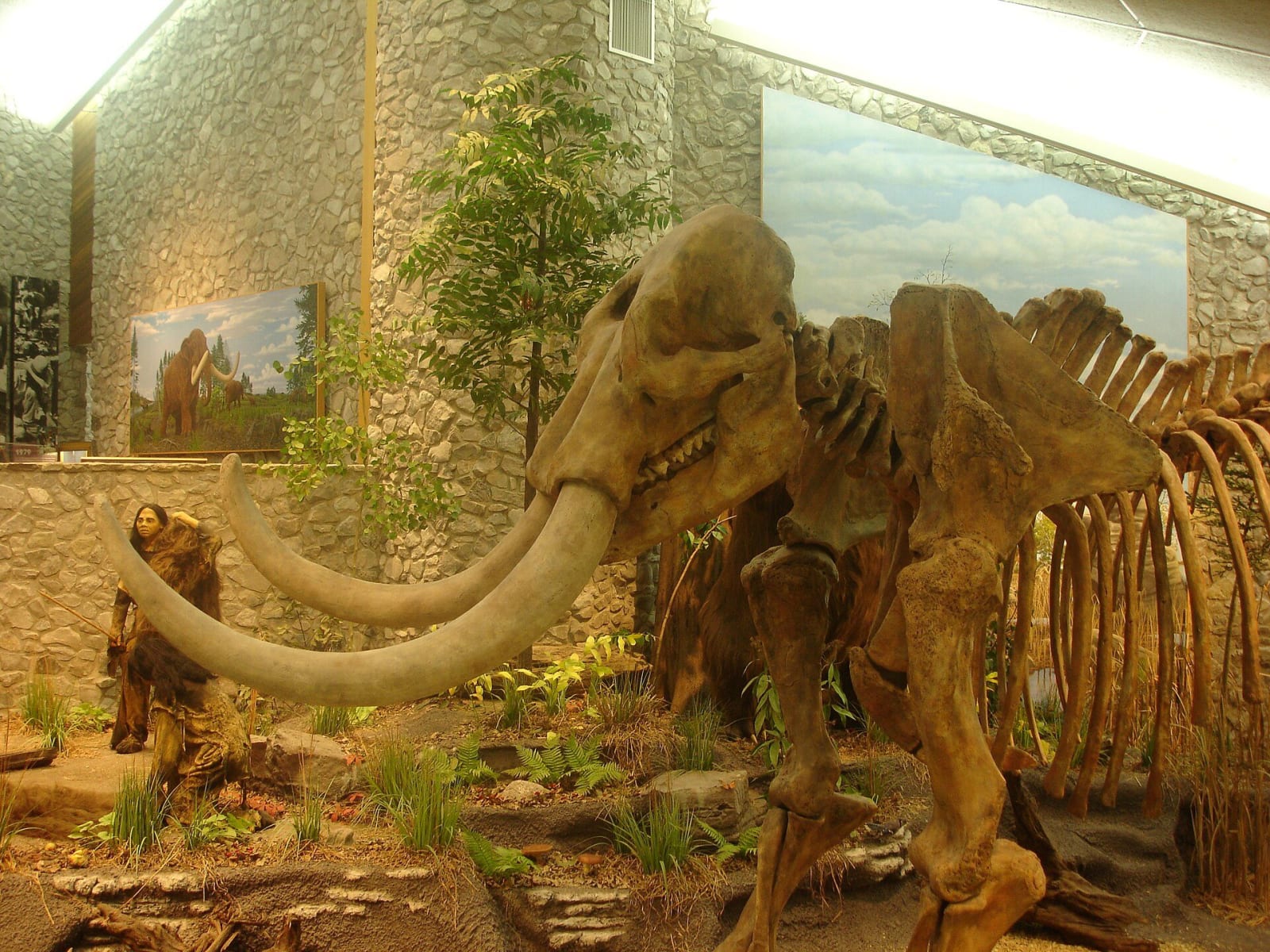
 Kevin Saff / CC BY-SA 2.0 via Wikimedia Commons
The Story
For a short time at the end of the last ice age, people and mastodons shared the mineral springs along Rock Creek, and the mud kept the bones. Proving it took almost a century and a half. Albert C. Koch, who ran a museum in St. Louis, dug here in 1839, assembled a skeleton he called the Missouri Leviathan until the anatomist Richard Owen of the British Museum persuaded him it was an American mastodon. Around 1900 the amateur C. W. Beehler dug up more skulls, jaws and tusks and kept a shack museum by the beds, and excursion trains brought visitors from St. Louis during the 1904 World's Fair. Because his digging went undocumented, the stone tools found in it were not accepted as evidence of ice age people, and a quarry worked the site from the 1870s into the 1930s, destroying much of what was left.
When the building of Interstate 55 threatened the ground in the 1970s, a local committee, legislators, companies and schoolchildren helped the state buy 418 acres in 1976. In the state's 1979 excavation, a Clovis spear point turned up with mastodon bones, and the paleontologist Russell W. Graham of the Illinois State Museum showed it was the first solid proof in eastern North America that people and mastodons lived together, more than 10,000 years ago.
The museum holds a full mastodon skeleton replica and a fifteen-minute film. Wildflower Trail leads from it down to the excavation site, where what remains of the bone bed lies safely buried again.
Visitor Info
On the Map
Nearby
The closest stops worth working into your route
Historical markers nearby
Roadside plaques and monuments within a short detour