Home / Alabama / Tuscaloosa & West Alabama / Capitol Park
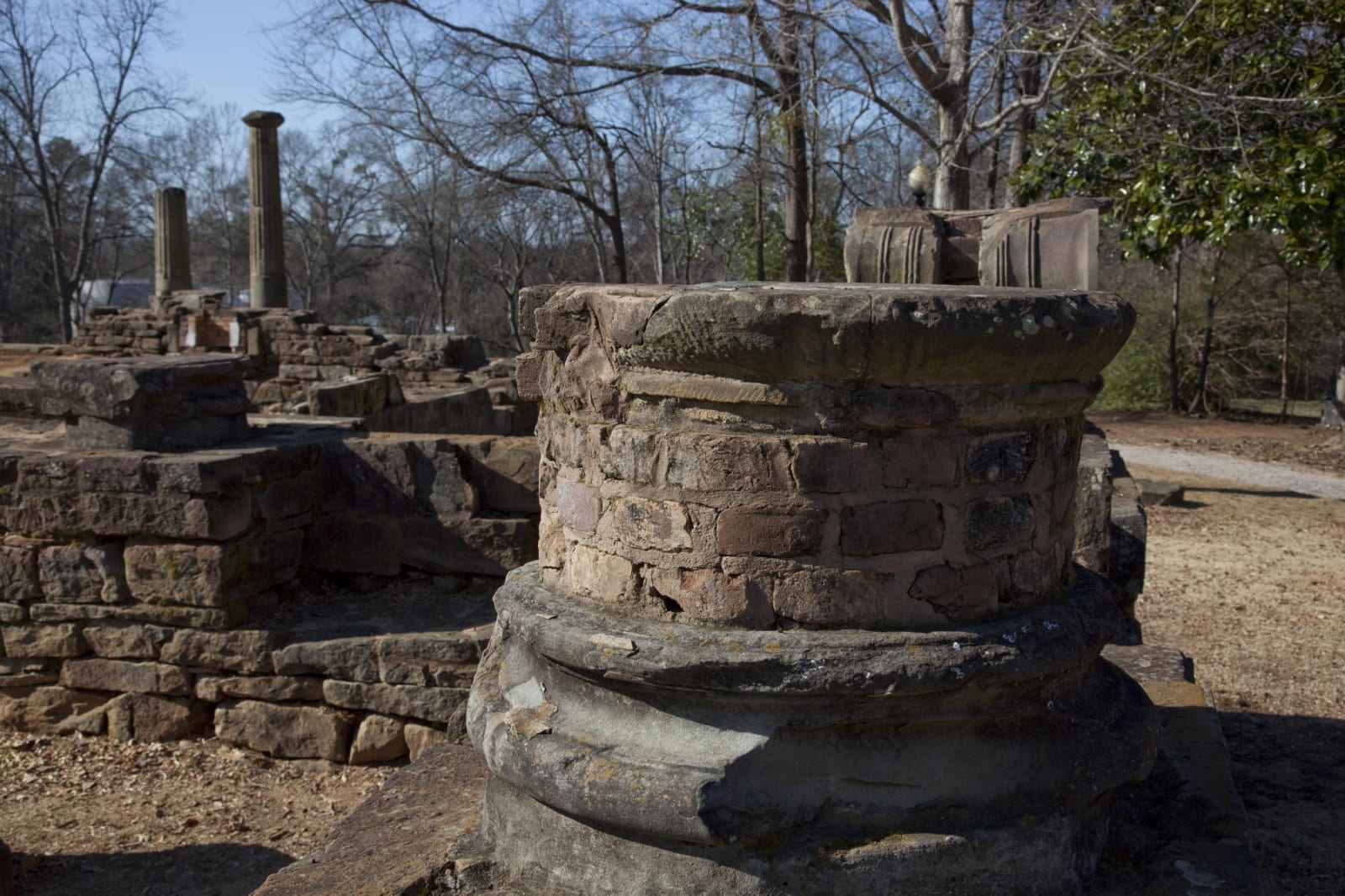
The stone base of a column and low brick walls of the old Alabama capitol ruins in Capitol Park, Tuscaloosa, with a standing column and bare trees behind.Carol M. Highsmith / public domain via Library of Congress
🏛️Historical

Capitol Park

Part ofTuscaloosa & West Alabama

The ruins of Alabama's 1829 capitol in Tuscaloosa, built with enslaved labor, where the legislature sat from 1826 until 1846, and first stop on the Tuscaloosa Civil Rights Trail.

⏱
Duration
Twenty to thirty minutes.
🎟
Admission
Free; an open city park.
📅
Best Season
Year round.

The Story

Tuscaloosa takes its name from Tascalusa, the Mississippian leader of Mabila who died at the hands of Hernando de Soto's army in 1540, and Tuscaloosa County was formed in 1818 from land the Creek and Choctaw nations had ceded. In 1825 the legislature voted narrowly to move the capital here from Cahawba, and it sat in Tuscaloosa from 1826 to 1846. Before Andrew Jackson took office in 1829, Alabama's lawmakers had already passed laws extending state jurisdiction over the Native nations' lands within its borders, part of the pressure that drove Removal.

English architect William Nichols designed the capitol, finished in 1829, with a copper dome over the rotunda visible from the river. Contractors brought enslaved craftsmen, George Hamer among them, and townspeople sent enslaved men to learn trades by forced apprenticeship; free Black workmen including Solomon Perteet, Ned Berry and James Abbott were paid for theirs. Stone for the building was quarried from university land. In these chambers the legislature passed slave codes, among them laws forbidding anyone to teach enslaved people to read.

The capital moved to Montgomery in 1846. The building became the Alabama Central Female College and burned on August 22, 1923, and townspeople carried away its brick and stone. What stands now is a rotunda wall and the foundation line, enough to show the building's size, in a small city park. It is the first stop on the Tuscaloosa Civil Rights Trail, which opened in 2019 and runs to First African Baptist Church and the university.

Visitor Info

⏱
Time Needed
Twenty to thirty minutes.
🎟
Admission
Free; an open city park.
📅
Best Season
Year round.
🛣️
Highway
6th Street (US 82 Business nearby)

On the Map

Nearby

The closest stops worth working into your route

historical0.3 mi away
First African Baptist Church
The 1907 Tuscaloosa church where 600 marchers set out for the courthouse on June 9, 1964, and were driven back with fire hoses and tear gas on Bloody Tuesday.
historical1.8 mi away
Foster Auditorium
The 1939 University of Alabama hall where George Wallace stood in the door on June 11, 1963, before Vivian Malone and James Hood registered.
natural8.5 mi away
Lake Lurleen State Park
A 1,625-acre state park northwest of Tuscaloosa around a 250-acre lake, with 23 miles of shoreline and woodland trail for hikers and mountain bikers.
historical14 mi away
Moundville Archaeological Park
The Mississippian town of 29 earthen mounds above the Black Warrior River, second only to Cahokia, with the University of Alabama's Jones Archaeological Museum.
industrial29 mi away
Tannehill Ironworks Historical State Park
Three sandstone blast furnaces in Roupes Valley, worked mostly by enslaved men and burned in 1865, with the Iron & Steel Museum of Alabama and a village of old cabins.
historical30 mi away
Pickens County Courthouse
Carrollton's 1877 courthouse, known for the 'face in the window' legend of Henry Wells, a freedman who died after his arrest in 1878.

Historical markers nearby

Roadside plaques and monuments within a short detour

Marker0.1 mi away
Lynching in America / Lynching in Tuscaloosa County
Tuscaloosa
Marker0.1 mi away
"The Indian Fires Are Going Out"
Tuscaloosa
Marker0.3 mi away
Christ Episcopal Church
Tuscaloosa
Marker0.4 mi away
Horace King
Tuscaloosa
Marker0.4 mi away
Alabama Corps of Cadets Defends Tuscaloosa
Tuscaloosa
Marker0.5 mi away
First Presbyterian Church
Tuscaloosa