Home / Alabama / Tuscaloosa & West Alabama / Moundville Archaeological Park
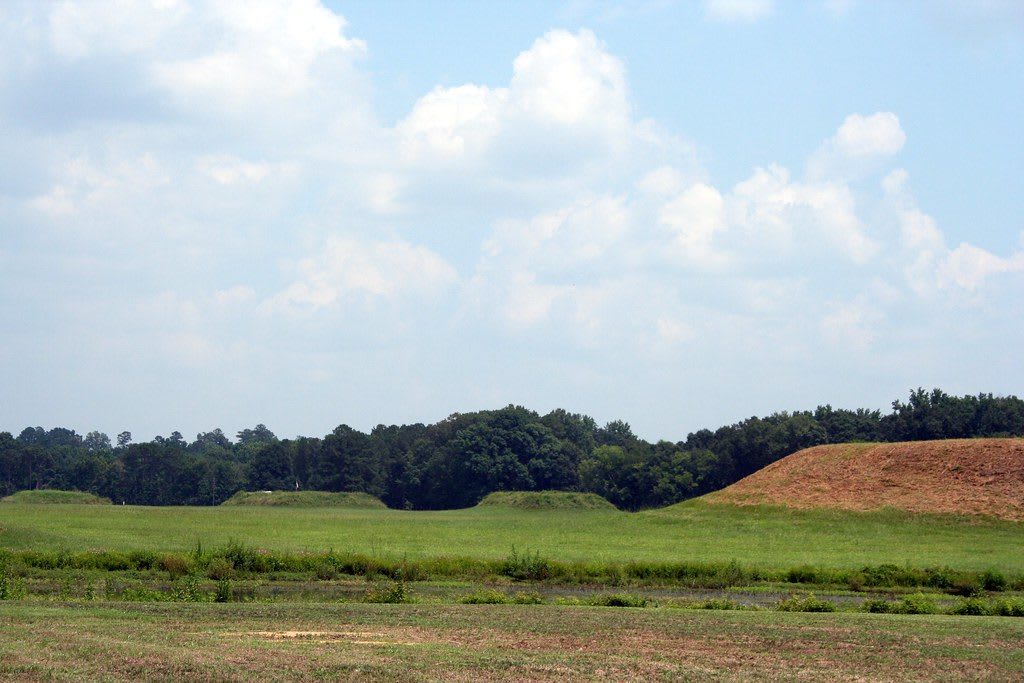
Grass-covered flat-topped earthen mounds rising beyond a mown field under a summer sky at Moundville.cyanocorax / CC BY-SA 2.0 via Flickr
🏛️Historical

Moundville Archaeological Park

Part ofTuscaloosa & West Alabama

The Mississippian town of 29 earthen mounds above the Black Warrior River, second only to Cahokia, with the University of Alabama's Jones Archaeological Museum.

⏱
Duration
Two to three hours.
🎟
Admission
Adults $8, seniors $7, students $6; free for Native American visitors with a tribal membership card (University of Alabama Museums, 2026).
📅
Best Season
Year round; spring and fall are best for walking the plaza. The Moundville Native American Festival is held each fall.

The Story

Between about 1120 and 1450, people of the Mississippian world built one of the largest towns north of Mexico on this bluff above the Black Warrior River. They leveled a great plaza and set 29 earthen mounds around it, raised by the basketload from borrow pits that are now small ponds. The tallest, Mound B, stands 57 feet. By 1300 a bastioned wooden palisade enclosed perhaps a thousand people. Leading families lived on the larger mounds, smaller ones held buildings for the dead, and most townspeople were buried near their houses, so the whole ground is a cemetery as well as a town, best seen from the paths.

After about 1350 most people moved out to smaller mound towns along the river, and Moundville became chiefly a place of burial and ceremony, its pottery and shell carved with hand-and-eye, falcon and winged-serpent designs. Few lived here when Hernando de Soto's army crossed the region in 1540, and archaeologists cannot tie the town with certainty to one later nation. The park works with descendant tribal communities; a 2026 exhibit co-curated by Jake Tiger of the Seminole Nation of Oklahoma makes the case that Moundville's crafts and ceremonies never vanished.

Clarence B. Moore dug here early in the 1900s and shipped his finds to Philadelphia, which helped push Alabama to pass an antiquities law in 1915. State geologist Walter B. Jones mortgaged his house to help buy the land. Civilian Conservation Corps workers, housed in segregated cabins, stabilized the mounds and built the 1939 museum, whose galleries were rebuilt in 2010 around the stone Rattlesnake Disk.

Visitor Info

⏱
Time Needed
Two to three hours.
🎟
Admission
Adults $8, seniors $7, students $6; free for Native American visitors with a tribal membership card (University of Alabama Museums, 2026).
📅
Best Season
Year round; spring and fall are best for walking the plaza. The Moundville Native American Festival is held each fall.
🛣️
Highway
AL 69

On the Map

Nearby

The closest stops worth working into your route

historical14 mi away
First African Baptist Church
The 1907 Tuscaloosa church where 600 marchers set out for the courthouse on June 9, 1964, and were driven back with fire hoses and tear gas on Bloody Tuesday.
historical14 mi away
Capitol Park
The ruins of Alabama's 1829 capitol in Tuscaloosa, built with enslaved labor, where the legislature sat from 1826 until 1846, and first stop on the Tuscaloosa Civil Rights Trail.
historical15 mi away
Foster Auditorium
The 1939 University of Alabama hall where George Wallace stood in the door on June 11, 1963, before Vivian Malone and James Hood registered.
natural20 mi away
Lake Lurleen State Park
A 1,625-acre state park northwest of Tuscaloosa around a 250-acre lake, with 23 miles of shoreline and woodland trail for hikers and mountain bikers.
historical21 mi away
Magnolia Grove
An 1840 temple-form Greek Revival townhouse in Greensboro, built for a cotton planter, with its original kitchen and a one-room slave house still standing behind it.
historical21 mi away
Safe House Black History Museum
Two shotgun houses in Greensboro's Depot neighborhood, one of them where neighbors hid Martin Luther King Jr. from the Klan on March 21, 1968.

Historical markers nearby

Roadside plaques and monuments within a short detour

Marker7.8 mi away
Greene Springs School
Havana
Marker14 mi away
Stillman College
Tuscaloosa
Marker14 mi away
Hunter's Chapel African Methodist Episcopal Zion Church
Tuscaloosa
Marker14 mi away
Lynching in America / Lynching in Tuscaloosa County
Tuscaloosa
Marker14 mi away
First Presbyterian Church
Tuscaloosa
Marker14 mi away
Christ Episcopal Church
Tuscaloosa