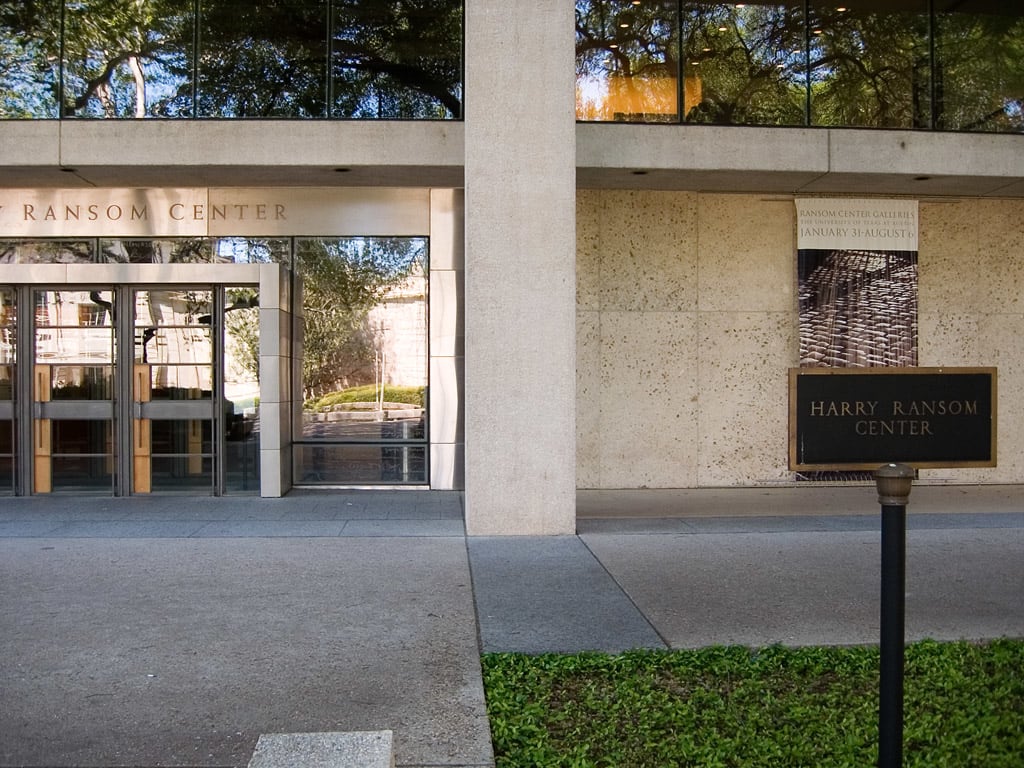
 bill_comstock / CC BY 2.0 via Flickr
The Story
The Harry Ransom Center began in 1957 as the Humanities Research Center of the University of Texas at Austin, the project of Harry Ransom, who led it only from 1958 to 1961 but oversaw a long expansion of its collecting until he left the university system's chancellorship in 1971. It moved into its present building in 1972 and took his name in 1983. It now holds some 36 million literary manuscripts, a million rare books, five million photographs and more than 100,000 works of art.
Two objects in the lobby galleries draw people who never use the reading room. The Gutenberg Bible, printed in Latin at Mainz by Johann Gutenberg and Johann Fust between 1454 and 1456, is one of only 20 complete copies known to survive; the center bought it in 1978 and keeps it on view. Nearby is the Niépce Heliograph, a view from an upstairs window at Le Gras in Burgundy, made in 1827 on a pewter plate coated with bitumen and left in a camera obscura for days. It is the earliest surviving photograph made in a camera, and it came to Austin in 1963 with the Gernsheim Collection.
The archives behind the galleries run from D. H. Lawrence, John Steinbeck and Evelyn Waugh to the David O. Selznick and Gloria Swanson papers and the Watergate papers of Bob Woodward and Carl Bernstein. Exhibitions rotate, admission is free, and anyone may register at the desk to use the reading room with a photo ID.
Visitor Info
On the Map
Nearby
The closest stops worth working into your route
Historical markers nearby
Roadside plaques and monuments within a short detour