The Story
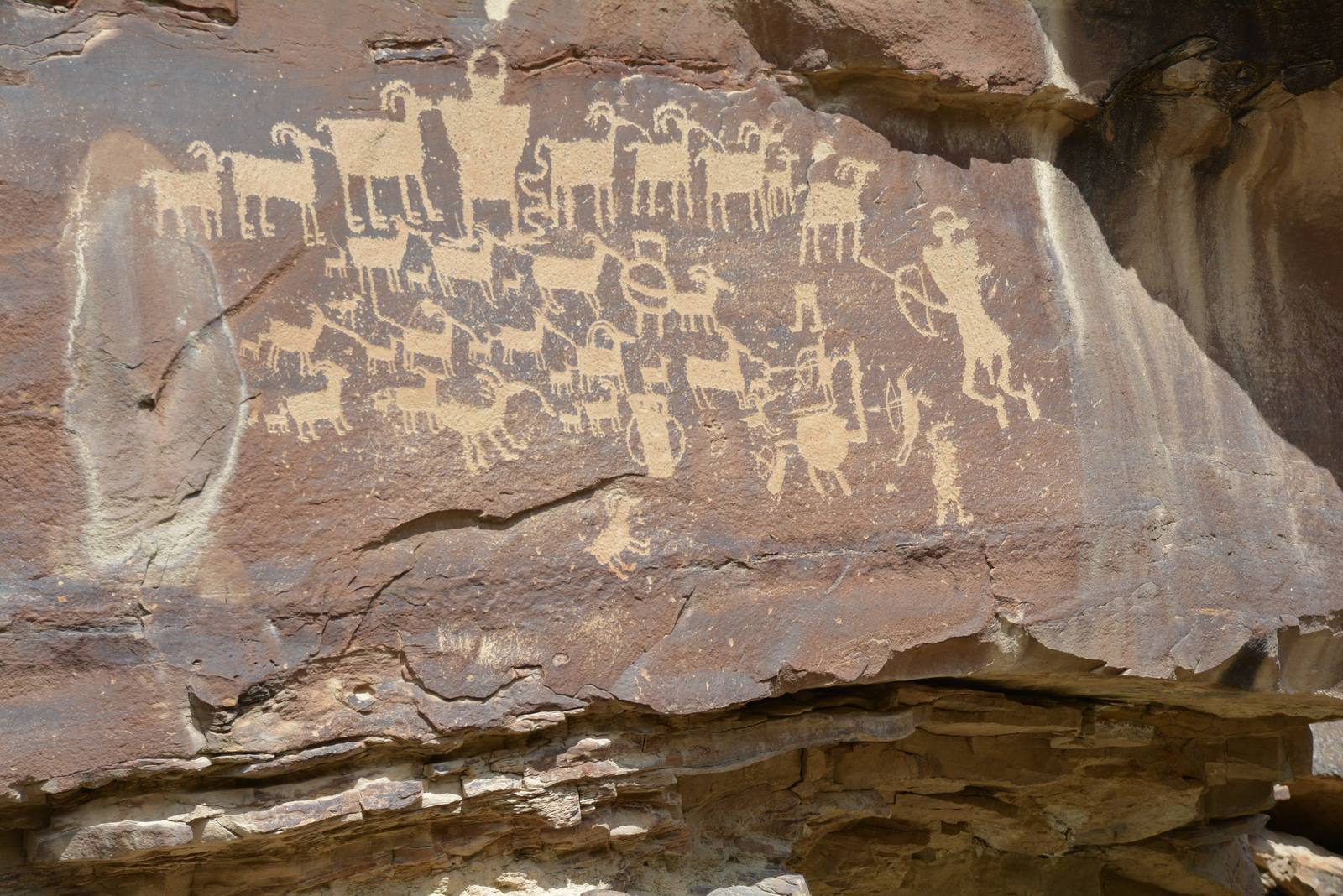
The Great Hunt Panel is the most famous image in Nine Mile Canyon, and it is famous for a reason that sets it apart from nearly every other rock art site in Utah: the people who stand in front of it feel that they understand it. Pecked into a varnished sandstone face at the mouth of Cottonwood Canyon — a south-side tributary roughly forty-six miles up the canyon road from Wellington — the panel arranges roughly thirty bighorn sheep into a funneling herd, flanked by hunters drawing bows, with a large horned anthropomorph presiding over the scene from above. Most Fremont rock art resists interpretation; the figures are formal, frontal, and silent about their purpose. The Great Hunt is different. It reads like a narrative, and the narrative reads like a hunt.
That legibility is exactly why the panel has been reproduced in National Geographic, in textbooks, and in art books around the world, and why it carries a second name — the Cottonwood Panel — from the side canyon whose mouth it guards. The horned figure at the top center is most often read as a hunt shaman, and the lines threading between the sheep have been interpreted as everything from migration routes to a statement of common ancestry among the animals. The readings are educated guesses. What is not in dispute is the skill: the composition is balanced, the bighorns are rendered with a consistency that implies a practiced hand, and the whole panel has survived in remarkable condition for something close to a thousand years old.
The Great Hunt is the work of the Fremont people, who occupied this canyon from roughly AD 200 to 1300, though the Great Hunt Panel Site as a whole — five panels clustered at the Cottonwood Canyon mouth — preserves imagery spanning a far longer reach of time, with some elements attributed to Archaic artists who worked these walls thousands of years before the Fremont arrived. The site is listed on the National Register of Historic Places, one of dozens of Nine Mile Canyon locations added in an effort to protect the corridor's rock art from the truck traffic and dust that came with the natural gas boom on the mesas above.
Reaching it is the easiest thing about it. The paved canyon road — turn north at Walker's Chevron on the east edge of Wellington, where a large brown sign marks the Nine Mile Canyon turnoff — runs all the way to a large pullout at the panel, and a level walk of about fifty meters reaches the base of the cliff. The pavement ends a short distance beyond, where the dirt road continues up into the narrowing confines of Cottonwood Canyon for anyone inclined to keep going. The Big Buffalo panel, one of the canyon's largest single petroglyphs, sits just before the Great Hunt pullout on the opposite wall, making the two an easy pair.
Light matters here more than at most rock art sites. The panel throws a shadow across its own figures in the middle of the day, so morning or late afternoon produces the cleanest view and the best photographs. And the rule that governs every panel in the canyon governs this one absolutely: do not touch it. The oils from a single hand accelerate the breakdown of both the rock varnish and the pecked images, and damage to a panel like this one is not damage to a curiosity — it is damage to one of the most significant pieces of ancient art in the American West. The Fremont left it on this wall for reasons we are still arguing about. The least the rest of us can do is leave it there for the people who come after us to argue about too.
Visitor Info
On the Map
Nearby
The closest stops worth working into your route
Historical markers nearby
Roadside plaques and monuments within a short detour