Home / Oklahoma / Green Country & the Ozark Hills / Fort Gibson Historic Site
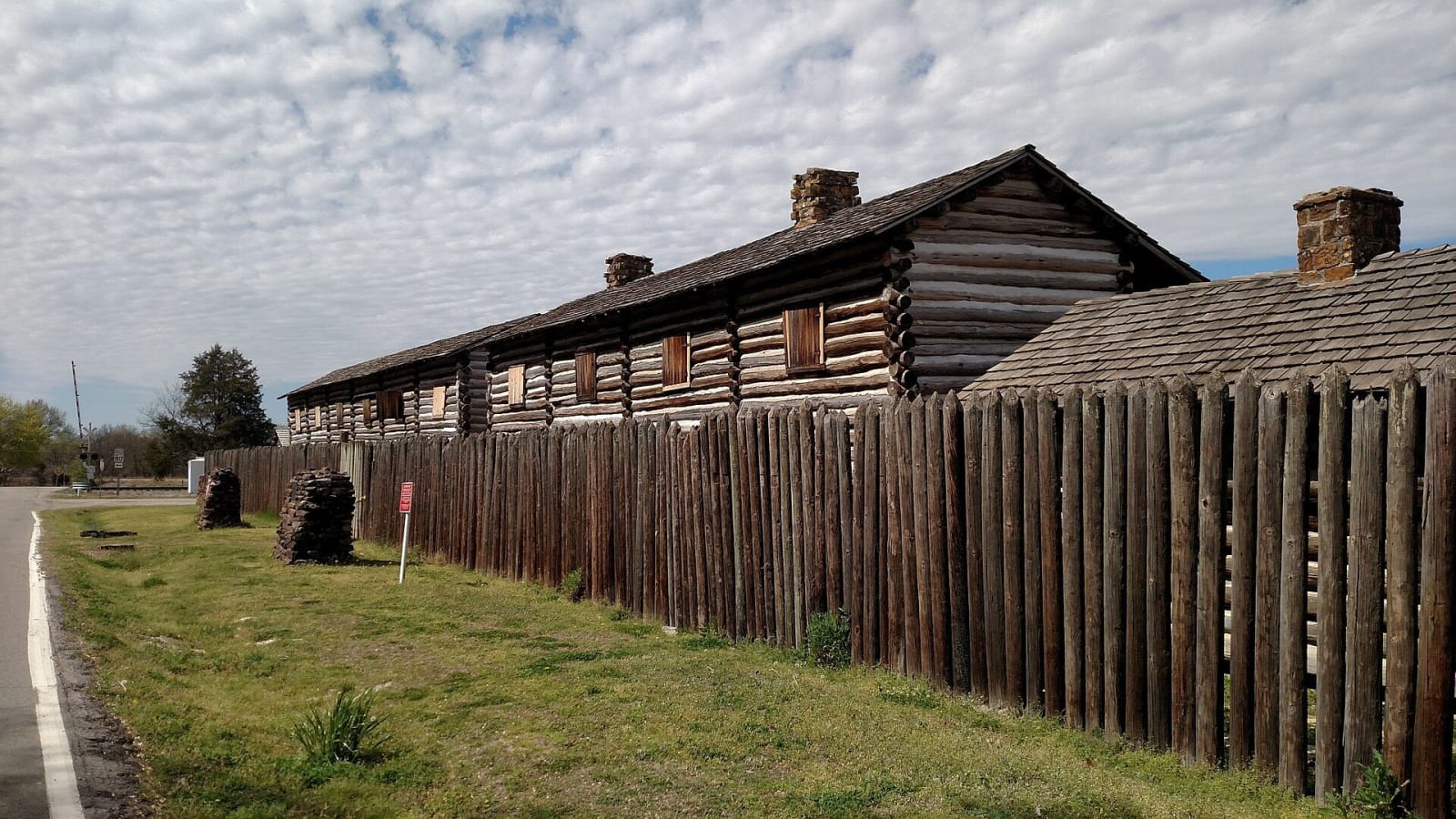
The log barracks and stockade fence of the reconstructed fort at Fort Gibson Historic Site.NPS / public domain via Wikimedia Commons
🏛️Historical

Fort Gibson Historic Site

Part ofGreen Country & the Ozark Hills

The army's first post in what became Oklahoma, built at Three Forks in 1824, where removed nations arrived; deeded to the Cherokee in 1857, it later housed the Dawes Commission.

⏱
Duration
One to two hours.
🎟
Admission
Adults $10, seniors (62+) $8, students 6-18 $5; children 5 and under, veterans and active military with ID, and OHS members free; family (up to six) $30.
📅
Best Season
Year-round. Open Tuesday to Saturday, 10 a.m. to 4:30 p.m.; OHS posts holiday closings.

The Story

Col. Matthew Arbuckle brought the Seventh Infantry up from Fort Smith in 1824 and built Cantonment Gibson on the Grand River a mile above the Arkansas, at the Three Forks where the Verdigris joins them. It was the first army post in what became Oklahoma, sent to keep peace between the Cherokee and the Osage and to watch the Texas Road. After the Indian Removal Act of 1830 it became Fort Gibson, and its troops built roads and provisioned the arriving parties. At the height of removal it had the largest garrison in the country, and by the time Arbuckle left in 1841 about forty thousand people from the eastern nations had arrived in the country around it.

A council here in 1836 persuaded the majority of the Muscogee (Creek) people to accept the government the McIntosh faction had already set up in the West. The Seminole came in after their war in Florida. In the 1850s the Cherokee complained of the liquor and brothels around the post and asked Congress to remove it, and in 1857 the army left and deeded it to them. Union troops took it back in 1863 as Fort Blunt and marched from it to Honey Springs. The army finally left in 1890, and the Dawes Commission later worked here enrolling the Five Tribes, Cherokee Freedmen above all.

The site keeps original buildings of the 1840s to 1870s, among them stone barracks, the commissary, a bakehouse and the hospital that is now the visitor center, beside a reconstruction of the early log fort and stockade.

Visitor Info

⏱
Time Needed
One to two hours.
🎟
Admission
Adults $10, seniors (62+) $8, students 6-18 $5; children 5 and under, veterans and active military with ID, and OHS members free; family (up to six) $30.
📅
Best Season
Year-round. Open Tuesday to Saturday, 10 a.m. to 4:30 p.m.; OHS posts holiday closings.
🛣️
Highway
US-62

On the Map

Nearby

The closest stops worth working into your route

cultural17 mi away
Cherokee National History Museum
The Cherokee Nation's own history museum, in the brick capitol it built on Tahlequah's square after the Civil War, a short walk from its 1844 supreme court and its 1875 prison.
historical24 mi away
Honey Springs Battlefield
The July 17, 1863 battlefield on the Texas Road, the largest fight in Indian Territory, where Cherokee and Muscogee regiments fought on both sides and the 1st Kansas Colored Infantry held.
historical31 mi away
Saline Courthouse Museum
The one Cherokee district courthouse of nine still standing, an 1884 building near Rose that the Cherokee Nation bought back and opened as a museum in 2019.
historical39 mi away
Sequoyah's Cabin Museum
The log cabin near Akins where Sequoyah, who gave the Cherokee language its syllabary, settled in 1829, kept since 2016 by the Cherokee Nation inside a stone shelter of 1936.
historical41 mi away
Will Rogers Memorial Museum
The limestone memorial and museum on the Claremore hilltop Will Rogers bought for his retirement, opened on his birthday in 1938 and holding his papers, his films and his tomb.
historical42 mi away
Muscogee (Creek) Nation Council House
The Muscogee (Creek) Nation's 1878 stone capitol on the Okmulgee square, where the House of Kings and House of Warriors met, lost at statehood and bought back by the Nation in 2010.

Historical markers nearby

Roadside plaques and monuments within a short detour

Marker0.7 mi away
Fort Gibson
Marker4.8 mi away
Fort Davis
Marker8.6 mi away
Wigwam Neosho
Marker8.6 mi away
Chief Pushmataha
Marker8.6 mi away
Tullahassee Mission
Marker10 mi away
State's Earliest Oil Refinery