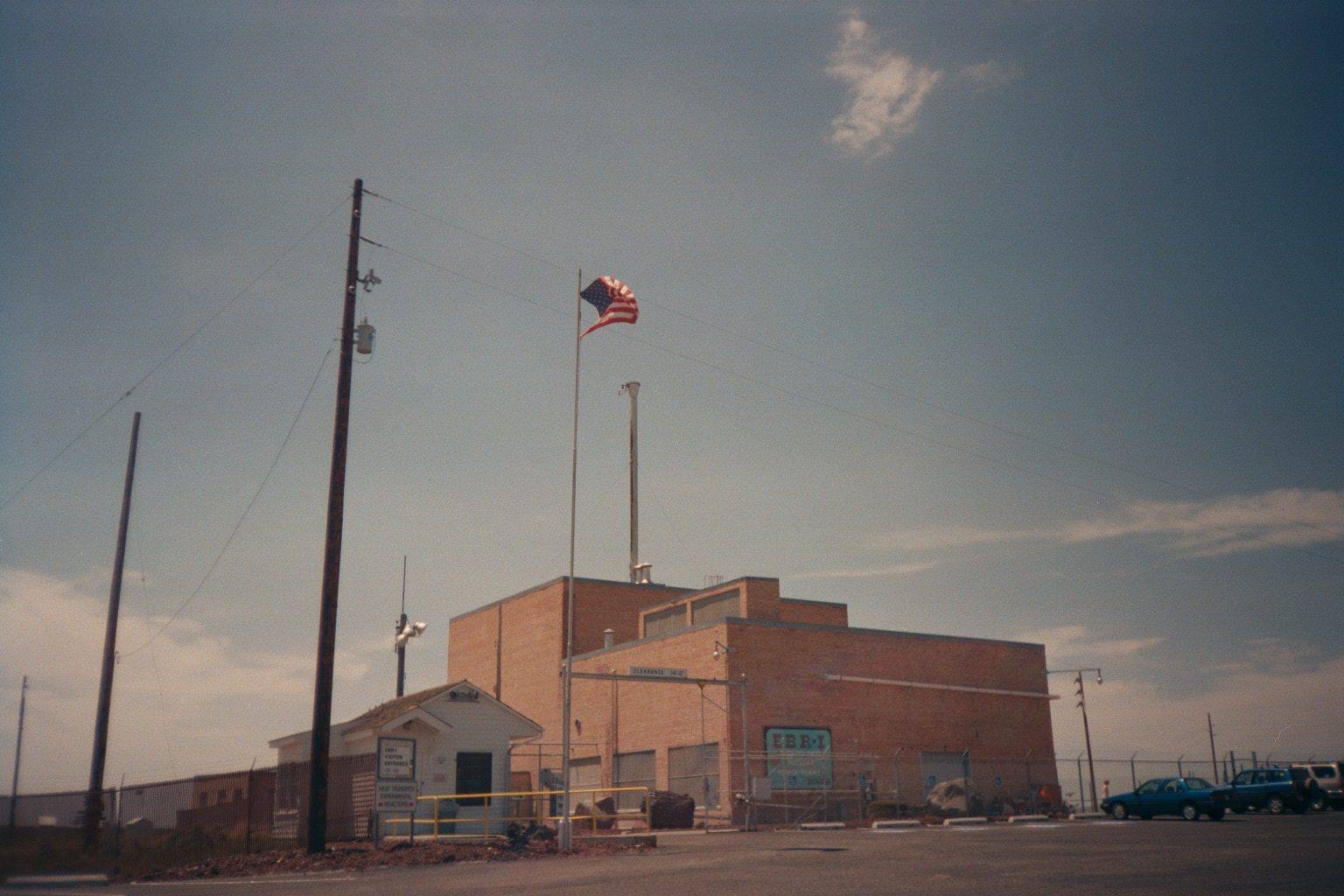
 Veedar / public domain via Wikimedia Commons
The Story
The four light bulbs of December 1951 get the fame, but they were a sideshow. Experimental Breeder Reactor I was built to test an idea of Enrico Fermi's, that a reactor could make more fuel than it burned, turning uranium-238 into plutonium as it ran. It proved the idea, and for a while breeders looked like the future of nuclear power.
On November 29, 1955, the crew ran a test to understand why the core behaved oddly at certain power and coolant settings. Power climbed faster than planned. When the order came to shut down, the slow-acting control was used instead of the fast one, and the correction came about two seconds late. Roughly half the core melted. Radiation alarms sounded and the building was cleared; no one was reported exposed. It was the first accidental meltdown of a breeder reactor's core. Argonne rebuilt the core, finished the experiment, and shut the reactor down for good in 1964.
Outside the museum sit two stranger machines. In 1951 the military set out to build a bomber that could stay aloft on nuclear power, its jet engines heated by a reactor instead of burning fuel, and General Electric tested the idea here in three Heat Transfer Reactor Experiments. HTRE-2 and HTRE-3 are parked on the lot. HTRE-3 had its own fuel meltdown in November 1958, when its automatic controls withdrew the rods. No aircraft ever flew on nuclear power, and the program was cancelled in 1961.
The reactor building is a National Historic Landmark and a free museum, in the desert about eighteen miles southeast of Arco on US-20/26. It opens from Memorial Day weekend through Labor Day.
Visitor Info
On the Map
Nearby
The closest stops worth working into your route
Historical markers nearby
Roadside plaques and monuments within a short detour