 Mobilus In Mobili / CC BY-SA 2.0
The Story
After two hundred miles of sagebrush and silence, Ely arrives like a small metropolis. This is the largest town on the loneliest road — close to four thousand people — and the crossroads where US-50 collides with US-93 and US-6 at the eastern end of the lonely stretch. It is also the odd one out. Austin and Eureka were silver towns that boomed and faded in the 1800s; Ely is a copper town that boomed in the 1900s and is, in its way, still booming. It comes with a working steam railroad, two dozen downtown murals, a 1929 hotel that was once the tallest building in the state, and the open road east to Great Basin.
Ely had been a sleepy stage stop and small gold camp since the 1870s, the seat of White Pine County, when the thing that made it happened underground to the west. In 1906 prospectors confirmed vast bodies of copper in Robinson Canyon, and the Nevada Consolidated Copper Company moved in to take them. This was a different animal from the silver bonanzas down the road. The ore was low-grade but enormous, and the only way to make it pay was to mine it by the mountain — steam shovels biting into open pits at Ruth that eventually merged into the vast Liberty Pit, a smelter up at McGill, and trainloads of rock around the clock. Kennecott ran it for decades; the copper market crashed in the 1970s, gold leached from the old waste rock carried the town through the lean years, and copper mining has since come back. The Robinson mine is working still.
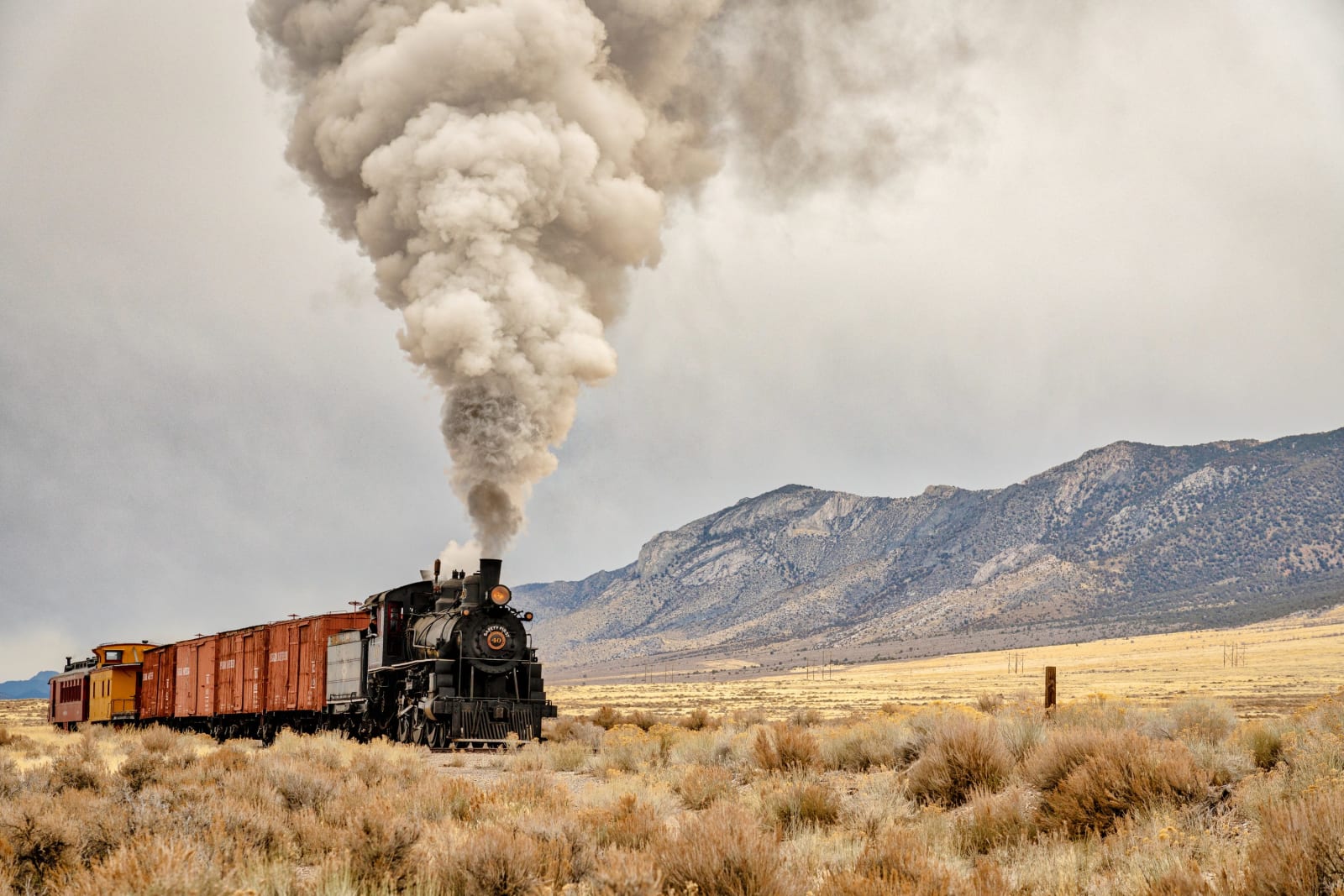
To move all that copper, the town built a railroad, and the railroad is now its treasure. The Nevada Northern was driven north from Ely in 1905 and 1906 to meet the transcontinental line at Cobre, a hundred and forty miles away, and for the next sixty years it hauled ore and people across the Steptoe Valley. When the mining slowed, the East Ely yard was simply too remote to bother modernizing — so it survived, whole. Engine houses, machine shops, depot, turntable, and rolling stock all still stand as they were, which is why the Smithsonian calls it the best-preserved steam-era railroad complex in the country and the government made it a National Historic Landmark. Today it runs as the Nevada Northern Railway Museum, and its working steam train — the Ghost Train of Old Ely, pulled by a locomotive built in 1910 — carries passengers up the old grade into the copper country. It is the single best thing to do on US-50.
The copper rush also made Ely the most cosmopolitan place on the road. The mines and the McGill smelter drew workers from all over the world — Greeks, Italians, Serbs and Croats, Basques, Chinese, and a dozen others — into one rough, polyglot town. That heritage is painted right onto the buildings: since 1999 the Ely Renaissance Society has covered downtown with more than twenty outdoor murals and sculptures under the banner Where the World Met and Became One, a walkable open-air gallery of the people who actually built the place. Few small Western towns wear their immigrant history this openly.
Anchoring the main drag is the Hotel Nevada, a six-story brick tower that looks taller than it is because nothing around it competes. When it opened in 1929 it was the tallest building in the entire state and its first fireproof one, a genuine skyscraper dropped into the high desert; it still runs as a hotel, restaurant, and casino, the neon and the old register intact. Around it stretches a downtown of early-twentieth-century storefronts that feels more like a working small city than a museum — which, unlike the ghostlier towns to the west, is exactly what Ely is.
Ely is also the jumping-off point for the eastern Great Basin. It sits between the Egan and Schell Creek ranges, sixty miles short of Great Basin National Park and its glacier-cut summit of Wheeler Peak. Closer in are Cave Lake's high reservoir, the beehive stone charcoal ovens at Ward, the garnet-studded slopes of Garnet Hill, and miles of mountain country for hunting, fishing, and rockhounding. For travelers doing the loneliest road properly, Ely is where you stop being only a driver and start being able to get out and climb something.
Practically, it is the one town on this road where you can do everything: ride the Ghost Train, walk the murals and the Hotel Nevada, fill the tank, eat well, sleep easy, and even find a blackjack table. There is more open at nine on a weeknight here than in the rest of central Nevada combined. From Ely the choice is simple — turn east for Great Basin and the Utah line, or point back west into the long emptiness toward Eureka and Austin. Either way, Ely is the hinge of the loneliest road: the place it stops being lonely, gathers itself into a real town, and lets you catch your breath before the next two hundred miles.
Visitor Info
On the Map
A story featuring this place
Go deeper into the history and character of this stop
Nearby
The closest stops worth working into your route
Historical markers nearby
Roadside plaques and monuments within a short detour