 ERoss99 / CC BY-SA 3.0 via Wikimedia Commons
The Story
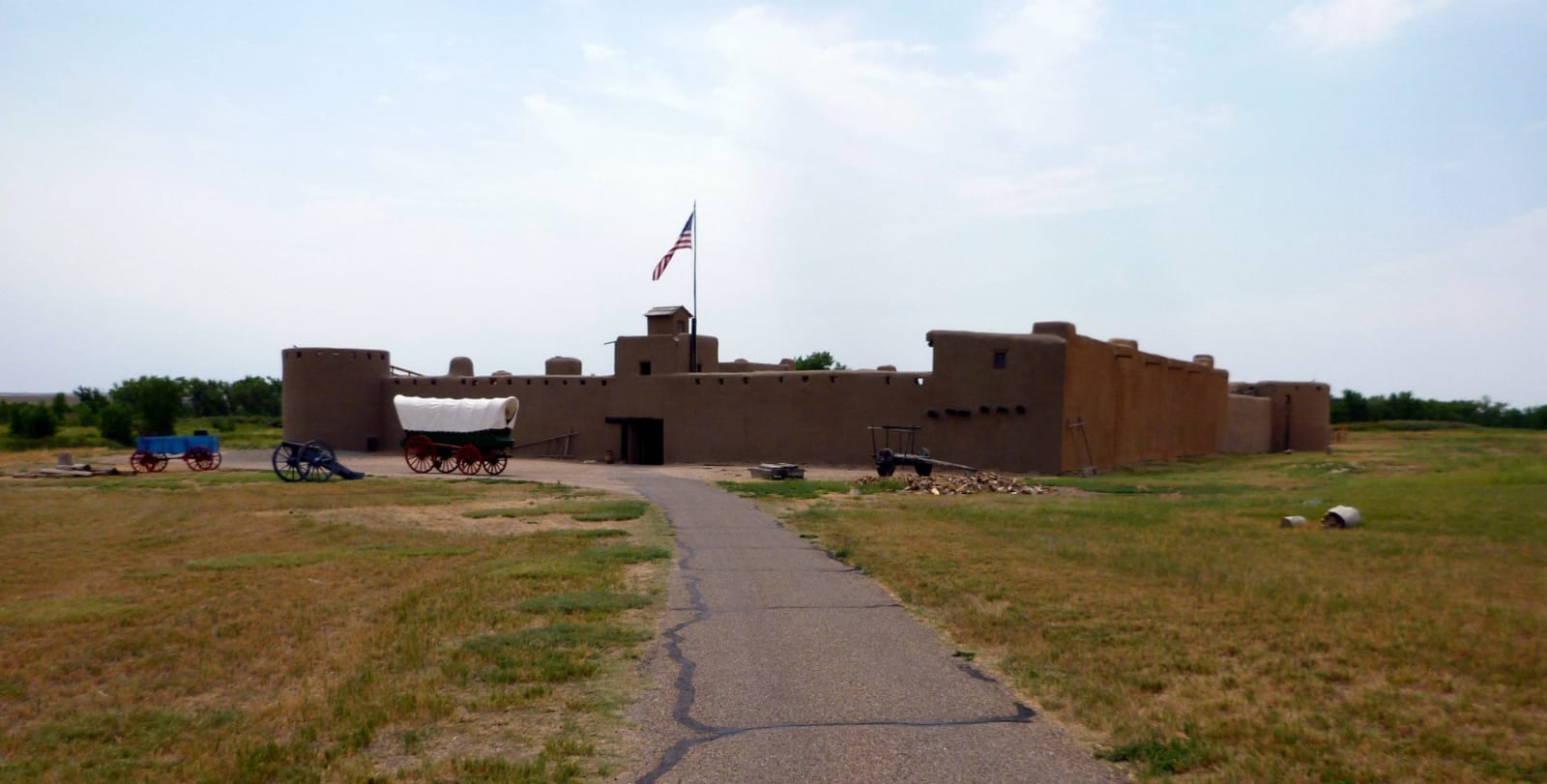
The trading post the Bents and Ceran St. Vrain raised on the Arkansas in the early 1830s was built by workers brought up from New Mexico, of local clay mixed with straw, with round towers at two corners and cactus planted along the tops of the walls. It was abandoned in 1849, and the walls slumped back into the ground. By the twentieth century little but foundations showed, in what had become a farm field.
Its rebuilding rests on a young army topographical engineer, Lieutenant James Abert, who stayed at the fort in 1845 and 1846, recovering from illness, and made measured pen-and-ink drawings and watercolors of it. National Park Service historians found his drawings along with more than twenty written descriptions, and archaeologists excavated the site, again in 1963, adding about thirty percent of what the architects needed. The rest was informed conjecture, and the decision to rebuild at full scale divided the advisers who were asked.
Work took about fourteen months. A contractor built a machine that turned out 4,000 adobe blocks a day, and about 160,000 of them went into the walls, set on a poured concrete foundation the original never had. The reconstructed fort, the fort of 1846 with its thirty-odd rooms around a plaza, was dedicated on July 25, 1976, for the national Bicentennial and Colorado's centennial, at a cost of about three million dollars. The adobe has needed constant repair ever since. Living-history staff work the forge, the trade room and the kitchen in season.
Visitor Info
On the Map
Nearby
The closest stops worth working into your route